Is it fair to judge a movie for what it isn't? Obviously, if it's rubbish, no one could deny it's the prerogative of those who have suffered through viewing it to rip into it like a Romero zombie horde, and that would include roasting it for all the much better things it failed to be, but what if it isn't really bad? What if it's actually a somewhat entertaining little picture but one that just spectacularly fails to live up to its potential?
October saw the U.S. television debut of just such a picture and I had just that sort of reaction to it. It's DEAD SET, a British horror "series"--in this case, essentially a movie carved into half-hour segments--about an outbreak of flesh-eating zombies that overruns the UK, and, apparently, the world.
Literally overruns it, in this case. The premise may be that of George Romero's epics, but DEAD SET eschews Romero's mournful, shuffling ghouls in favor of the hard-charging sprinters popularized in Danny Boyle's (non-zombie) 28 DAYS LATER (2002) and the godawful 2004 remake of DAWN OF THE DEAD. When it comes to the living dead, I'll confess a general partiality for the slower, stiffer breed. When trying to sell an utterly fantastic premise to an audience, it's best to try to make it as plausible as possible and it helps if what are supposed to be reanimated corpses actually look and move like one would imagine reanimated corpses would.[1] Some who share my preference are quite dogmatic about it. While my own view is that, as a rule, slower, stiffer zombies are best, if a movie works I wouldn't give that question a second thought. I'm certainly no rabid fanboy on the point.
Simon Pegg is, though. Sort of. The star of SHAUN OF THE DEAD wrote a very good mini-essay on the subject, a piece that also featured some thoughtful insights into what makes the best zombie cinema work. In particular, Simon is--forgive me--dead on in awarding the zombie "the title of Most Potent Metaphorical Monster." Zombies, as Romero used them, are such great fodder for film because they're cracked reflections of human beings. They're driven to try to eat the living, of course, but other than that, some semblance of what they were still fires through the synapses of their putrefying grey matter.[2] They're people reduced to their impulses.[3] One can use zombies to tell just about any kind of story.
The kind of story DEAD SET creator/writer Charlie Brooker and director Yann Demange were telling is about a zombie uprising that lays siege to the Big Brother house. Big Brother is a noxious--and depressingly popular--"reality" show contest wherein a diverse group of shallow fame-seekers is confined to a house for months and forced to live together, entirely isolated from the outside world and under constant surveillance. They're given various challenges and, one by one, they're eliminated, as viewers vote to "evict" them from the house.
Eviction Night is a big deal on Big Brother, and that's where DEAD SET begins, with a gala event featuring a loud crowd of rabid fans gathered to see off the evictee. That's also where it begins to fall short. Some shots of these screaming, overly-excited fans would have made a great contrast to the later shots of hordes of rabid corpses laying siege to the house. The parallel is so obvious it positively begs to be drawn. Unfortunately, DEAD SET doesn't bother to draw it, and its absence is palpable.
The series had a premise that was absolutely ripe for a relentlessly caustic satire. I'd even hazard a guess that the desire to create just that is what gave birth to the initial idea for it. By virtue of taking place around a lame-ass "reality" show, it begs for that sort of treatment. And, in fact, we do get the odd nod in this direction. One of the characters, surveying a scene of zombie carnage for the first time, blurts out, "Does this mean we're not on tele anymore?" Another, scavenging through a drug store for supplies, is excited to come across a tabloid with his picture on it then becomes upset by the less-than-flattering story in it. And the ending of the picture is sheer wicked brilliance. Unfortunately, these moments only serve to underscore the missed opportunity inherent in the decision to treat the rest of the picture like a more-or-less run-of-the-mill survival horror story. Of course, DEAD SET doesn't have to be anything other than another survival-horror movie. It had the potential to be a great deal more, though.
As a regular movie it's entertaining enough, even if it is mostly unexceptional. There's plenty of mayhem and gore. Brooker wrote some great dialogue. Most of his characters are entirely unlikable and tend to be one-note stereotypes, which is appropriate given that they're contestants on Big Brother (a fact that even led me to forgive their relentlessly stupid behavior throughout the proceedings). My favorite was easily Patrick, the unbearable Big Brother producer. Essayed by Andy Nyman, he's DEAD SET's version of Capt. Rhodes from DAY OF THE DEAD, a mouthy, dictatorial prick from his first appearance to his last.[4] His dialogue mostly consists of creative insults, and he dominates every scene in which he appears. His finest moment comes when he gets the idea of chopping up the now-dead Big Brother houseguests and using the pieces to bait the zombies away from the gate so they can escape. Everyone else is horrified by the suggestion, so he gets a knife and starts hacking on the bodies himself. He's hacking away, pulling off body-parts and getting absolutely covered in gore, and the whole time, he never stops ranting at the others, going on about how he has to work for a living, how, on the other hand, they're just fame-seeking twats who want the easy way through life and so on. The scene is way over-the-top hideous and should have been absolutely hilarious, but--yet again--DEAD SET proves not to have the stomach for that sort of humor--the moment is juxtaposed with shots of the other characters, at a distance from the carnage, crying as Patrick rants while somber music plays over it. Too bad.
So what am I to make of DEAD SET? As a survivor horror tale, it's entertaining. A bit long [5] It has its moments. It has some problems.[6] I wouldn't call it "great," and I don't see myself revisiting it often in the future. Where it really fails is in blowing what could have been some great material. The project had potential to burn. It just doesn't live up to it and the overwhelming impression with which I'm left is one of disappointment, because I can see where some better choices would have made it something very special. Is it fair to judge a movie because of what it isn't? I don't know, but with this one, I suppose I have.
--j.
---
[1] Running zombies lead to other logical problems as well. If they maintain the strength and coordination to sprint, why are doors and even flimsy fences a barrier to them? Particularly when they're in force. It's never a good sign when a movie makes one start thinking of things like this, and DEAD SET does.
[2] ...and, in that respect, eating other people doesn't seem so much the exception to their humanity as my wording, there, would suggest.
[3] ...which is why I dislike another trend in zombie flicks also followed by DEAD SET, the complete dehumanization of the zombies. They already eat people. When they also have utterly inhuman (rather than just dead) eyes, emit animal sounds, and run harder than they ever could in life, they may make ghoulish monsters but we entirely lose any connection between them and ourselves and all of the rich metaphorical material that comes with it. They may as well be invaders from Mars.
[4] His last scene, in fact, directly references Rhodes.
[5] Nearly 2 1/2 hours, a consequence of stretching a story for a feature-length film over five episodes. It isn't dull, to be sure, but the middle portion is a bit middling and the whole project is a bit padded. A subplot, for example, about the boyfriend of one of the Big Brother assistants trying to get to his girl eats up a lot of screen-time and doesn't really go anywhere--it could have been entirely excised without any real loss, except for one moment it provided which I particularly liked. The line is "I liked our farmhouse." See it in context and you'll like it too.
[6] Something I really disliked was the tiresome shaky-cam-on-steroids, which is used in all of the suspenseful scenes. The technique doesn't bother me the way it does some. It's just that it has been done to death, and rather than being an artistic choice, it's usually a substitute for one. Like the running zombies, it's blatant pandering to the zero-attention-span crowd and to be blunt, no one who is serious (or worthy of being taken seriously) should be concerned with pandering to them.
Tuesday, November 9, 2010


Friday, November 5, 2010
The Many Frankensteins of Peter Cushing
Brian, over at "The Scarecrow's Blogspot," has written an appreciation of THE CURSE OF FRANKENSTEIN, the film that, in 1957, heralded Hammer Film Productions' historic entry into Gothic horror. He doesn't say so in his blog but I believe he's even said (over on the Internet Movie Database) that this is his favorite Hammer film.
I wouldn't go that far. It's not among the best of even the larger Hammer Frankenstein series. Still, it does have its charms, the biggest by far being Peter Cushing in the lead role. Brian likes him, too:
I wouldn't go that far. It's not among the best of even the larger Hammer Frankenstein series. Still, it does have its charms, the biggest by far being Peter Cushing in the lead role. Brian likes him, too:
"The ultimate success of the Hammer series derives from Cushing's making the part all his own."Cushing is very good in the part. One hesitates for a moment about calling him the definitive screen Frankenstein only because it may be somewhat misleading, as Cushing didn't just play one Victor Frankenstein in that series--he played half a dozen.

It's fortunate that Terence Fisher directed most of those movies. Like most of the Hammer hands, he was a craftsman working in a movie factory, not some unwavering auteur with a strong, committed sense of what the series should be. While his lack of any significant cohesive personal vision for the series--and, more to the point, the mechanics of the Hammer factory--allowed for discontinuities galore,[1] it also meant we got lots of different versions of Frankenstein out of it. And since Fisher was Hammer's top director, it meant a lot of them were really good.
One--the one introduced in THE CURSE OF FRANKENSTEIN--is the relatively one-note mad scientist playing at being a god and in the end being punished for it. The next was introduced in the next film, THE REVENGE OF FRANKENSTEIN, and is almost the polar opposite, a compassionate (if, shall we say, sometimes overzealous) fellow whose work has a genuinely humanitarian aspect but who, in the end, is undone by the ignorance and bigotry of others. The succeeding films all offer, speaking broadly, either variations on one or the other or combinations of both--new versions of the character continuing his work in many different circumstances. Cushing's Frankenstein can be a malevolent chaos-agent, compassionate, slyly witty, brilliant, insane (as opposed to evil), and he's making monsters, turning himself into his own monster, transferring souls (in one installment), working for what he sees as the betterment of mankind or just following a mad personal obsession.

Fortunately, I don't have to pick a favorite. Cushing played them all and he was very good at every one of them. Even when some of the ideas embraced by the films went off into the ozone,[3] Cushing could still keep a straight face and sell them to an audience. Hammer's Frankenstein films, like all its series, are uneven in quality,[4] but even in the least of them, Cushing is always spot-on. Only once was he replaced in the role and the resulting film sucked like space, which just underlines more strongly that, to the extent those films can be said to work, he was a very large part of what made it so.
--j.
---
[1] That shouldn't be read as a slam of Fisher--continuity within all of Hammers' horror series was tenuous, at best.
[2] The theme doesn't really feature in the original Mary Shelley novel either, where Frankenstein's sin wasn't creating life but in neglecting the creature he'd given life.
[3] That soul-transplant business really just came out of the blue and went back there after that movie was over but it made for a really good movie.
[4] Though not, it should be said, as uneven as most of most of the others.
Wednesday, November 3, 2010
The Legend of Wagon Wheel Joe (Version 2.0)
When filming the cheapy Westerns he made early in his career, director Joseph H. Lewis used to tote around a box of wagon wheels. Whenever a scene was uninteresting, he'd plop down a wheel in the foreground and shoot through its spokes. The nickname this earned him, "Wagon Wheel Joe," was meant, at the time, as a put-down. In retrospect, it's emblematic of why Joseph H. Lewis should be a lot more widely respected than he is.
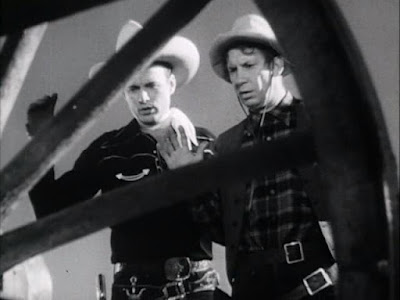 |
| Lewis' wagon-wheels in action, from BORDER WOLVES (1938) |
Lewis was one of the great B-picture artists of Golden Age Hollywood. Working mostly on Poverty Row, he didn't let perfunctory stories, trite scripts, bad actors or budgets that more closely resembled the catering bill for A-pictures slow him down. Film is primarily a visual medium and if the other raw materials with which Lewis had to work were sometimes wanting, he could at least make the movies visually interesting. Those wagon wheels were just the beginning. Lewis rebelled against the traditional "invisible" Hollywood style, shooting, instead, tight, expressionistic cinema filled with unusual and inventive camera work--odd angles, odd staging, utterly individualistic. It's said to have driven his editors nuts but it often pepped up what would have otherwise been some forgettable--sometimes even awful--films, and made some better ones better yet.
Lewis cut his teeth on those cowboy quickies. He wasn't stuck with the shortest of short ends for long though. While he remained firmly ensconced in B-level productions for most of his career,[1] his budgets, his actors and his scripts did improve and soon, he wasn't just the only good thing about a bad movie.[2] With more resources with which to exercise his resourcefulness, he came into his own as a filmmaker and proceeded to make some damn good ones.
He usually tried to hook viewers early and was frequently very good at drawing in an audience with his first scene.[3] GUN CRAZY (1950) begins on an adolescent demonstrating an almost-sorta-has-to-be sexual attachment to a pistol in a store window. So overcome is he that he just can't resist breaking the glass and stealing it, only to immediately trip over his own feet and send the gun skittering across the rain-soaked street to come to a halt at the feet of a bystander revealed, as the camera moves up, to be a grim-faced policeman, who saw the whole thing. The pre-title sequence of TERROR IN A TEXAS TOWN (1958) is one of my favorites. There's Sterling Hayden playing a beefy Swedish whaler. He's marching through a Western town, totally out of place, with a crowd gathering behind him as he comes to a particular building and calls out some badman. The villain--in black, so we know he's a no-goodnik--has a gun on his hip but Hayden is hefting a harpoon on his shoulder as his weapon of choice. They're about to have it out and we cut from the scene to the opening credits.
 |
| Sterling Hayden--so tough he brings a harpoon to a gunfight. |


There's no way in hell anyone is going to watch that and not stick around for the rest of the movie. More subtle but also effective is the opening of MY NAME IS JULIA ROSS (1945), wherein we follow the lead character through the street in pouring rain, up to a rooming house then inside, where our heroine's situation is set up via a conversation with the housekeeper. Lewis doesn't let us go until we're into the picture.
Lewis had an affinity for close-ups and favored elaborate staging and long takes. Not static ones though. His camera is always on the move, always gliding from one set-up to another without cutting. He would sometimes even allow it to pass through apparently solid objects like windows. He set-ups are often expressionistic. In CRY OF THE HUNTED (1953), a lawman (Barry Sullivan) stuck in a swamp is trying to call to those searching for him but finds he has no voice--his POV is shot through a bank of reeds that look like prison bars set between himself and his would-be rescuers.


In SO DARK THE NIGHT (1946), a--what other kind could it be?--dark thought crosses the mind of a character sitting at a desk in a fully lit room; the lights abruptly dim, leaving only the characters' face illuminated from below in an extraordinarily sinister way. The thought quickly passes and the light in the room returns to normal--all of this one unbroken take.


Later in the same film, a heated fight is photographed through the flames of a fire.

Lewis had range. He shot a wide variety of films--melodramas, a war picture, spy pictures, period adventure, horror, musicals. For his last feature, he returned to the Western and gave us the aforementioned TERROR IN A TEXAS TOWN. Much more than just a run-of-the-mill oater, the film was an open challenge to the McCarthyism of the era, ghost-written by Dalton Trumbo and Lewis' friend Nedrick Young when both were still blacklisted. Making it was a bold move, and Lewis not only shot it but also cast Young as the villain. Shot with his usual flair, it's almost like an homage to his own earliest films.
Lewis's best work, however, was in film noir and his noir-adjacent projects. ...JULIA ROSS and SO DARK... were solid, visually impressive efforts, while THE BIG COMBO (1955) was a genuine genre classic. It was also a bit notorious for one scene in which Richard Conte goes down on Jean Wallace. Conte is standing behind Wallace nuzzling her, telling he he'll give her anything she wants and drops down out of frame, as Lewis moves the camera into her face, which certainly gives away the game as the director holds the shot for a moment.


The scene initially got Lewis in hot water with the studio censors but, as he told it,[4] he turned the tables on them. Faced with their insistence that he'd shot a "filthy" scene, he professed not to understand what they were talking about. The intimation of oralism was utterly blatant but it didn't show anything. Apparently, the suggestion that they, themselves, had willfully chosen to interpret as "filthy" a scene the director (disingenuously) insisted was innocuous sufficiently embarrassed the Breen boys that they allowed it to remain in the film.
The flick for which Lewis is best remembered today though--the only one for which he's widely remembered--is GUN CRAZY. A directionless gun fetishist hooks up with a sexy, sharp-shooting sociopath, sparks of passion become a twisted obsession and soon the two are hard-charging down a path of self-delusion, robbery and murder that can only lead to their destruction, the whole of their rise and downward spiral sensationally photographed by Lewis's off-kilter camera. Easily Lewis's best picture and one of the best films noir of all time. Paul Schrader assesses that it's "one of the best American films ever made," or at least they quote him as saying so over on the Turner Classic Movies site. I certainly wouldn't characterize the assessment as hyperbole. The number of productions that have clipped from it would form a fairly sizable genre unto themselves.
Lewis has developed a cult following but that's as good as he's managed. Film nerds (like Shrader) dig him but he's a fairly obscure figure. Too obscure. His work deserves better than that, so this is my little contribution to getting it its due.
--j.
---
[1] The one exception I've seen is DESPERATE SEARCH (1952), which apparently had a much bigger budget than Lewis's other projects and also seemed to be an effort at a more "mainstream" film. Though not without its moments, the movie is, for the most part, depressingly average. Lewis ditches most of the visual flair of his other pictures and the result is the least interesting Lewis movie I've yet encountered.
[2] Since that sounds uncomfortably like an over-generalized knock on those "cowboy quickies," I'll go ahead and note that I'm a fan of both Lewis' early Westerns and the milieu in general and would certainly defend them against any accusation that they were merely disposable junk.
[3] In THE TYPEWRITER, THE RIFLE, AND THE MOVIE CAMERA, Jim Jarmusch recounting Sam Fuller's advice to him on screenwriting: "When you start your script, if the first page doesn't give you a hard-on, throw the goddamn thing away." Lewis seems to have had the same attitude. Lewis's brashness, his disregard for the conventional and the hook-'em-and-keep-'em tabloid aesthetic his films often radiate remind me of Fuller.
[4] On PBS's American Cinema series.
Thursday, May 20, 2010
"Finally, I swear upon what I believe in, the cinema..." (UPDATE BELOW)
In some places in the world, being both an humanitarian and a filmmaker is enough to put the connection between one's head and neck in jeopardy. Corrupt autocrats don't like some uppity lefty humanist type calling them out on their abuses, and when the troublemaker has a camera and talent and can put the whole sordid business before the entire world, well, the autocrats sometimes decide the world would be a lot better place without such a character.
Iranian director Jafar Panahi has learned this the hard way. Being an humanitarian put him at odds with the malevolent mullahs who hold unearned power in his country and don't so much rule as afflict the nation like a cancer. In March, they put the pinch on him and slapped him in the clink--a darkly infamous clink, at that--for no stated reason, at first, later amended to the allegation that he was committing the unpardonable act of "making a film against the regime..." He wasn't, but he's been plenty critical, in the past, of the pernicious effect their way of doing business has had on Iranian society. The mullahs don't like that sort of thing in quiet times; when the country began to revolt against them after they fixed the "election" in favor of their dog Ahmadinejad, the word "restraint" has largely slipped from their vocabulary. They've locked Panahi in a hole and apparently haven't bothered extending to him much that could be mistaken for due process.
Iranian director Jafar Panahi has learned this the hard way. Being an humanitarian put him at odds with the malevolent mullahs who hold unearned power in his country and don't so much rule as afflict the nation like a cancer. In March, they put the pinch on him and slapped him in the clink--a darkly infamous clink, at that--for no stated reason, at first, later amended to the allegation that he was committing the unpardonable act of "making a film against the regime..." He wasn't, but he's been plenty critical, in the past, of the pernicious effect their way of doing business has had on Iranian society. The mullahs don't like that sort of thing in quiet times; when the country began to revolt against them after they fixed the "election" in favor of their dog Ahmadinejad, the word "restraint" has largely slipped from their vocabulary. They've locked Panahi in a hole and apparently haven't bothered extending to him much that could be mistaken for due process.
Things have just escalated. On Tuesday, Panahi was able to get a statement out of Evin prison, and it looks as if, one way or another, these events are soon going to reach a conclusion. The full text:
---
I hereby declare that I have been subject to ill treatment in Evin prison.
On Saturday May 15, 2010, prison guards suddenly entered our cell, no. 56. They took us away, my cell mates and I, made us strip and kept us in the cold for an hour and a half.
Sunday morning, they brought me to the interrogation room and accused me of having filmed the interior of my cell, which is completely untrue. Then they threatened to imprison my entire family at Evin and to mistreat my daughter in an unsafe prison in the city of Rejayi Shahr.
I have eaten and drunk nothing since Sunday morning, and I declare that if my wishes are not respected, I will continue to abstain from drinking and eating. I do not want to be a rat in a laboratory, victim of their sick games, threatened and psychologically tortured.
My wishes are:
--The possibility to contact and see my family, and the complete assurance that they are safe.
--The right to retain and communicate with an attorney, after 77 days of imprisonment.
--Unconditional liberty until the day of my judgment and the final verdict
--Finally, I swear upon what I believe in, the cinema: I will not cease my hunger strike until my wishes are satisfied.
My final wish is that my remains be returned to my family, so that they may bury me in the place they choose.
---
I hope this isn't Jafar Panahi's epitaph.
--j.
---
UPDATE (14 June, 2010) -- It turned out not to be Panahi's epitaph. After he declared his hunger strike, Iranian authorities finally granted him a hearing, and a week later, he was released on $200,000 bail. This doesn't appear to be over though. After Panahi's release, as related by Ian Black of the Guardian, "the Tehran prosecutor's office said that Panahi's file and the charges against him had been sent to a revolutionary court that deals with security offences. It did not detail the charges." Stay tuned.
Friday, May 7, 2010
Joe Sarno & the Good Works of SOMETHING WEIRD

That bill, by the way, is owed, by every fan of the cinema to the folks at SWV, who have literally rescued from oblivion a chunk of cinematic history. It's a big chunk too. The less enlightened--a category to which, I trust, my readers don't belong--may conclude that oblivion was the only fate earned by many of the films making it up. SWV specializes in, broadly speaking, exploitation films. Horror pictures, action pictures, nudie cuties, stag loops, blaxsploitation, sexploitation, hicksploitation and name your any-other-sploitation. Or, depending on your perspective, your poison. Pictures with titles like BLOOD FEAST, ALLEY TRAMP, THE ACID EATERS, DRACULA THE DIRTY OLD MAN. Mostly, but not exclusively, American films. A lot of small flicks that, for decades, had small releases in various localities and that, in most cases, all but disappeared after their brief runs. A great many of them, in fact, did disappear. Went missing for decades and would have likely remained lost forever were it not for the efforts of the SWV gang to unearth them.[1] With a very few notable exceptions, no market existed for most of these flicks until SWV came along and made one for them.
SWV provided my first exposure to the wonderfully cracked work of Doris Wishman (her INDECENT DESIRES was as good an introduction as I could have hoped) to Michael and Roberta Findlay's bizarre "Flesh" trilogy (an insane, visually inventive series of films about a misogynistic murderer that plays, at times, like an old fashioned serial adventure gone very wrong) to Dave Friedman's larger body of work (he really is "the Mighty Monarch of Exploitation" but before SWV I'd seen only his legendary gore-filled collaborations with Herschell Gordon Lewis, which SWV also handles) and to Joe Sarno's sizzling sexual melodramas of the '60s, among so many others.
I became quite fond of Joe Sarno's movies. Actually I became quite fond of a great many of the filmmakers SWV first allowed me to see but Sarno's movies were my most recent infatuation among them before I landed out of work and too broke to significantly pursue cinematic love affairs. Joe Sarno died last week. It didn't seem right to me that I hadn't really written about him yet but it seemed positively criminal that, on the occasion of his death, so few others seem to have done so.
Alongside politicians, ugly buildings and whores, it seems we can add makers of dirty movies to the list of things that sometimes become respectable if they last long enough. Or maybe not. Sarno spent nearly his entire career making low-budget sex films of one breed or another, over 100 of them, and he did sort of achieve some little degree of "mainstream" respectability. This is loudly touted by many of his admirers but as the overwhelming silence that has greeted his death helps attest, this didn't really extend much further than the loud praise of critic Andrew Sarris many years ago. I've never had much use for "mainstream" respectability anyway and if Joe did, he never cashed his in on the career in larger "mainstream" pictures he could have easily had. Sarno's work speaks for itself and doesn't need the praise of slumming Establishment types.[2]
The match-made-in-heaven (or elsewhere) mating of Sarno and skin-flicks happened in the early '60s. As the decade came to a close, Sarno, by then an accomplished hand at the art, packed up his ruck and left his native U.S., bopping around Europe and making most of the movies for which he became best known (if you aren't old enough to remember or well-read enough to have learned of it, look up a little film called INGA--it was quite the sensation in '68).[3] SWV's Sarno releases, however, deal with his earlier films, that 1960s series of steamy, soapy sexploiters wherein Sarno first worked out the psychological approach to erotica that would become one of his trademarks.
These early films were incredible little dramas about regular people lost in the modern world. Bored, lonely, alienated, they begin to look, often desperately, for an escape from the emptiness of their very Normal Lives and, usually at the urging of some status-quo-disrupting element, find it in sexual exploration. Sarno tells his stories from the point of view of the women involved and he's always sympathetic to their plight, even though the way they deal with their problems doesn't, in his telling, always pan out for the better.
Sarno's imagery is often mercilessly subversive. In SIN IN THE SUBURBS (1964), he takes a typical-for-its-time idealized representation of a normal suburb, filled with commuting husbands, overly wholesome teens and dutiful housewives and begins gleefully ripping it to shreds. In an early scene I've always found particularly amusing, a frumpily-dressed housewife, after chiding her departing husband for the long hours he works, finds her teenage daughter's boyfriend at her door, playing hooky from school. She invites him into the den, puts on some music and as they're more-or-less innocently doing the twist, it becomes quite apparent that they're both allowing their minds to wander into thoughts of doing a rather different kind of twist. It's very well done,[4] a great scene.
Sarno was a master of generating and maintaining sexual tension. His interest was in the psychological component of sex and he managed to dig it out in all its particulars time and time again. But for all the heat his early flicks generate, the sex happens off camera. Often just off camera, admittedly. Surprisingly, there isn't even much nudity in these early films. Even when Sarno began to make generous use of naked flesh in his later softcore pictures, he remained a minimalist when it came to displays of rampant rutting.[5] In pursuit of verisimilitude, he encouraged his players to unsimulation when it came to stimulation but he photographed their fevered undulations sans any shots of penetrations. Until he went into hardcore films, anyway. Hardcore destroyed the market for the soft stuff so near and dear to Sarno's heart (and other organs). Like many of the old softies, Sarno held out for a long time but the hard stuff meant the writing was on the wall and he eventually bowed to the inevitable, though often behind the guise of a pseudonym.
Sarno and his wife and longtime collaborator Peggy (known on screen as Cleo Nova) contributed two commentaries to SWV's releases and that the gang at SWV arranged for this sort of thing is another part of what makes their work so special. Some years ago, SWV went into partnership with Image Entertainment to release a huge number of films on DVD, usually in double- and triple-feature discs, and the SWV gang treats each disc as a mini-lesson on the history of exploitation cinema, packing them with trailers, shorts and artwork related, in some way, to the featured attractions,[6] and tracking down those involved in making the movies to get them to do commentaries. SWV founder Mike Vraney brags that they pack each disc to capacity.
Vraney says he doesn't care so much for doing the commentaries, probably because he's done so many, but a lot of them are just priceless; rare opportunities to hear from a relatively obscure and interesting group of filmmakers. Sometimes, the commentary is far better than the film itself. That's certainly the case with David Friedman's commentary on GOLDILOCKS AND THE THREE BARES. It's a "nudie cutie," and, as a mere film, dull and forgettable (as "nudie cuties" tend to be). Turning on the commentary improves it immeasurably. Friedman is quite a character, an endless encyclopedia of exploiteer lore who loves to talk and is always entertaining (he's done perhaps dozens of commentaries for SWV).
The SWV deal with Image ended not long ago but Image keeps the discs in print. You can buy them and many other films in the SWV collection at the official Something Weird site, where the films are also available for digital download.
SWV is a big treasure chest. Collectively, it amounts to the most extensive history of underground American cinema ever assembled. And how's this for some praise? SWV belongs alongside the Criterion Collection and Mondo Macabro as the most important DVD labels we have. The films with which SWV deals were made in a world so different, they can often seem as if they're from another planet entirely. They're one-stop shopping for those of adventurous spirit who may be burned out on the same-ol' same old and are looking for something unusual, something different... something weird.
--j.
---
[1] Mike Vraney, SWV founder, admits to a fetish for film negatives and he's acquired quite a pile of them over the years but some of the movies with which SWV deals are known to exist today only in battered, scratched, spliced prints. Watchable, but not the best choice for those who prioritize showing off the capabilities of their fancy entertainment system over love of cinema.
[2] If imitation is the sincerest form of flattery, Joe has been flattered by some of the best. Stanley Kubrick lifted significant portions of EYES WIDE SHUT from Sarno's SIN IN THE SUBURBS; Hollywood did the same with the premise of Sarno's THE LOVE MERCHANT, turning it into INDECENT PROPOSAL.
[3] Seduction Cinema's Retro- label did a series of releases from Sarno's Euro-period, including INGA.
[4] On the commentary for SIN IN THE SUBURBS, Vraney says the movie has sold very well over the years, and has become one of the favorites among SWV's fans. It's certainly a favorite of one SWV fan.
[5] PASSION IN HOT HOLLOWS features an interesting cinematographical experiment, as Sarno and his crew make some unique uses of light and shadow to obscure parts of the many-bodies-in-much-motion.
[6] Some of the ad campaigns for the movies, documented in these extras, are as entertaining as the films themselves.
Wednesday, April 28, 2010
Snoots v. Horror on the IMDb
A huge, supernaturally powerful monster plagues a community, attacking the residents, literally eating them alive and leaving only pieces of them as evidence of the slaughter. The local sheriff deduces the problem but as officialdom is adamantly indifferent/openly hostile to his explanation and the killings continue, he enlists the aid of experts, who join him as the monster goes public, starting a panic and forcing officialdom to get behind our heroes. The tale culminates in an all-out effort to destroy the monster, one in which the hunters become the hunted and are, themselves, nearly destroyed before launching a final desperate ploy that manages to take out the menace.
The plot in this case is that of JAWS from 1975 but nearly every significant element of it had been standard fare in horror movies since the 1950s, movies of which JAWS is a lineal descendant.[1] Nominally based on a novel by Peter Benchley, the film bears only a passing resemblance to the book. Its cinematic influences are primarily those earlier horror tales,[2] beefed up with a more visceral approach to visceral matters, a healthier quotient of blood-spilling, more attention to characterization and a helping of post-Watergate cynicism toward authority.[3]
That last wasn't really a new element in these films. While their heroes were usually drawn from officialdom, their monsters were very often unleashed via ill-advised government nuclear tests. JAWS revived the specter of malevolent authority in a huge way and it quickly became a cliché in the horror movies--and, eventually, in a wide range of the genre movies--of the decades that followed.
That's only part of the profound influence JAWS had on the horror genre. It truly was a landmark. There probably isn't a monster movie that followed it that wasn't in some way influenced directly or indirectly by it. It spawned three direct sequels. It began a very long cycle of direct rip-offs.[4] Derivative but less rigidly duplicative man-vs.-nature films sprang up in its wake to such an extent that they became a virtual sub-genre unto themselves. The lineage of the film was widely recognized and whereas many of the older movies in its DNA subtextually (and sometimes textually) converted their creeping, crushing killer critters into ambulatory critiques of an aspect of Cold-War-ism, these derivative pictures often featured a modern twist on the same theme--human tampering with the Earth's ecology was often what produced the problematic plague of monsters.[5] Nearly every aspect of JAWS, from its editing to its tension-building horror-movie score, proved inspirational to more future productions than can be easily counted. It even managed to make some very classy use of such shopworn horror movie elements as jump-scares.
Scares are what the movie promised--"The Terrifying Motion Picture From the Terrifying No. 1 Bestseller," raved it's overtly horror-movie poster--and scares are what it delivered. JAWS became the most successful horror film ever made and in much the same way PSYCHO had generated a great deal of anxiety about showering, a lot of people, in the summer of '75, suddenly stopped going to the beach. The film became an omnipresent reference in the literature on horror cinema in the decades that followed, claimed a place on more critical "best horror movies" lists than can be easily counted and was uncontroversially regarded as a horror film by entire generations of viewers.
So where am I going with this?

It seems the inclusion of JAWS in the horror genre--the genre that birthed it, the genre over which it subsequently had such a tremendous influence--is now being called into question in certain quarters. A breed of snoots who have long vexed genre cinema regard horror movies as inherently worthless low-brow trash and hold that no film as good or as well-made as JAWS could possibly be rightly included in the genre. These snoots are not deterred by the fact that their fanciful "opinion" requires ignoring the entire history of something like JAWS. Indeed, they often turn the universe on its head by accusing horror fans of trying to appropriate the prestige of such a film by falsely associating it with this disreputable genre.
Over at the Internet Movie Database, where users submit data about the films covered by the site--all films, in theory--the snoots have been trolling of late and systematically removing "horror" from the genre classification of large numbers of films that, while clearly horror movies, have achieved acclaim or popularity. They replace "horror" with "mystery" or "fantasy" or "action" or "thriller" (probably the most popular replacement). Movies caught up in the snoots' crusade include ALIEN, JAWS, THE SIXTH SENSE, PSYCHO, THE SILENCE OF THE LAMBS and many others, all of which have routinely had their "horror" genre classifications inappropriately removed.[6]
Fans on the IMDb boards, particularly horror fans, noticed this development and began to take offense at it. Some of them even decided to make a fight of it and actively work toward countering the snoots. It's been a recurring brawl on the site for a while now. It recently flared up again, with posters Zombie CPA, Golgo 13, and Gertflump, among others, taking up the cause. They pointed out that, while JAWS and ALIEN had been inexplicably stripped of their "horror" tags, the sequels to these films still carried them; the sequels were promptly stripped of their horror tags as well. ALIEN recently recovered its tag but JAWS remains, in the IMDB, a "thriller." Any user trying to change that classification in any way is met with this:
"Our genre manager has determined that this title is not an action or horror movie."
THE SILENCE OF THE LAMBS is currently tagged "crime" and "thriller." Unlike most of the others, it's a film about which legitimate arguments can be made,[7] but try to add a "horror" tag to it and here's what appears:
"Our genre manager has determined that this title is not a horror picture."
The genre classification on these (and probably other) films has been locked, so it can no longer be changed, which points to the most significant aspect of the snoots' crusade and why I decided to write this piece: Officialdom, in the person of IMDb's "genre manager," has inappropriately sided with this tiny, noisier-than-knowledgeable minority, carving its inane, ill-informed and inaccurate assertions into stone and even ignoring IMDb's own genre guidelines in order to do so:
"Horror should contain numerous consecutive scenes of characters effecting a terrifying and/or repugnant narrative throughout the title."
That is, frankly, terrible as a guideline, in that it excludes from "horror" a large percentage of the total horror films ever made, particularly the older classics.[8] More to the point though, some of the movies it definitely doesn't exclude are the very ones the snoots have challenged. ALIEN, THE SIXTH SENSE, SE7EN, PREDATOR, and both JAWS and THE SILENCE OF THE LAMBS--both officially and permanently excluded from the "horror" genre by the genre manager--not only fit the definition but couldn't fit it more precisely if they'd been intentionally designed to do so. Only by willfully ignoring even this excruciatingly narrow guideline--so narrow as to be, practically speaking, worthless--can they be excluded from "horror."
The practical effects of all of this is that "horror" is in danger of being reduced, in the database, to an absurdly truncated category, shorn of many of its best-known films, while the genres usually used as replacements for it are, by this abuse, being stretched to the point of meaninglessness. Someone attempting to actually use the database to find horror movies ends up getting a very incomplete selection, while those looking for things like mysteries and thrillers end up getting tons of movies that are neither. A portion of the database is being rendered increasingly useless by the actions of the snoots.
It doesn't help that the snoots are almost invariably as obnoxious as their views. IMDB's managers at least tend to be more diplomatic, even if completely, wrong, uninformed and trying to defend the indefensible. Their defenders--the snoots removing the "horror" labels in the first place--are not. And I don't like them. I don't like the poisonous blend of loud arrogance and complete ignorance they demonstrate when they crawl out of their holes and try to condescend to those who know the subject far better than they do.[9] And I don't like people who are supposed to be responsible moderators who, instead, abuse their power by becoming partisans of such idiocy by ignoring even their own guidelines in order to carve it into stone and place it beyond challenge.
I do love movies. I do love horror movies. I like the IMDb Horror board, even for all of its shortcomings. It's the liveliest of the IMDb boards and I'm fond of a lot of the folks who post there. They've been the ones bringing attention to this problem and I'm certainly with them all the way. To them I would say, you're right--don't ever give up. Feed the snoots to the damn sharks and let them explain, as they're being gobbled down, if the experience is thrilling or horrifying.
--j.
---
[1] In fact, the movie, structurally, is practically a remake of 1957's THE MONSTER THAT CHALLENGED THE WORLD, a movie about giant mollusks in the Salton Sea, with a touch of MOBY DICK thrown in during the final portion.
[2] Also in its genes: In his highly-praised 1940s horror movie cycle, producer Val Lewton employed what became a much-lauded technique of keeping the menace mostly out of sight, letting the imagination of the viewers fill in what they weren't seeing. Spielberg adopted this for JAWS.
[3] It's also a sort of follow-up to an excellent, stripped-down monster movie director Steven Spielberg had made three years earlier. In DUEL, the "monster" was a lumbering behemoth of a semi (whose driver is never seen), which pursued motorist Dennis Weaver across desert highways with murderous intent, and JAWS makes plenty of references to it (Spielberg has said he viewed it a sort of sequel to DUEL).
[4] There were dozens of them in the wake of JAWS. CLAWS (1977), TENTACLES (1977), PIRANHA (1978), CROCODILE (1979), UP FROM THE DEPTHS (1979)--they go on and on. GRIZZLY is a virtual shot-by-shot remake of JAWS but--like CLAWS--uses a bear for the monster. GREAT WHITE (a.k.a. THE LAST SHARK, 1981) was so similar to JAWS that Universal Pictures sued on intellectual property grounds and had it pulled from theaters. These movies have continued to the present and every one of them are--like JAWS was for decades--universally regarded as horror movies.
[5] The idea of horrors being generated by man tampering with nature is an element of horror cinema with a lineage stretching back nearly as far as the film medium itself (since at least Thomas Edison's 1910 adaptation of FRANKENSTEIN).
[6] The database allows for a film to carry multiple genre classifications. Some have as many as six or seven. This makes the snoots' insistence on removing "horror" from movies that are clearly horror films even more offensive.
[7] A note to those who do make those arguments over this movie: I'm not writing about you when I'm writing about snoots.
[8] And the "horror" definition is only one of many prominent problems with the guidelines.
[9] JAWS features a 25-ft. long great white shark (the largest verified great white on record was only 21 ft. and it was found over a decade after the movie), one that is supernaturally powerful--we see it uproot a pier, drag around a large boat, and haul multiple barrels full of air beneath the surface of the water at will. Rather than being nomadic like real sharks, it vindictively plagues the same island community. It makes human beings its regular diet--by the end, the three human beings in all the ocean who want to kill it--and even jumps onto a boat to sink it so that it may eat its passengers. It's a movie monster and literally nothing about it is normal, yet when I started writing about it in relation to genre classification over the weekend, "Motley moth," one of the most clownish of the snoot clowns, wrote, to me, "You need to study marine biology. There is nothing that happens in Jaws that could not happen in real life. Everything the shark does has been observed in real life. There is nothing in its behavior that is unnatural, bizarre, or previously undocumented. It was a scientifically accurate portrayal of a large predator in its natural environment. I'm not trying to insult you. I'm just giving you the facts."
The plot in this case is that of JAWS from 1975 but nearly every significant element of it had been standard fare in horror movies since the 1950s, movies of which JAWS is a lineal descendant.[1] Nominally based on a novel by Peter Benchley, the film bears only a passing resemblance to the book. Its cinematic influences are primarily those earlier horror tales,[2] beefed up with a more visceral approach to visceral matters, a healthier quotient of blood-spilling, more attention to characterization and a helping of post-Watergate cynicism toward authority.[3]
That last wasn't really a new element in these films. While their heroes were usually drawn from officialdom, their monsters were very often unleashed via ill-advised government nuclear tests. JAWS revived the specter of malevolent authority in a huge way and it quickly became a cliché in the horror movies--and, eventually, in a wide range of the genre movies--of the decades that followed.
That's only part of the profound influence JAWS had on the horror genre. It truly was a landmark. There probably isn't a monster movie that followed it that wasn't in some way influenced directly or indirectly by it. It spawned three direct sequels. It began a very long cycle of direct rip-offs.[4] Derivative but less rigidly duplicative man-vs.-nature films sprang up in its wake to such an extent that they became a virtual sub-genre unto themselves. The lineage of the film was widely recognized and whereas many of the older movies in its DNA subtextually (and sometimes textually) converted their creeping, crushing killer critters into ambulatory critiques of an aspect of Cold-War-ism, these derivative pictures often featured a modern twist on the same theme--human tampering with the Earth's ecology was often what produced the problematic plague of monsters.[5] Nearly every aspect of JAWS, from its editing to its tension-building horror-movie score, proved inspirational to more future productions than can be easily counted. It even managed to make some very classy use of such shopworn horror movie elements as jump-scares.
Scares are what the movie promised--"The Terrifying Motion Picture From the Terrifying No. 1 Bestseller," raved it's overtly horror-movie poster--and scares are what it delivered. JAWS became the most successful horror film ever made and in much the same way PSYCHO had generated a great deal of anxiety about showering, a lot of people, in the summer of '75, suddenly stopped going to the beach. The film became an omnipresent reference in the literature on horror cinema in the decades that followed, claimed a place on more critical "best horror movies" lists than can be easily counted and was uncontroversially regarded as a horror film by entire generations of viewers.

So where am I going with this?

It seems the inclusion of JAWS in the horror genre--the genre that birthed it, the genre over which it subsequently had such a tremendous influence--is now being called into question in certain quarters. A breed of snoots who have long vexed genre cinema regard horror movies as inherently worthless low-brow trash and hold that no film as good or as well-made as JAWS could possibly be rightly included in the genre. These snoots are not deterred by the fact that their fanciful "opinion" requires ignoring the entire history of something like JAWS. Indeed, they often turn the universe on its head by accusing horror fans of trying to appropriate the prestige of such a film by falsely associating it with this disreputable genre.
Over at the Internet Movie Database, where users submit data about the films covered by the site--all films, in theory--the snoots have been trolling of late and systematically removing "horror" from the genre classification of large numbers of films that, while clearly horror movies, have achieved acclaim or popularity. They replace "horror" with "mystery" or "fantasy" or "action" or "thriller" (probably the most popular replacement). Movies caught up in the snoots' crusade include ALIEN, JAWS, THE SIXTH SENSE, PSYCHO, THE SILENCE OF THE LAMBS and many others, all of which have routinely had their "horror" genre classifications inappropriately removed.[6]
Fans on the IMDb boards, particularly horror fans, noticed this development and began to take offense at it. Some of them even decided to make a fight of it and actively work toward countering the snoots. It's been a recurring brawl on the site for a while now. It recently flared up again, with posters Zombie CPA, Golgo 13, and Gertflump, among others, taking up the cause. They pointed out that, while JAWS and ALIEN had been inexplicably stripped of their "horror" tags, the sequels to these films still carried them; the sequels were promptly stripped of their horror tags as well. ALIEN recently recovered its tag but JAWS remains, in the IMDB, a "thriller." Any user trying to change that classification in any way is met with this:
"Our genre manager has determined that this title is not an action or horror movie."
THE SILENCE OF THE LAMBS is currently tagged "crime" and "thriller." Unlike most of the others, it's a film about which legitimate arguments can be made,[7] but try to add a "horror" tag to it and here's what appears:
"Our genre manager has determined that this title is not a horror picture."
The genre classification on these (and probably other) films has been locked, so it can no longer be changed, which points to the most significant aspect of the snoots' crusade and why I decided to write this piece: Officialdom, in the person of IMDb's "genre manager," has inappropriately sided with this tiny, noisier-than-knowledgeable minority, carving its inane, ill-informed and inaccurate assertions into stone and even ignoring IMDb's own genre guidelines in order to do so:
"Horror should contain numerous consecutive scenes of characters effecting a terrifying and/or repugnant narrative throughout the title."
That is, frankly, terrible as a guideline, in that it excludes from "horror" a large percentage of the total horror films ever made, particularly the older classics.[8] More to the point though, some of the movies it definitely doesn't exclude are the very ones the snoots have challenged. ALIEN, THE SIXTH SENSE, SE7EN, PREDATOR, and both JAWS and THE SILENCE OF THE LAMBS--both officially and permanently excluded from the "horror" genre by the genre manager--not only fit the definition but couldn't fit it more precisely if they'd been intentionally designed to do so. Only by willfully ignoring even this excruciatingly narrow guideline--so narrow as to be, practically speaking, worthless--can they be excluded from "horror."
The practical effects of all of this is that "horror" is in danger of being reduced, in the database, to an absurdly truncated category, shorn of many of its best-known films, while the genres usually used as replacements for it are, by this abuse, being stretched to the point of meaninglessness. Someone attempting to actually use the database to find horror movies ends up getting a very incomplete selection, while those looking for things like mysteries and thrillers end up getting tons of movies that are neither. A portion of the database is being rendered increasingly useless by the actions of the snoots.
It doesn't help that the snoots are almost invariably as obnoxious as their views. IMDB's managers at least tend to be more diplomatic, even if completely, wrong, uninformed and trying to defend the indefensible. Their defenders--the snoots removing the "horror" labels in the first place--are not. And I don't like them. I don't like the poisonous blend of loud arrogance and complete ignorance they demonstrate when they crawl out of their holes and try to condescend to those who know the subject far better than they do.[9] And I don't like people who are supposed to be responsible moderators who, instead, abuse their power by becoming partisans of such idiocy by ignoring even their own guidelines in order to carve it into stone and place it beyond challenge.
I do love movies. I do love horror movies. I like the IMDb Horror board, even for all of its shortcomings. It's the liveliest of the IMDb boards and I'm fond of a lot of the folks who post there. They've been the ones bringing attention to this problem and I'm certainly with them all the way. To them I would say, you're right--don't ever give up. Feed the snoots to the damn sharks and let them explain, as they're being gobbled down, if the experience is thrilling or horrifying.
--j.
---
[1] In fact, the movie, structurally, is practically a remake of 1957's THE MONSTER THAT CHALLENGED THE WORLD, a movie about giant mollusks in the Salton Sea, with a touch of MOBY DICK thrown in during the final portion.
[2] Also in its genes: In his highly-praised 1940s horror movie cycle, producer Val Lewton employed what became a much-lauded technique of keeping the menace mostly out of sight, letting the imagination of the viewers fill in what they weren't seeing. Spielberg adopted this for JAWS.
[3] It's also a sort of follow-up to an excellent, stripped-down monster movie director Steven Spielberg had made three years earlier. In DUEL, the "monster" was a lumbering behemoth of a semi (whose driver is never seen), which pursued motorist Dennis Weaver across desert highways with murderous intent, and JAWS makes plenty of references to it (Spielberg has said he viewed it a sort of sequel to DUEL).
[4] There were dozens of them in the wake of JAWS. CLAWS (1977), TENTACLES (1977), PIRANHA (1978), CROCODILE (1979), UP FROM THE DEPTHS (1979)--they go on and on. GRIZZLY is a virtual shot-by-shot remake of JAWS but--like CLAWS--uses a bear for the monster. GREAT WHITE (a.k.a. THE LAST SHARK, 1981) was so similar to JAWS that Universal Pictures sued on intellectual property grounds and had it pulled from theaters. These movies have continued to the present and every one of them are--like JAWS was for decades--universally regarded as horror movies.
[5] The idea of horrors being generated by man tampering with nature is an element of horror cinema with a lineage stretching back nearly as far as the film medium itself (since at least Thomas Edison's 1910 adaptation of FRANKENSTEIN).
[6] The database allows for a film to carry multiple genre classifications. Some have as many as six or seven. This makes the snoots' insistence on removing "horror" from movies that are clearly horror films even more offensive.
[7] A note to those who do make those arguments over this movie: I'm not writing about you when I'm writing about snoots.
[8] And the "horror" definition is only one of many prominent problems with the guidelines.
[9] JAWS features a 25-ft. long great white shark (the largest verified great white on record was only 21 ft. and it was found over a decade after the movie), one that is supernaturally powerful--we see it uproot a pier, drag around a large boat, and haul multiple barrels full of air beneath the surface of the water at will. Rather than being nomadic like real sharks, it vindictively plagues the same island community. It makes human beings its regular diet--by the end, the three human beings in all the ocean who want to kill it--and even jumps onto a boat to sink it so that it may eat its passengers. It's a movie monster and literally nothing about it is normal, yet when I started writing about it in relation to genre classification over the weekend, "Motley moth," one of the most clownish of the snoot clowns, wrote, to me, "You need to study marine biology. There is nothing that happens in Jaws that could not happen in real life. Everything the shark does has been observed in real life. There is nothing in its behavior that is unnatural, bizarre, or previously undocumented. It was a scientifically accurate portrayal of a large predator in its natural environment. I'm not trying to insult you. I'm just giving you the facts."
Friday, March 19, 2010
SWAMP THING (1982)
"Not long ago, in the unexplored reaches of an unmapped swamp, the creative genius of one man collided with another's evil dream, and a monster was born. Too powerful to be destroyed, too intelligent to be captured, this being still pursues its savage dream."
Some clunky wording, but an opening that does manage, at first, to strike a chord of myth, and with it begins Wes Craven's SWAMP THING, a movie as uneven as the legend. Its full-scale rise-to-the-level-of-mythical moments are there, to be sure; they're just few and far between. It's moments of thud-and-blunder are there as well, and while they don't entirely sink the project, they do condemn it to failing to live up to its potential.
Some clunky wording, but an opening that does manage, at first, to strike a chord of myth, and with it begins Wes Craven's SWAMP THING, a movie as uneven as the legend. Its full-scale rise-to-the-level-of-mythical moments are there, to be sure; they're just few and far between. It's moments of thud-and-blunder are there as well, and while they don't entirely sink the project, they do condemn it to failing to live up to its potential.

It's potential was significant too. The then-defunct DC comic on which it was based is excellent and excellently suited for screen adaptation. Creators Len Wein and Berni Wrightson crafted a dark fantasy world where evil wizards in foreboding castles schemed to take their revenge against the world that had spurned them and red-eyed werewolves haunted fog-shrouded Scottish moors and dark caves held Lovecraftian creatures-from-beyond who plotted the downfall of the universe, and at the center of it all, a man made monster by science. "Swamp Thing" was part of a renaissance of moody, excellent and utterly under-appreciated-in-their-time horror comics that appeared in the 1970s as long-standing Comics Code restrictions on the genre were lifted.
The movie falls well short of the comic but in much the same way as the Grand Canyon is a bit of a ditch, there's a bit of a gap between the standard set by the comic and Bad and, overall, the movie falls into it, often frustratingly so. Craven, a horror specialist, was a solid choice for director but his adaptation is an uncomfortable cross-breeding of a contemporary action picture with what would, in the '30s, be classified as a "weird tale." The weird end of it works. The action end of it mostly doesn't.
The cast is a genre fan's dream. Ray Wise is Alec Holland, a brilliant scientist working on a super-secret government project to build a better vegetable, plants with a stronger survival instinct capable of averting future famine. Holland has set up shop in a particularly photogenic--and particularly swampy--swamp in Middle of Nowhere, U.S.A. and as the film opens, we enter his world via stunningly beautiful genre fave Adrienne Barbeau. She plays Alex Cable, a new agent assigned to the project (her predecessor having been eaten by a gator!). Barbeau has a great part in this; no Damsel In Distress--though a damsel and sometimes in distress--her character is smart, resourceful and gets to kick a lot of ass as she thwarts the bad guys at every turn. The head bad guy on the end of all that thwarting is Anton Arcane, a shadowy villain intent on stealing Holland's work and using it to blackmail an increasingly hungry world. Louis Jourdan may be the only actor in the world who could have made Arcane work as written. The character is the sort of soft-spoken, laid back but evil and sharp-witted mastermind villain who sits around his posh estate sipping brandy while telling one of his doe-eyed followers how brilliant he is. It's the sort of part over which most actors would tend to ladle the camp. Jourdan instead plays it utterly straight and utterly sells it. One of his followers of a significantly less than doe-eyed variety is David Hess, the World Champion of Cinematic Sadists who, as Arcane's chief henchman Ferret, gets to run riot through all his boss's very dirty work. It's the kind of work Ferret really seems to love and the casting of Hess represents another perfect mating of actor and role. Arcane tries to put the snatch on the plant project, Cable makes off with the notebook containing the secret of Holland's formula, Holland ends up doused in his own chemical stew and it combines with the swamp into which he dives to transform him into a muck-encrusted, ambulatory humanoid plant-monster, played by Dick Durock. Holland, now the Swamp Thing, spends the rest of the movie trying to protect Cable from Arcane and his thugs.
That's the point at which things go awry. There are some good and even great moments thrown in along the way--the monstrous Holland's return to his now-destroyed lab, some great bits with a country-store-minder named Jude (Reggie Batts, who steals every scene he's in), a great scene between Cable and the creature when she discovers he's Holland--but a lot of the film's mid-section drops into underplotted-action-movie mode and, with Holland's notebook as the MacGuffin, becomes a repetitive series of chases and escapes--an ill-conceived structure hampered by a straitened budget and, palpably, the restrictions inherent in a PG-rated film (even the far more liberal PG rating of 1982). A lot of this material looks and feels as if it belongs in an entirely different movie. Harry Manfredini's score has the same problem. In its quieter moments, it's excellent, understated and perfectly suited to the material. The opening piece can even make the word "weird" pop into your head. When it switches to action-movie overdrive, it's loud, booming, with martial elements in the mix and while it does what it can to build suspense and is well mated to what's on the screen, it's just as out-of-place.
The movie recovers in its final act. Lots of weird goings on, some strange images, a final showdown between Holland and Arcane. Like the opening act of the film, it's much closer to the spirit of the comic but "closer," there, shouldn't necessarily be read as making the movie a horse-shoe or a hand grenade. It's entertaining. It could have been great.
--j.
Subscribe to:
Posts (Atom)