Sunday, April 7, 2013

SCREAMs and Scream Again And Again

In the success of SCREAM, there was a lot of irony to go around. The slasher subgenre had virtually consumed the larger horror genre in the 1980s but it had gone into decline as that decade had progressed and by the end of the Reagan era, it was, in effect, dead and gone. By 1996, it had been dead and gone long enough that a fellow named Kevin Williamson could come along and write a loving homage to it, one that thoroughly deconstructed it and, by doing so, killed it for good and provided it a far better epitaph than it ever deserved. That was SCREAM. After the film suffered an embarrassingly poor opening weekend, word began to get around. It took off like a rocket and the film that should have ended the slashers brought them, instead, roaring back to life for a few more years.

"Life," there, shouldn't be read to suggest there was any real vitality in what followed. The slashers had, as a rule, been creatively bankrupt from birth and the trend set off by SCREAM was more about trying to ape the elements--and, hopefully, the success--of SCREAM. One of those elements, the one on which I'm going to narrowly focus here, was SCREAM's poster artwork. For a long time, I've had the idea of putting together a series of posts on the general degradation of the art of the movie one-sheet. In this era of Photoshopped "big faces" posters, even calling this an "art" anymore often stretches the meaning of the word to the breaking point. It's often--and correctly--noted that, in Hollywood, nothing succeeds like success, and any successful film is liable to see its poster artwork copied at some point. SCREAM, however, features what is probably the most copied artwork in the history of cinema. The knock-offs began appearing almost immediately, and have continued for over 16 years, as of this writing.[1] Their subjects quickly moved beyond the mere SCREAM-sploitation pictures; SCREAM knock-off posters were used for all manner of horrors, for sci-fi movies, action pictures, war dramas, even comedies.

What I've assembled here is just a little survey of this phenomenon. It is by no means, comprehensive--the subject is so enormous, I doubt anyone even could prepare one that covers it all. What's here is sufficient to make my point.

When SCREAM first appeared right at the end of 1996, this line of fresh, young faces decorated the artwork one found in the can at one's local movie house:


It was obvious that just about everything about SCREAM--except the fact that it was good--weighed heavily on the creators of this next picture (among them, SCREAM's own Kevin Williamson) when it turned up later that same year:


In 1997, SCREAM 2 also turned up. Copying itself, it would, itself, be often copied:


Some versions, such as this French one, removed the line of faces--I include it because it, too, is copied later:


This little sci-fi thriller also appeared, with a very appropriate title, insofar as its artwork is concerned:


The following year, 1998, someone took MIMIC up on its title:


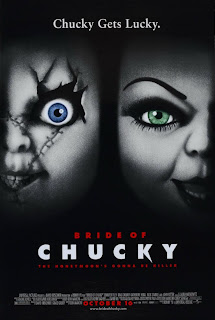
The ad guys trying to get out the word on THE BRIDE OF CHUCKY had seen the poster for SCREAM 2:

The poster for the 4th entry in the LETHAL WEAPON series SCREAMed:


The I KNOW WHAT YOU DID LAST SUMMER gang was back with a sequel (which, despite the passage of time, was not called I KNOW WHAT YOU DID TWO SUMMERS AGO):


SAVING PRIVATE RYAN, Steven Spielberg's unfortunate Oscar-bait movie that year, was a Frankenstein's monster creation, sewn together from pieces of much better war movies from the past, so--in what this writer would like to believe was a private joke--those in the marketing department slapped a SCREAM on it:


More from the "Class of '98":


1999, the song remains the same:


The year 2000 sees the third installment of SCREAM, and again, the franchise copies itself:


And leads to further knock-offs:


In 2001, they come large and small:


David DeCoteau made a trilogy of films called THE BROTHERHOOD and was apparently so enamored of the SCREAM trend that variants on it advertised all three, the first 2 in 2001:


And the 3rd in 2002:


Some other 2002s:


2003:


2004:


2005:


2006:


2007:


And on and on:

2008

2009

2009

2010

2011

2011

2012

Monotonous enough to make you want to, well, scream, right?

--j.

---

[1] Not so long ago and in a different life, I owned a video store. One night, I was sufficiently bored that I rearranged an entire portion of the horror section to showcase only movies with SCREAM cover art. Before I was finished, I had the better part of three shelves covered by them.

Wednesday, April 3, 2013

Death of An Amateur

"Y'know, many times, they say [of me] 'he's an amateur,' and I sort of say 'Thank you very much,' because that means I love cinema. It's the real meaning of the word. And this amateurism is disappearing."

The amateur who spoke those words spent 59 years making movies. I suspect no one knows exactly how many. His filmography on the Internet Movie Database lists 199 features and shorts as director, but there are so many variants on so many of his films, so many unreleased works, so many pieces of incomplete projects left scattered all over the world that any mere list is probably doomed to hopeless inadequacy. Making movies wasn't, for him, a job; it was his life. He was a director, writer, producer, composer, cameraman, actor--he could do it all, and did. For six decades, he lived, breathed, ate, slept, walked, talked, shot, and shat film. Earlier this week, he died.

Over the years, this perennial amateur, Jesús "Jess" Franco, has been alternately praised as a genius and, more often, reviled as a hack. Both are, to an extent, true. Buffs of the kind of off-the-beaten-track flicks on which he spent his career like to fight over what constitutes the precise mixture. In this era of implacable dichotomies, one finds very few middling reactions to Franco--he tends to be a love-him-or-hate-him proposition, and people tend to attach great emotion to whatever conclusion they reach. If anyone can be said to be the ultimate cult director, he certainly fits the bill.

I've been a big fan of his work. More than that, he's a real source of inspiration. An indefatigable work-horse of fiercely independent spirit, he could take a few rolls of quarters, some bologna sandwiches, and some pals to a location and emerge, a week later, with a mini-masterpiece. He did it over and over again. I've never been one to dismiss his lapses (which can, at times, be rather spectacular), but I have argued, for a good, long while, that his shortcomings tend to be greatly overstated and his work often significantly underrated, even by those who admire him. I still think this is the case. Even his absolute worst pictures tend to have at least one moment of the brilliance that shines through the frames of his best, and when it comes to the latter, he has scores of genuine classics under his belt.

Over the years, I've written a few articles about him and about his films. I'd written about my first impressions of his work. I'd reviewed EUGENIE DE SADE, one of his best pictures. I wrote "Figuring Out Jesús Franco," an effort to explain the amaestro to heathens who didn't get it. When the lovely and talented Lina Romay, his longtime companion/collaborator/muse, died just last year, I wrote a fairly well-received reminiscence. These are just little pieces though, narrowly focused vignettes. If they work, they convey some of my enthusiasm for their respective subjects. Doing justice to his life in the event of his death is much harder.

Film was the life of Jesús Franco. His viewfinder was his ever-voyeuristic eye, his zoom was the beat of his cinema-infatuated heart, and what it pumped through his veins for six decades was sublime and ridiculous, sweet and savage, silly and superior celluloid, even when he'd switched to video. His career was a bona fide epic, like nothing else in the history of cinema. If trying to sum up that epic in only a few words is just as much an exercise in futility as the IMDb's filmography, the movies are still there, and can tell you all you need to know.

Rest easy, you damned old amateur. This fellow amateur will miss you.

Jesús Franco Manera
12 May, 1930 – 2 April, 2013

--j.

Monday, April 1, 2013

Welcome To The Tombs of THE WALKING DEAD

For a television series, a season ender is a big event. Ratings tend to radically rise, offering a chance for greater exposure beyond the normal fanbase, and traditionally, series creators really pull out the stops and try to bring their A-game to the project. The problem for THE WALKING DEAD has been that its A-game tends to look pretty much like anyone else's third- or fourth-string. The series has all the potential in the world and there are the occasional episodes that don't entirely suck but in the larger context of the series, they seem to be more like happy accidents than the result of anyone genuinely applying themselves. TWD splits its season and, as a consequence, has had the equivalent of five season enders to date. None of them have been good. The second season ender, "Beside the Dying Fire," remains, to date, one of the absolute worst episode of the entire run. And that's saying an awful lot. Tonight's season 3 capper, "Welcome To The Tombs," did nothing to reverse this trend.

At times, TWD collapses into such a morass of ineptness that it plays like a parody of itself and that was on display quite a bit tonight.

TWD has the pace of molasses in January. Its creators talk a bullshit propaganda line about running a show where anyone can die at any moment, but when it comes to potentially alienating the audience with the deaths of popular characters, TWD doesn't take any risks, and their decision to spend all season turning Andrea into a hate-figure added up, tonight, to exactly what it always does. GINO leaves Andrea handcuffed to a chair and viciously stabs Milton, leaving the bespectacled scientist to die so he will reanimate and chow down on her.[1] Milton left a pair of pliers where Andrea can get to them though. It's a race against time, with Andrea trying to retrieve the pliers with her feet before Milton's life bleeds entirely out of him. As with most TWD races-against-time though, it turns into more of a really slow creep against time, running most of the length of the episode with--as usual with TWD--filler moments continually destroying any tension the scenario could have built. At one point, Andrea entirely halts her escape attempt to have a few minutes of conversation with the expiring Milton about why she stayed in Woodbury. Later, when she thinks he's reanimating, it doesn't spur her to redouble her efforts--instead, she comes to another complete stop and just sits and looks at him.[2]

As I said, a parody of itself.

GINO takes a Woodburian army to the prison, which serves as the excuse to unleash some loud, visually impressive pyrotechnics as they blast their way in. These looked good in the "next week on AMC's The Walking Dead" preview and that's the only reason they were included. After building to it all season, there's no big fight over the prison. Most of the prison group hides nearby while GINO and his men explore the empty facility. When the Woodburians venture into the zombie-infested area,[3] a smoke-bomb that was left for them explodes and they run from the building like rabbits. Glenn and Maggie are waiting behind cover to shoot at a few of them as they run out. They needn't have bothered--Woodbury takes to its vehicles and flees in terror. GINO and a pair of his trusted lieutenants pursue and, stopping the convoy, GINO becomes so angry his people won't fight that he guns them down himself! And so was ludicrously ended the great Woodburian threat.

Again, parody.

GINO and two of his men survive though and leave for parts unknown, leaving open the prospect of a return--something I imagine most viewers would, after this pathetic mess, welcome about as much as they'd welcome a return to Hershel's farm. Or the return of new Coke.

The episode did feature one really striking moment that hit at the heart of one of TWD's many shortcomings. During the prison attack, Carl guns down a surrendering Woodburian. Rick confronts him about this and Carl thoroughly dresses down his father, noting that their failure to deal with potential threats in a responsible manner is what results in their people being killed over and over again. He failed to kill the walker that killed Dale; Rick failed to kill Andrew, which resulted in Lori and T-Dog dying; Rick didn't shoot GINO when he had the chance, resulting in the attack that had just happened. And so on. At someone finally speaking this hard, frank, nowhere-to-run-or-hide truth, this viewer and vociferous critic of the series felt like cheering. Even more so when Rick looked as if he'd been slapped, then took on the countenance of a rapidly deflating balloon. Unfortunately, TWD has never had the stomach for this kind of matter-of-fact sentiment and Mazzara, its now-fired showrunner and the writer of record on this episode, double-stacked the deck against Carl's brutally frank words by having the incident that led to it be Carl shooting a surrendering teenager, then, in the end, having Rick take in the remaining Woodburians, mostly kids and old people (nothing wrong with that, in and of itself, but it was presented as a direct and total repudiation of what Carl had said).[4]

Instead of moving everyone to Woodbury, Rick moved the Woodburians to the prison, damaged and still mostly full of zombies as a consequence of our heroes' failure to clear it.

TWD, this season, has definitely been a tale told by an idiot (more particularly, a group of them), filled with sound and fury, signifying nothing. Except without the fury. Fury requires competent pacing and was definitely a no-show most of the time. The final count: three episodes that didn't entirely suck ("Seed", "Clear", and "This Sorrowful Life"), adrift in a sea of rubbish. The story: A lot of claim-staking and brainless posturing over a prison that, as was presented, wasn't worth keeping; and a threat to it posed by a well-equipped villain who has no motive to want to do them harm other than being the designated villain (and who turned out to be no real threat at all). It doesn't add up to anything.

Except THE WALKING DEAD.

--j.

---

[1] GINO kills Milton because Milton torched his zombie zoo in the previous episode and, he says, because of that, eight Woodburians were killed by Merle, which makes one wonder if Glen Mazzara, the writer of the episode, even bothered to read the script for the previous ep. Merle was able to take out a few Woodburians because he brought an army of zombies to the meeting and shot GINO's men in the confusion that resulted. How more zombies roaming around through that situation would have helped GINO is anyone's guess.

[2] And because of the episodes in ludicrous ass-draggery, she is bitten and meets her end.

[3] Why on earth would our heroes take over a huge prison as their new home then confine themselves all season to one tiny, filthy cell-block of it while allowing zombies to roam freely through the bulk of the facility? There's a collapsed wall on one end of the compound, allowing the dead--and, more importantly, any potential enemy--free access to their home, while cutting off their only means of retreat, should they be attacked. Why on earth would they allow the existence of that breach, unrepaired and entirely unguarded, throughout most of this season? To use it as plot points later, of course! Tonight was the payoff on that.

[4] In another low point, the writers attempt to free Rick from the appalling, irremovable stain they'd left on his character by having Michonne forgive him for contemplating turning her over to GINO, telling him that considering it was the right thing to do. She even thanked him for taking her in!

Monday, March 25, 2013

This Sorrowful WALKING DEAD

The writer of record on this week's installment of THE WALKING DEAD was Scott Gimple, who will be next season's TWD showrunner. "This Sorrowful Life" is very much a mixd bag, bit it has a head up on much of the rest of TWD in that it not only has something to say but has something to say that's worth saying.

Two week ago, TWD wasted an episode on a completely ridiculous "peace conference" between Rick and GINO. The writers had done nothing to establish any reason for the characters to talk. GINO's substantial crimes against Rick's people--kidnapping, terror, torture, murder--had been entirely unprovoked, nothing more than the determined whim of a madman. Not only was there no reason for Rick to do anything but shoot GINO on sight, there was every reason to do just that, and no rhyme or reason in doing anything else. When, mere moments into the proceedings, GINO made it clear he was only there to accept the prison group's surrender, anything less than a hail of bullets into GINO's brain amounted to a character assassination of Rick. In the midst of the staring contest that followed, which didn't include any hail of bullets, the writers threw in a subplot in which Merle, back at the prison, argued the group needed to trek to the meeting and kill GINO while they could. He tried to get the others to go along with him. His idea was presented as stupid and was violently vetoed.

That's how you know TWD's writers don't want you to think about something--they put it in the mouth of a Designated Villain character. They did the same thing last season. As the search for Sophia had dragged on well past the point there was much chance of ever finding her alive, it was becoming dangerous to continue. The idea of calling it off needed to be soberly considered. Instead, the writers put that sentiment in the mouth of Shane, who, by then, they'd turned into a cartoon villain. Rather than getting a fair hearing, one that could lead to a tough call that could alienate the viewing audience, the idea was made merely the devious thought of a heartless villain. Two weeks ago, the writers realized the entire premise of their present episode--the abjectly pointless "peace conference"--was a non-starter, and were trying to self-servingly justify it by making the idea of simply eliminating GINO an emanation of the brain of a dumb, villainous hick.

Way back in my original article on TWD, I wrote:

"TWD would be a difficult property for most commercial television outlets. It's a very dark story, set in a bleak, unforgiving, relentlessly dangerous world that, on a regular basis, forces tough decisions on its characters, the kind that could utterly alienate a mainstream television audience."

In season 2, the writers used Shane to get around this. Once he was reduced to cartoon villain-hood, he was made to solve all of the manufactured moral dilemmas on which the writers spent the season, keeping the tough calls out of--and the consequent blood off of--the hands of our heroes. He dealt with their problems, then, as a designated villain, could, himself, be eliminated with no muss and no fuss.

"This Sorrowful Life" makes a plot-point of addressing this way of doing business. Appearing, at first, to continue it, the episode ends up refuting it. It's a direction that's definitely commendable. The getting there is a bit too TWD to earn unalloyed applause, though.

These days, GINO wants to lay his vengeance upon Michonne, and offered to let the prison group live if they'd turn her over to him. It was a bullshit offer, and there was absolutely no reason to believe he wouldn't, upon receipt of Michonne, just kill everyone anyway. Rick knows this and says as much, and, of course, immediately decides to turn her over anyway.

Those who have been paying attention will immediately realize that the creators wouldn't, under any circumstances, ever allow anything like that to happen. Michonne had proven herself a valuable addition to the group, and had stood with them even after they'd treated her rather badly. A consistently-written Rick wouldn't have even considered such an offer, but then, again, neither would he have suffered a GINO to live. As I've noted many times, there is no "character development" on TWD. There are barely even any characters. Those who serve the function of characters are, at no point, conceptualized as human beings. They are, instead, written as being whatever the script for the week requires them to be, without regard for who they were the week before or will be the week after. Rick's entertaining of GINO's offer was a return of the spineless, indecisive idiot version of Rick the writers had invented and arbitrarily imposed back in season 2, a Rick that should have never existed at all, and certainly a Rick the current Rick should be well beyond. He returns because he's the only version pathetic enough to engage with this ridiculously phony moral dilemma of handing over Michonne. The mechanics of TWD absolutely forbid him from this course of action, which makes the entire exercise one of merely burning through screen-time, but the attitude in the writer's room seems to be that the screen-time has to be filled by something, that they don't have anything better, and that they aren't going to trouble themselves to come up with anything, either.

The reappearance of season 2 Rick also, it turns out, signals a revisiting of that season's theme of questioning Rick's leadership. Rick keeps GINO's offer a secret from the larger group. He brings Hershel and Daryl in on his plot to turn over Michonne. Both are abjectly opposed to the notion, but, proving themselves moral cowards, go along with Rick anyway. It's when Rick turns to Merle as his fourth conspirator that things get interesting.

Merle understands the metatextual "rules" of TWD; he knows Rick turns to a Designated Villain like him to do his dirty work, and knows Rick can't be allowed to be responsible for such a terrible thing, so, while agreeing to help, he jumps the gun and takes matters into his own hands--he kidnaps Michonne himself, with the intent of taking her to GINO. It makes no real sense for Merle to do this, as he knows better than Rick that giving up Michonne won't deter GINO. For the ep to work, one just has to go with that part of it.[1]

On their way to the rendezvous with the forces of Woodbury, Merle and Michonne start to talk. At first, it's a rehash of Shane's litany. Rick is too tender-hearted. He won't do what it takes to keep his people safe, and would back out of this deal. It takes a bad dude like Merle to git 'er done. But then, as an intelligently-written Michonne[2] conjures some thoughts that become a needle beneath his skin, things start to change. For the first time, Merle steps out of the background, is given some depth, and becomes an almost interesting character. Careful observers of TWD know what that means. It would be nice to report that, for once, TWD broke with the cliché, but the telegraph, unfortunately, tells the tale yet again--Merle's emergence from unidimensional villainous redneck-ism signals only his impending death.

Before things get that far, though, there's the rest of a tale to tell.

Back at the prison, Rick does, indeed, have a change of heart. He just can't make himself do such a terrible thing.

Shocking, right?

But by the time he gets off his pot, Merle has absconded with Michonne, and it may be out of his hands. He gives what I'm sure Gimple and the other writers felt was an effective, impassioned speech to the group about his own leadership failures. In practice, it's yet another of TWD's usual ludicrous, overblown orations, delivered, by Andrew Lincoln, with an air of grand pomposity as if he was addressing throngs of faceless followers, rather than just the handful of intimates actually present. "We're the reason we're still here"--an actual line from it. He was wrong, he says, not to tell them about GINO's offer, thus proving that he hasn't a clue as to where he actually went so terribly wrong in that matter. Democracy, he says, is restored. The "Ricktatorship" he declared at the end of season 2 is no more. Ding, dong, the witch is dead! Whatever. The significant part--and the part least likely to last--is that they're now going to take responsibility for their own actions.

Back on the road, Merle decides he's not going to do GINO's dirty work for him anymore. He cuts Michonne loose. He tells her to go back to the prison, that, to follow the cliché to a fault, he has something he needs to do first. That something, of course, is to redeem himself. He makes his way to the rendezvous with GINO with a zombie horde in tow and does something else Rick has been unwilling to do--starts kicking ass and taking names.[3] Unfortunately, the last name taken--written before he can kill GINO--is his own.

With its many inanities, it's impossible to call this a good episode, but it can't help but look better compared to the absolute garbage that has preceded it week after week. The repudiation of that habit of letting Designated Villains make the hard calls, even if (as I believe likely) it proves only temporary, was welcome. The ep does feature, mixed in with the usual rubbish, some better-than-TWD's-average dialogue, and some particularly solid work by Danai Gurira (Michonne) and Michael Rooker (Merle). As in "Clear," Gurira shows what a crime TWD's writers have committed in so badly mishandling Michonne. There's a real actress, there, and she deserves better. Rooker, the central focus of the episode, is just a rock-solid talent, and always has been. His time as Merle has always been an essay on how a talented actor can take nothing--the substance he's consistently been given by the writers--and turn it into something worth a moment of your time, and for all its other problems, this ep was definitely his high-point in the part.

--j.

---

[1] Is it possible that in some early version of the script, he may have taken Michonne in order to get her away from all of it, rather than to turn her over to GINO? One scene, wherein he uses her sword, strongly suggests he wants her to escape. It would have been a nice touch to have made this his intention, but there really isn't anything in the ep to support it beyond that one scene and the illogic of what he does.

[2] Gimple is the only one of TWD's writers who has ever written Michonne as anything more than a caricature.

[3] Merle shows some solid tactical thinking in his confrontation with GINO's thugs, and earlier in the ep, Michonne had, as well, pointing out that the prison can be made defensible by making it too costly a prize for any attacking force.

Tuesday, March 19, 2013

It's WALKING DEAD Time Again

One of the most popular of my many articles about THE WALKING DEAD--presently, only a few hits away from becoming the most hit-upon article on this blog--was a piece I wrote about the series' many timeline problems. When it comes to constructing a standard linear narrative in which no exoticism in the use of time is intended, a coherent timeline is one of the most basic elements. As that original article made painfully clear, this is just another of the features of minimally competent storytelling ignored by TWD. "Prey," this week's unfortunate episode, has brought this issue to the fore again.

"Prey" begins in Woodbury, the morning after GINO's meeting with Rick in the previous episode. GINO has his thugs cleaning out an armory, preparing for war. After episode after episode of fence-sitting, Andrea finally decides to break with GINO and return to her former comrades. She slips out of town and hightails it for the prison at a full gallop. TWD has never established exactly how far the prison is from Woodbury, but only a few episodes ago, in "I Ain't A Judas," Andrea walked the distance in a short time while wrangling a zombie. So it ain't far. This week, Andrea leaves Woodbury, presumably fairly early in the day, and heads for the prison at a dead run. In the forest, she has a brief encounter with some of TWD's patented teleporting zombies, and as night starts to fall, has to detour into an old building to give a pursuing GINO the shake.

The "as night starts to fall" part would sort of say it all--she appears to have ran all day, but can't get to a prison that was previously established as a short walking distance--but it gets even worse, because after giving GINO the slip just after nightfall, it takes her the entire night and part of the next day to get to the prison. A large chunk of time, perhaps 20 hours or more, was simply made to disappear from the timeline.

This was a chronic problem in TWD season 2, and old habits, it seems, die hard.

I intended to write about this in my initial article on "Prey," but simply forgot about it. This is something that happens more and more often lately. The series wears on me, and it's hard to pay too much attention to it when its creators themselves pay so little. The other timeline issue with the episode was one I entirely missed. It was brought to my attention by "spectre." Not the terrorist org in Bond pictures, but a long-time comrade in TWD criticism over on the Internet Movie Database's TWD board. He notes that it's suddenly fall on TWD.

In my original article on TWD's timeline problems, written last year, I noted how, after having nearly the whole series set in the summer, the writers had tried, in the last few episodes of season 2, to shoehorn in the coming of winter. The characters started wearing jackets, the weather was colder, fall was definitely in the air. It was impossible to make this match the episode-by-episode timeline. Rick had awakened from his coma at a time when, the 1st season established, daytime temps were in excess of 100 degrees. Less than 3 weeks of storytime passed between then and the point at which the writers started trying to turn things into a deep fall, where the daytime temps made Carl visibly shiver and complain that he was "FREEZING!"

A little over eight months passed between season 2 and season 3. By the time TWD returned, dialogue established that Lori's pregnancy was overdue. If we assume that season 2 ended in October--and given the incompatibility of what was presented, the only reason to assume this is that the writers clearly wanted us to assume this was roughly where it was set at the moment they were writing it--that puts the beginning of season 3 at some point in June. The characters still had most of the summer before them.

The season 3 chronology isn't as tight as the earlier two seasons, but even by the most liberal estimate--say, that provided by the timeline at the Walking Dead Wiki--less than 3 weeks of story time have so far passed in season 3.[1] That would put events, as of this week's episode, in July, the hottest part of summer. Instead, "Prey" is clearly set in the fall, in October or November. Everyone is wearing jackets again, and the fall foliage is readily apparent, and blown over every road we see. Once again, months of time have simply been made to disappear.[2]

--j.

---

[1] And that's a very liberal timeline. It has the events of season 3 taking place over only 19 days (20, including the most recent ep). There are some serious problems with that. For example, the timeline assumes, without basis, that there are three days between the events of "Sick" and the initial encounter between Andrea and Michonne and the Woodbury gang in "Walk With Me"--this is pulled from thin air, and nothing on the show even suggests it. The timeline also assumes a further gap of five days between that and the events of "Killer Within," for a total of 8 days between "Sick" and "Killer Within." The problem, there (other than the fact that, again, nothing in the show even suggests it), is that the latter appears to be happening the day after "Sick." As it opens, the prison group hasn't even cleaned up the bodies of the zombies they'd killed in "Sick" (they're preparing to do so), and they're only just moving their vehicles on to the prison grounds. Did they really just hang around the prison for 8 days amidst reeking, rotting bodies in the heat of June while doing nothing at all? For the Wiki timeline to be accurate, the brainlessly vengeful prisoner Andrew, chased away in "Sick," would have to have survived for over a week outside the protection of the prison. Also in "Killer Within," Michonne inspects the military vehicles GINO captured and discovers the blood of the Guardsmen GINO killed in "Walk With Me," still fresh enough to be wet. That absolutely precludes 5 days having passed since the slaughter of the Guardsmen, and it seems pretty obvious that the later episode was originally meant to occur the day after "Sick," as is the custom on TWD. This conclusion is, however, complicated by a stray line by Oscar--perhaps inserted late in the script process and certainly clumsily--in which he says he and Axel had been hauling out the dead bodies from their cell block "all week." So it doesn't make any sense, but, as usual, the Wiki timeline errs on the side of (indefensible) generosity.

[2] The writers made a plot-point of the prison group's intention to use part of the prison grounds for planting crops. Eric Pallen, a reader who also noticed the radical time jump, notes that the sudden, inexplicable onset of fall means "they missed an entire growing season." Food and fresh water are, in a survival situation, the primary concern. Skipping a growing season is a huge deal, and should have a major impact on what happens as TWD goes forward. It won't.

Monday, March 18, 2013

THE WALKING DEAD Prey On Viewers

Forget Vanna White. A job on the writing staff of THE WALKING DEAD must be one of the best gigs in the world, for the money. Only the participants, their paymasters and perhaps the stray fly on the wall knows how much time the present team actually spent designing the ongoing third season of the zombie hit, but we can say, for certain, that a team of the least ambitious writers in the world could have put together this season's entire story arc in less than 5 minutes. TWD's premise sells itself, and once this realization allowed this theoretical team to dispense with trying for anything particularly challenging, complex, or, heaven particularly forbid, original, the rest would simply involve throwing together a bunch of awful, worn-out clichés from soaps and bad movies. They'd have the entire season arc in the can in less time than any one of them spent on the toilet before coming to "work," and the only difficulty, from that point forward, would be concocting the details of the filler needed to stretch the 3 or 4 episodes worth of plot they'd assembled thin enough that it ate up the full 16 episodes. As "Prey," this week's dreary TWD installment, further testifies, this season's story arc gives every impression of being assembled in just that way.

Nearly all of "Prey" is one extended chase scene. Andrea finally decides GINO is a treacherous menace, leaves Woodbury to return to the prison, and GINO pursues. And that's it. After an entire ep devoted to one of the least suspenseful screen chases in recent memory,[1] GINO catches her, brings her back, and we see her strapped to a chair in a torture chamber GINO had designed for Michonne. The end.

I write a lot about the wasted potential of TWD. A group of writers with talent who understood it and had an enthusiasm for it could turn it into an awesome storytelling machine. They'd generate more material at any given brainstorming session than could be used in multiple seasons. Squeezing it all into only 16 episodes would have been impossible, and deciding what to leave out a major challenge (and painful). Instead, we get the soap treatment--a few episodes worth of utterly unambitious, hack-work-level plot stretched to cover the entire season.  Shortly after Glen Mazzara was fired as showrunner, it was reported that his regime had provided such a sparsity of material, particularly in the second half of the season, that the show was running out of things to shoot, and production had to be repeatedly shut down because of it.[2] The last six episodes, which have featured only around a single episode worth of relevant plot, certainly attest to that. For a lot of this time, the TWD team was apparently just shooting anything it could, just to fill time.

Because the writers don't properly plot TWD, they're forced to employ a series of absurd contrivances in order to stretch out what little plot there is. This does an incredible amount of damage. The treatment of Andrea is probably this season's loudest example. She's been stuck in place the whole season. After she and Michonne are taken to Woodbury, Michonne begins to figure out there's something rotten about it and about GINO. She tells Andrea as much, and says they need to leave, but, because the "plot" calls for Andrea to stay in Woodbury, she never shares with Andrea any of the actual evidence she's accumulated, not even when directly asked. So Andrea won't leave. This repeats, then repeats, then repeats again, while both Michonne and the audience are shown something is very wrong with Woodbury. It makes Andrea look terrible. Then, when Andrea starts to realize Michonne was right, it's another holding pattern. Andrea sees GINO's private fish-tank of human heads and the zombified creature he kept on a leash in his closet. She sees GINO put Daryl and Merle in a death match. She's horrified, but she's stuck in Indecision Mode. She learns the extent to which GINO is a lying psychopath, and she's still stuck. In one ep, she starts to kill GINO in his sleep, but can't bring herself to do it--still stuck. In another, she just can't imagine going back to Woodbury after the "peace conference," then does it--still stuck. And so on. While the writers do these things just to drag out their perpetually underplotted story, the effect is that her character has been assassinated far more completely than if they'd just made her an outright villain. A viewer could at least enjoy a good villain. Through this, Andrea became a grown woman in her 40s who, even when it's a matter of life and death for perhaps dozens of people (including all of her living friends), just couldn't get over an utterly inexplicable school-girl crush on a raving, psychotic animal who shows evidence of not a single appealing characteristic. The effect was devastating, and her decision to finally break with him this week comes far too late.

No one is sitting around writing these sorts of things based on any sort of conceptual vision of the characters. Attributing to them these sorts of decisions isn't dictated by any effort at quality storytelling. It's all just a matter of doing whatever it takes to stretch underwritten material.

It's the same reason the prison group completely lost interest in most of their new home almost immediately after moving into it. Their decision to take it was dictated by survival concerns, but those concerns seemed to cease just as soon as they captured the one cell-block. The prison is a large complex, potentially full of useful equipment and material, but they confine themselves to a single suffocating section of it.[3] In addition to a spacious and utilitarian home, the prison also offers a potentially great defensive position. Being a prison, its design would include the ability to lock down each section individually. With a little work, it could be turned into a death-trap for any invading force--a Hittite hive they could use to systematically destroy anyone trying to move through it, while fortifying various areas as hold positions. They could dig escape tunnels leading to the outside, and, for that matter, a network of tunnels and other covert means of moving about the grounds, creating hidden passages, false walls, and so on. No one in the group ever even discusses such things, and, in fact, they've left a huge, gaping hole in the rear of the place for a lot of the season. Not only have they not fixed it, they haven't even shown much interest in it. They learned about it after Tyreese and his group came through it, which is, itself, fairly damning--it means they never even surveyed the prison perimeter, even after the prisoners told them, early in the season, that the fence was down on the other side. This is a hole through which zombies pass, and our heroes simply allow these zombies to roam about most of their home. It's also a hole through which GINO could send a force that would help bury them.[4] The writers intend to use that hole and the zombies it allows in as a plot-point later, so everyone on the show itself just gets stupid for most of the season until that moment comes around.[5]

If TWD's writers were only to be judged as ordinary working guys and gals, I suppose it would be hard to fault them too harshly when it comes to this sort of thing. Times are tough. TWD has a premise that does sell itself, and will continue to do so for at least a while. It's a hell of a lot easier to spend a few minutes constructing, from a bunch of worn-out cliche's, a thin plot to stretch over the entire season than to spend long hours creating something original that would actually fill a season. There's no motive to put the kind of hard work into the project the latter would require--the pay would be exactly the same, and so would the ratings. So ride the gravy-train until people get wise and derail it, and if there is a twinge of shame in being paid so well for so little, salve one's conscious later. When one judges them as creators, though, what they've done is is a disgraceful waste of what could have been the finest project of their respective careers. I suppose the proper judgment lies somewhere in between. Readers will have to decide where.

--j.

---

[1] As usual, I watched the ep with a friend who likes the show, and the clichés were so heavy and so telegraphed that I was able to tell him exactly what was about to happen moments before it, indeed, did happen on four different occasions (but, to be fair, I missed on one).

[2] Unfortunately, this was overshadowed by salacious, tabloid-style "reporting" of rumors about TWD comic creator Robert Kirkman allegedly wanting Mazzara gone. Mazzara himself has cited "creative differences" with AMC as the reason for his departure. If the reporting about production shutdowns is accurate--and, given the last six episodes, that certainly seems to be the case--those "creative differences" could have just been the final straw.

[3] And, in fact, there's no real reason for the group to stay there after Woodbury became a problem. Part of this is further fall-out from the ill-advised decision to begin the current season eight months after the end of the last. The group spent those 8 months on the road, moving from place to place. We weren't shown how hard they had it, but what we can say, unequivocally, is that, at the end of that time, they were all in great shape, and no one had been killed or seriously injured. Their move into the prison was dictated by the idea that it would be a safe-haven, but keeping it has killed a few of them, now, and it has proven a horrible place where they live in filthy, cramped conditions, and now face a war with a madman bent on destroying them. In the comic, the prison was a great place where the group built a community. That's why the Governor wanted it. On tv, it's a dark, zombie-infested shit-hole, and they have absolutely no reason to stay there once GINO--who wants to destroy them in his tv incarnation solely because he's the designated villain--became a problem.

[4] Such a force could enter totally unobserved, because that section of the building isn't watched, and as long as it didn't give away its presence, it would have unlimited time to work its way to our heroes' living area. Once this team was in place and GINO places a larger force in front, our heroes would be Spam in a can--nowhere to run or hide.

[5] A few episodes ago, Glenn was in war mode, and, with Rick out chasing ghosts, was trying to get the rest of the group in action to prepare for an attack. He angrily noted that no one was on watch; subsequently, no one bothered to take a watch. He was trying to come up with a way to deal with that hole in the prison. He and Carl tried to survey the situation from inside, but there were zombies and they abandoned the effort. As Plan B, he was going to check out the hole by driving around the prison from the outside. Maggie, whom he wanted to accompany him, angrily slapped him away so she could lay on her bunk and do nothing at all. He set Carrol and Axel to putting up some barricades; they laughed and joked the whole time they plodded along, doing as little as possible and taking as much time as possible to do it. Hershel gave Glenn a lecture on how his hyped-up state was going to get hm killed. Glenn tried to get them to take their situation seriously, and the entire thing was written as if he was the one being a dick.

ADDENDUM (21 March, 2013) - To continue on that last thought (but somewhat outside the context of that footnote)... In the world of TWD, basic survival concerns should always be on the minds of all of the characters, but the writers act as if they resent this, and such concerns are routinely put into contexts that make them look inappropriate. Glenn, in that ep, was trying to get everyone to prepare for war, and he was presented as if he was being a jerk. Back in season 2, when the search for Sophia had become protracted and was endangering those taking part in it, the idea of possibly calling it off should have been soberly discussed. Instead, the writers put the idea in the mouth of Shane, who they'd turned into a cartoon villain (they made him the mouthpiece for other survivalist concerns as that season continued). Just last week, Rick and GINO had their "peace conference," and there was absolutely no reason for Rick to do anything except kill GINO on first sight. It would have solved all of their problems in an instant. Instead, the writers had Rick do his supine little sit-down with the psycho, and even seriously consider turning over Michonne, while putting the idea of using the encounter to kill GINO in the mouth of Merle, yet another cartoon villain.

Sunday, March 10, 2013

Killing Time on THE WALKING DEAD

Nothing happened tonight on THE WALKING DEAD.

Again.

For 60 minutes, the creators of the series once again chose to dedicate nearly an entire episode of their season merely to killing time.

Episode title: "Arrow on the Doorpost"

The part that matters: Rick and GINO held a "peace conference" at a grainery. GINO made it clear, moments into it, that he was only present to accept Rick's surrender, not to negotiate. Toward the end, he offered a basis for a deal: he wants Michonne. Turn her over and, he says, he'll let the prison group live in peace. And Rick returned to the spineless imbecile to which the writers had arbitrarily devolved him back in season 2.

Total plot progression: less than 5 minutes worth.

The other 55+ minutes: Filler.

The last 5 episodes, in fact, have collectively featured less than 1 episode worth of plot. In this regard, the writers seem intent on trying to break their season 2 record.

GINO makes his intentions very clear right from the beginning. The entire godawful storyline that has been this season could have been ended simply by Rick blasting GINO and there's absolutely no reason why he wouldn't do that on  first sight of him. Rick has shown he'll kill problematic people without a moment's hesitation or second thought. He's the prison group's leader. His job is to look out for his own. GINO is a madman who, without any provocation, has already kidnapped, threatened, tortured and murdered those Rick leads, knocked down the door to their home so every stray zombie can wander in and tried to kill them all. Even sitting down with such a creature renders Rick weak, stupid, indecisive and absolutely pathetic. He sat there with this arch-villain who. at arm's length, threatens them all, even after GINO makes it clear there's no point, lets himself be repeatedly insulted and ends by telling GINO he'll think about giving over one of his own. And then does it, even while admitting such a "deal" is no deal at all.

I've often written about the tragically wasted potential of TWD. I've never felt this as heavily as I did tonight. The return of spineless Rick, after everything that has happened, is absolute garbage writing of the kind that has buried TWD and actually made me angry. Something this awful shouldn't be able to get even that little bit of a rise out of me. Or maybe it should get a rise out of everyone who appreciates cinematic art. What a pathetic waste of space is TWD.

--j.