The most excellent blog of the most excellent Mondo Macabro presently features a brief piece I penned pimping MM's deliriously endearing double feature FOR YOUR HEIGHT ONLY/CHALLENGE OF THE TIGER. Check it out, and if it grabs you, grab a copy of the disc. In fact, grab lots of Mondo Macabro releases--you'll be glad you did, and you'll be supporting the work of one of the best labels we have.
--j.
Wednesday, August 22, 2012


Saturday, July 7, 2012
The Tangled Web of SPIDER-MAN 2
THE AMAZING SPIDER-MAN, Sony's effort to reboot their Spidey franchise (and hold on to the lucrative movie rights to the character), has just opened, and from the initial reviews it sounds a bit like those behind this new film may have made some effort to get right some of the things the much-lauded (but not very good) SPIDER-MAN 2 got so wrong.
I was a fan of the first Sam Raimi movie. It certainly wasn't perfect but it succeeded a lot more often than it failed and watching it unexpectedly turned into one of the two best theater-going experiences of my life. In my childhood, Spidey had been a good friend of mine. I read before most kids my age could even recognize their letters and even at that, I was a fan of comics before I could read them myself. And Spider-man was one of my favorites from the beginning. I spent hours pouring over his four-color adventures, making them three-dimensional in my head, then I'd take to the back yard and make up new ones of my own at such a pace that my efforts to instantly act them out could scarcely keep up. At some point, I lost touch with that. You grow up, your outlook on things changes and even if you retain a love for what had captured your heart back then, that love changes as well. Something that means so much to you at that age never really leaves you though. That remarkable level of enthusiasm ends up stamped on your DNA, even when you're not aware of it, and sometimes--very, very rarely but every so often--you come across something that, seemingly like magic, reconnects you to it in some way. This is what happened to me when I saw SPIDER-MAN. Going into it, I was just hoping for a good flick. What I got was one that stuck a tap right into that intense enthusiasm of childhood and turned the spigot wide open. It--and by "it," I mean this feeling I'm trying to describe--was awesome. Spell that word in all caps, bold print, with it underscored and enough exclamation-points after it to make up the Great Wall of China and it would still never be enough.
That reaction wasn't random. Sam Raimi had more than just the talent to pull off the picture and more than just the right kind of talent. He also had that same love of the character, and it floated between every frame. Transmitting that through a big, Hollywood picture is quite a trick. With me, he managed it.
For a brief time, the movie could still bring on faint aftershocks of that initial reaction. This didn't, however, lead me to exaggerate the merits of the movie. It never became one of my favorites. I haven't watched it very often. The Green Goblin's "Power Ranger chic" look never fails to make me groan. It still managed to be a damn good movie though, and in spite of some missteps, a damn fine adaptation of the character and his world.
SPIDER-MAN was a huge hit. It received mixed critical reviews. Two years later, the gang behind the first film returned with SPIDER-MAN 2. It cost more and didn't make as much but it met with smashing critical success. People saying it was better than the original. Calling it the best comic adaptation of all time. Saying it transcended the comic material, which is what people who look down upon comics but know nothing of them always say when they like something based on one.
Nearly seven years ago, I wrote about SM2, and, as is so often my habit, took a very different view. Here's what I had to say about it then:
THE TANGLED WEB OF "SPIDER-MAN 2"
20 Oct., 2005
It raked in a fortune at the box office, was greeted with nearly universal critical approval, and, in the year since its release, has frequently been a hailed as one of the best comic book movies of all time. Often, as the best.
But I didn't like SPIDER-MAN 2.
More than that, I didn't even think it was a good movie. I didn't hate it, though my reaction to it admittedly becomes much firmer when faced with the blind adoration of many of its fans. It had its moments, some of them wonderful. Overall, though, not good. Frequently awful, in fact. Inferior to the mostly excellent original in pretty much every meaningful way.
Being a lifelong comic fan, I'm always trying, when I begin one of these reviews, to work out some sort of formula that allows me to offer criticism of these movies as both movies and as adaptations. A movie can, after all, be a good one even if it's a poor adaptation, just as the reverse can be the case if the material isn't well suited for the screen. For fans of the characters and stories, of course, the ideal is to have both a good film and a good adaptation. For this piece, I'm not going to make as much of an effort to separate the two, aiming instead for something a little less structured and a lot more free-flowing; more like a series of observations. This are several potential pit-falls to this approach and I may not avoid them all. For the record though, I'm not one who thinks a poor adaptation necessarily makes for a poor film.
On with the show...
In discussing the film in different venues, I've often referred to it as SPIDER-MAN 1 FOR MORONS. Thematically, the movie is simply a rehash of SPIDER-MAN, retreading the same power/responsibility theme that had already been covered in the first film and doing so in exactly the same way, often using exactly the same scenes. Have great power, shirk responsibility, bad things happen, resume responsibility. Rinse. Or, depending on the metaphor one feels is more appropriate, wipe and flush. Essentially a remake, it adds exactly nothing to the story of the original film and in fact takes much away from it in the retelling. Most of the humor is eliminated, most of the elements that allowed us to identify with Peter are removed or severely watered-down and, most egregiously, the story is retold with all the subtlety of a loaded log-truck traveling up a bad road. Lots of noise, lots of flash, lots of driving home the points the film wants to make in sledgehammer-to-the-face fashion but far less intelligence, little charm, little wit and no real point.
This alone isn't necessarily sufficient grounds to damn SPIDER-MAN 2. The power/responsibility theme, even if it is simply being rehashed, is still a Spider-Man theme (though as I'll get into in a moment, the movie deviates wildly from the source material in most matters). And big, dumbed-down rehashes can be fun sometimes too.
"Fun," however, isn't a word in the vocabulary of SPIDER-MAN 2.
In the comics, being Spider-Man caused Peter Parker plenty of problems but it also served as a release from the frequently high stress of his ordinary life. As Spider-Man, he could swing free through the city on a pleasant day, flip off rooftops with reckless abandon and be as big a clown as he wanted. The mask freed him. As dangerous as his activities could be, they were also fun. His Spider-Man persona was that of a merry prankster, a smartass, always throwing wisecracks, relentlessly teasing and taunting the stuffy underworld stiffs he battled, reveling in the role.
This is a crucial elements of Spider-Man, one of the central ones. The first film, though arguably underplaying it, clearly understood it. The second, however, hasn't a clue. Being Spider-Man is presented in it as some sort of cold, harsh discipline to be engaged in relentlessly, joylessly, in martial fashion and as a matter of "responsible behavior," regardless of whatever trouble it may cause in one's own life. Everything else is to be held as a secondary concern; the discipline must always come first.
This is, to put it mildly, quite out of step with the spirit of Spider-Man. Having chosen to shear away such a crucial element of the character, however, director Sam Raimi inexplicably chooses, as the major source for the film's story, a plotline from the comics which depended entirely upon this clown persona element he'd excised. The result is a hollow adaptation, one that uses superficial elements of the original story to tell an entirely different one.
In "Spider-Man No More,"[1] the principal comic story from which most of SPIDER-MAN 2 is drawn, Peter, after years as a costumed crimefighter, had lost touch with why he'd become Spider-Man in the first place. Maintaining the identity was causing him a lot of problems and he was becoming convinced that, because it was fun and got in the way of his more adult pursuits, it was an immature thing. "...every boy, sooner or later," Peter thinks, "must put away his toys, and become a man." It was time to grow up, so "toy" Spidey went in the trash, in that famous image from the comic recreated in the movie. After Peter renounced his secret identity, crime became, for him, what it is to most people; a distant thing about which he heard on the news. Though it took some adjusting, this distance made it much easier to ignore. One night, though, Peter, passing by a warehouse, sees a night watchman being attacked by a pair of thugs. With the crime no longer distant but right there, up close and personal, he doesn't hesitate for a moment to jump into the fray and put away the two would-be thieves. The incident and the sight of the watchman, an older fellow, bring flooding back the memory of his Uncle Ben and of the reason he really became Spider-Man--those things with which he'd lost touch--and this makes him realize he'd gotten the equation reversed. Spider-Man wasn't a toy of childhood. It was his mature acceptance of responsibility, not a youthful shirking of it. He reclaims the mask and swears that no one will ever come to harm because Spider-Man failed to act.
In SPIDER-MAN 2, being Spider-Man isn't something Peter enjoys at all and though he helps others, it seems to serve no positive function in his own life--it is, instead, a joyless exercise through which he puts himself in almost masochistic fashion and that he allows to utterly consume his life because he feels it's the responsible thing to do. He hasn't lost touch with why he became Spider-Man. He has, in fact, become obsessed by it to a very unhealthy degree. When he has an imaginary conversation with his deceased Uncle Ben and tells him he's going to stop being Spider-Man, it's a conscious walking away from what he'd seen and accepted as a responsibility.[2] Such a characterization of Peter is a drastic deviation from "Spider-Man No More" and from nearly all of the over 40 years worth of comic stories. This sharp disconnect from the source material is made even sharper by a scene in which Peter witnesses a mugging a few feet away from him, mirroring the one in the original "Spider-Man No More" story, and, with the victim yelling for help, just walks away.[3]
Such a gross mischaracterization is actually the point where an earlier ill-conceived snowball became an avalanche. That early snowball was set to rolling at the end of the first film, when Peter tells M.J., the love of his life, that he can only be her friend, nothing more. It was only one scene and troubling though it was, it did arguably help give a more operatic ending to the movie. And, of course, it could be written off later without too much trouble. Unfortunately, Raimi decided, instead, to build an entire movie upon it. Thus was born the Peter Parker of SPIDER-MAN 2 who, out of a combination of masochistic commitment to being Spider-Man and an obsessive fear of putting loved ones in danger, shuns intimate human contact and commits himself to a lonely, loveless existence--that harsh, joyless discipline. This is a Peter Parker entirely alien to the comic character. In the book, Peter actively pursued romantic interests over the years, like any other normal person. Even after Gwen Stacy, whom he intended to marry, was murdered by the Green Goblin because of her connection to him, he never adopted the course chosen by the movie Peter. And for good reason; it's a completely irrational choice. In the first film, it appeared at the very end out of nowhere. During the course of the movie, the Green Goblin had learned that Peter was Spider-Man and had menaced M.J. and his Aunt May. This is a problem, but the obvious solution is for Peter to zealously guard his secret identity. If it's compromised, all of his friends and family would be in danger in any case.[4] Unless he planned to cut off all human contact--and he clearly didn't--it made no sense to deny himself a romantic interest. Yet that's exactly what he decided to do in "reaction" to the Goblin's actions. The filmmakers arbitrarily committed movie Peter to this inane choice, setting up being Spider-Man and having a real life as all-or-nothing mutually exclusive options. This notion doesn't logically flow from anything in the movie and has more patently obvious holes in it than a Swiss cheese but it becomes the "rationale," if the word can be so abused, for his giving up Spider-Man. It's the only way he thinks he can live a normal life.
In the all-important matter of M.J., we can only empathize with Peter to the degree to which we choose to ignore the fact that he's losing the love of his life only because he, himself, is needlessly throwing her away.[5] M.J., at the end of the film, easily refutes his "reasoning" for doing so by pointing out another of those obvious holes in the cheese; she's an adult, and can make her own decision about what kind of risks she's willing to take. In the meantime though, we've had to sit through two hours of a movie allegedly about Peter Parker/Spider-Man wherein a character who isn't recognizable as Peter Parker or Spider-Man commits to a transparently illogical, arbitrarily-imposed decision Peter Parker never made, requiring him to go through a process through which Peter Parker never had to go in order to reach a conclusion that should have been obvious to anyone from the beginning.
Not very impressive, either as an adaptation or as a film on its own merits.
In the adaptation department, Dr. Octopus doesn't fare much better than Spider-Man. The movie appropriates the spectacular visual of Doc Ock with little of the substance. This isn't necessarily a bad decision--in spite of the efforts of various writers over the years to better shade the character, Doc Ock, in the books, is still rather bland and lacking in depth. He's insane, obsessive, greedy, self-absorbed--quite a weird little guy. The accident that grafts his mechanical arms to his body damages his mind but he wasn't in very good shape in that department to begin with; the brain damage only made bad matters worse. Unfortunately, the filmmakers don't succeed in replacing this with anything better. Their attempt to build a better Dr. Octopus makes of him a sort of sympathetic pseudo-villain. Movie Ock is actually a good guy, a fellow with a loving wife and stable life, selflessly dedicated to the cause of bettering mankind. He only does bad things because a protective microchip on his neck burns out during the accident allowing the artificial intelligence in his mechanical arms to manipulate him into it.
The scope of Spider-Man's powers in the film offers another wild deviation from the source material adopted to the film's detriment. This, too, was born, somewhat, in the first film, where we see Spider-Man exhibiting strength and ruggedness that if not completely beyond the abilities of the comic version are certainly at the extreme end of those abilities. With SPIDER-MAN 2, however, all restraint goes out the window. At one point, when his webs stop working in mid-swing, he falls what looks like 50 or 60 stories, crashes into a roof and gets right up without even having the wind knocked out of him (comic Spidey would have been killed instantly by such a fall). Later, he takes another nasty fall and lands with his bare midsection crunching, full body weight, across the lip of a dumpster. Again, no apparent harm. Later, another nasty fall and he bounces off the roof of a car. This time, he appears to be injured but only for humorous purposes (the scene is a repeat of the playing-across-rooftops scene from the first movie[6]). In his battles with Dr. Octopus, he's repeatedly slammed face-first into stone and brick walls; slammed so hard those walls crack and crumble under the impact of his face and body. They leave him completely unmarked and don't even slow him down. (Comic Spidey has, when weakened, been bloodied by ordinary human foes). He falls off a speeding el train, landing on the paved street far below, and zips right back into action without a moment's pause. By far the most outrageous scene though (and the most embarrassingly awful), is the one wherein he stops that train, speeding out of control, with his bare hands.[7]
Such things look absolutely ridiculous on the screen; they're abjectly pointless, brutal assaults on the willingness of the audience to suspend disbelief. Perhaps more importantly, they amount to an attack on another core element of the Spider-Man character: his basic humanity. This was the very thing that made Spider-Man so revolutionary in the 1960s. He's "not Superman," to quote Aunt May's laugh-line from the first movie. He isn't a god pretending to be a regular fellow; he is a regular fellow who just happens to gain amazing powers. Throughout SPIDER-MAN 2 though, he's presented as an all-but-indestructible juggernaut, with strength and durability so far beyond our frame of reference as to seem positively otherworldly. This works to undermine our ability to relate to the character; it's a constant visual reminder that he's not one of us--taken to the extreme it is in the movie, not even remotely one of us.
Related to this is another of the character's core attributes brutalized by this treatment: his bravery. For all of Peter's doubts and anxieties, Spidey is a very gutsy fellow. Frequently, he's completely outmatched by his opponents. In the early years of the book, which saw the introduction of most of the key villains, it became a virtual formula that he would fail in his first attempt at taking them down, sometimes rather spectacularly being served a dish of his own posterior. In the latter category belongs his first encounter with Dr. Octopus.[8] Ock dismantled him in short order, tossing him aside when he was through like a piece of refuse. But as in all those other stories, Peter gets it together, comes back and, defying the odds, puts the villain away. By contrast, it's difficult to imagine anyone giving too much trouble to the character with the capabilities we see in SPIDER-MAN 2, much less outmatching him. He's relentless, unstoppable, possessed of Hulk-like strength and nearly impossible to injure; attributing bravery to him for what he does is like attributing it to a person who squashes a bug.[9]
Of course, no one wants to see a movie about a "hero" squashing a bug. The filmmakers deal with the problem they've created in so radically amping up Spider-Man's powers in exactly the wrong way; they radically amp up the durability of the villain in order to make him more of a match. They don't bother to give any in-story reason for it either. As with their Spider-Man's vow of celibacy earlier, this is a matter of one bad decision dictating another. The result is both an absurdity made even more absurd and a thing so completely removed from the source material as to be unrecognizable. In both the comics and the movie, Dr. Octopus is bonded with his mechanical arms via a lab accident but he, himself, has no superpowers--physically, he remains a normal human. In a fight with Spider-Man, comic Ock must let his mechanical arms do the work and be careful not to let Spidey land a solid blow on him. One good shot and it's all over. In the movie though, Spider-Man is shown laying into Ock with full-blown, right-to-the-face haymakers over and over again, to little or no apparent effect. In a bank, he hits Ock so hard with a very large bag of coins that Ock is blasted backwards, his head and body leaving a crater in a rock wall, again little effect. Moments later, he hits Ock with a desk so hard it blows Ock off his feet, across the room, through a plate-glass window, and into the side of a car outside. Even after all that, Ock's impact on the car is still violent enough to blast it off the ground as though another car had plowed into it at a high speed. It doesn't even slow Ock down.
And so on.
"Spiderman 2" isn't one to let a little thing like internal logic or consistency get in its way either. The fellow who can stop a train with his bare hands can't even slow down Ock with repeated haymakers but frail old Aunt May manages to stagger Ock by striking him with her umbrella.[10] The film's lowest point in this regard occurs as the dreadful climax of the elevated train sequence. As noted earlier, the entire film presents Peter as being almost pathologically obsessed with the notion that his activities as Spider-Man pose a danger to his friends and family; it is, in fact, his central motivation throughout the film. If such a fear had no other effect, it would certainly lead him to zealously guard his secret identity, exposure of which would be the very thing that would place his loved ones in danger. His anxiety about this is so great that he's made of his life a misery, but during the train sequence, he whips off his mask and needlessly exposes his identity to the entire train full of people.[11] Rumor at the time was that this was done at the insistence of star Tobey McGuire, who wanted to be more strongly associated by moviegoers with the character of Spider-Man rather than just nerdy Peter Parker. This seems likely, as the entire film is replete with scenes where, while out as Spider-Man, he removes his mask. It thus offers a character far more more obsessed than his comic counterpart has ever been with the fear of placing his loved ones in danger via his Spidey activities, but one who, paradoxically, is far more careless--almost cavalierly careless--than his comic counterpart about having his identity revealed to the world.
SPIDER-MAN 2 was a big success and I know I'm pushing a very large rock up a very steep hill on this one but I also know that history's judgment of a film often isn't the same as that passed by the temporary passions of its own day. I don't really have any formal closing comments here. These are some of my observations on the film and why I didn't like it. Take them for what they're worth.
--j.
---
[1] From "Amazing Spider-Man" #50
[2] Raimi visualizes this by having Peter revert to his former pre-Spider-Man nerdy self from the first film.
[3] The only exception to this that springs readily to mind is "Spidey Cops Out" from "Amazing Spider-Man" #112, wherein, in the course of two pages, Spidey encounters but refuses to get involved in a mugging, then a kidnapping, the latter with the victim screaming to him for help. In the story, Aunt May had disappeared and he'd decided it was more important to try to find her than to get involved in the incidents in question. Still, it comes across as a gross mischaracterization (the fact that I even remember it attests to that). The story was written by Gerry Conway. It was only his second issue on the book and he hadn't quite gotten a handle on the character yet. He went on to a classic run.
[4] He keeps M.J. at "just friends" arm's length throughout SPIDER-MAN 2 but she's still kidnapped because of the Spidey connection.
[5] In the comics, the creators were forever devising ways to put Spider-Man between Peter and his various romantic interests but as contrived as they sometimes were, they made much more sense and you could empathize with Peter's plight. Betty Brant, after the death of her ne'er-do-well brother, was very firm on the point that she wanted a stable, boring mate who took no chances. Gwen Stacy believed Spider-Man had murdered her father. And so on.
[6] Significant portions of the movie were direct repeats of things from the first film. We get Peter taking out the garbage again, leading to another familiar conversation with M.J. We get the villain-talking-to-himself scene (in the first movie, it was Osbourne talking with his evil Goblin side--this time around, it's Octavius conversing with his mechanical arms). Another rescue of another child from another burning building. Another conversation with Uncle Ben (same car set, same wardrobe as the first time around). A repeat of that roof-jumping scene, played for comedy as it was the first time around. M.J. is once again kidnapped by the villain in order to draw out Spider-Man. The villain once again has a last-minute moment where he comes to his senses. And so on.
[7] Regarding the scope of Spidey's strength, there are moments of wild inconsistency in the comics (the most outrageous--and idiotic--probably being his takedown of the cosmically-powered Firelord in Amazing Spider-Man #269-270), but stopping a speeding train like that is a feat worthy of the Hulk; it isn't even remotely within the power range of any version of Spider-Man we've seen before. I singled out the train thing but that's only the most outrageous example of this sort of thing.
[8] From "Amazing Spider-Man" #3, another story from which SPIDER-MAN 2 is drawn.
[9] To put a finer point on this line of criticism, one of the most celebrated moments from the comic came in "Amazing Spider-Man" #32-33, when Spider-Man is pinned beneath a large piece of machinery in a room that is rapidly flooding. A few feet away is a new serum that will heal a dying Aunt May. If he can't free himself, he'll die, and, without the serum, she'll die. He's completely exhausted though. He's been running for days without a break. He'd just fought his way through a phalanx of hoods then gone 10 rounds with Dr. Octopus. The machine above him is massive. When he first tries, he can't budge it an inch. Between the two issues he spends seven pages--an eternity, by Silver Age comic standards--struggling to free himself, thinking of Aunt May, beating himself up again for Uncle Ben's death, insisting to himself that he won't let May die.

And, throughout the course of this, slowly, ever so painfully, he manages to begin lifting the machine off his back and, with the strain so great he's on the verge of blacking out, he frees himself. The sequence is one of the greatest moments in the history of superhero comics and is widely regarded as Spider-Man's defining moment. As such, its a severe criticism of SPIDER-MAN 2 indeed to note the obvious fact that such a sequence--Spidey's defining moment--would, after seeing what he does in the second film, look insultingly disrespectful of continuity if included in any subsequent film.
[10] She saves Spider-Man's life by doing so--Ock was about to skewer him on a large blade. In SPIDER-MAN 2, May is a fan of Spider-Man and dislikes Dr. Octopus, exactly the opposite of the comics.
[11] The passengers' subsequent promise that they won't tell anyone is pure corn, and handled in such a disgustingly saccharine manner as to be wretch-inducing--easily the lowest depth the film plumbs.
...
This is reprinted from my comics blog, here:
http://comicscomments.blogspot.com/2005/10/tangled-web-of-spider-man-2.html
I was a fan of the first Sam Raimi movie. It certainly wasn't perfect but it succeeded a lot more often than it failed and watching it unexpectedly turned into one of the two best theater-going experiences of my life. In my childhood, Spidey had been a good friend of mine. I read before most kids my age could even recognize their letters and even at that, I was a fan of comics before I could read them myself. And Spider-man was one of my favorites from the beginning. I spent hours pouring over his four-color adventures, making them three-dimensional in my head, then I'd take to the back yard and make up new ones of my own at such a pace that my efforts to instantly act them out could scarcely keep up. At some point, I lost touch with that. You grow up, your outlook on things changes and even if you retain a love for what had captured your heart back then, that love changes as well. Something that means so much to you at that age never really leaves you though. That remarkable level of enthusiasm ends up stamped on your DNA, even when you're not aware of it, and sometimes--very, very rarely but every so often--you come across something that, seemingly like magic, reconnects you to it in some way. This is what happened to me when I saw SPIDER-MAN. Going into it, I was just hoping for a good flick. What I got was one that stuck a tap right into that intense enthusiasm of childhood and turned the spigot wide open. It--and by "it," I mean this feeling I'm trying to describe--was awesome. Spell that word in all caps, bold print, with it underscored and enough exclamation-points after it to make up the Great Wall of China and it would still never be enough.
That reaction wasn't random. Sam Raimi had more than just the talent to pull off the picture and more than just the right kind of talent. He also had that same love of the character, and it floated between every frame. Transmitting that through a big, Hollywood picture is quite a trick. With me, he managed it.
For a brief time, the movie could still bring on faint aftershocks of that initial reaction. This didn't, however, lead me to exaggerate the merits of the movie. It never became one of my favorites. I haven't watched it very often. The Green Goblin's "Power Ranger chic" look never fails to make me groan. It still managed to be a damn good movie though, and in spite of some missteps, a damn fine adaptation of the character and his world.
SPIDER-MAN was a huge hit. It received mixed critical reviews. Two years later, the gang behind the first film returned with SPIDER-MAN 2. It cost more and didn't make as much but it met with smashing critical success. People saying it was better than the original. Calling it the best comic adaptation of all time. Saying it transcended the comic material, which is what people who look down upon comics but know nothing of them always say when they like something based on one.
Nearly seven years ago, I wrote about SM2, and, as is so often my habit, took a very different view. Here's what I had to say about it then:
THE TANGLED WEB OF "SPIDER-MAN 2"
20 Oct., 2005
It raked in a fortune at the box office, was greeted with nearly universal critical approval, and, in the year since its release, has frequently been a hailed as one of the best comic book movies of all time. Often, as the best.
But I didn't like SPIDER-MAN 2.
More than that, I didn't even think it was a good movie. I didn't hate it, though my reaction to it admittedly becomes much firmer when faced with the blind adoration of many of its fans. It had its moments, some of them wonderful. Overall, though, not good. Frequently awful, in fact. Inferior to the mostly excellent original in pretty much every meaningful way.
Being a lifelong comic fan, I'm always trying, when I begin one of these reviews, to work out some sort of formula that allows me to offer criticism of these movies as both movies and as adaptations. A movie can, after all, be a good one even if it's a poor adaptation, just as the reverse can be the case if the material isn't well suited for the screen. For fans of the characters and stories, of course, the ideal is to have both a good film and a good adaptation. For this piece, I'm not going to make as much of an effort to separate the two, aiming instead for something a little less structured and a lot more free-flowing; more like a series of observations. This are several potential pit-falls to this approach and I may not avoid them all. For the record though, I'm not one who thinks a poor adaptation necessarily makes for a poor film.
On with the show...
In discussing the film in different venues, I've often referred to it as SPIDER-MAN 1 FOR MORONS. Thematically, the movie is simply a rehash of SPIDER-MAN, retreading the same power/responsibility theme that had already been covered in the first film and doing so in exactly the same way, often using exactly the same scenes. Have great power, shirk responsibility, bad things happen, resume responsibility. Rinse. Or, depending on the metaphor one feels is more appropriate, wipe and flush. Essentially a remake, it adds exactly nothing to the story of the original film and in fact takes much away from it in the retelling. Most of the humor is eliminated, most of the elements that allowed us to identify with Peter are removed or severely watered-down and, most egregiously, the story is retold with all the subtlety of a loaded log-truck traveling up a bad road. Lots of noise, lots of flash, lots of driving home the points the film wants to make in sledgehammer-to-the-face fashion but far less intelligence, little charm, little wit and no real point.
This alone isn't necessarily sufficient grounds to damn SPIDER-MAN 2. The power/responsibility theme, even if it is simply being rehashed, is still a Spider-Man theme (though as I'll get into in a moment, the movie deviates wildly from the source material in most matters). And big, dumbed-down rehashes can be fun sometimes too.
"Fun," however, isn't a word in the vocabulary of SPIDER-MAN 2.
In the comics, being Spider-Man caused Peter Parker plenty of problems but it also served as a release from the frequently high stress of his ordinary life. As Spider-Man, he could swing free through the city on a pleasant day, flip off rooftops with reckless abandon and be as big a clown as he wanted. The mask freed him. As dangerous as his activities could be, they were also fun. His Spider-Man persona was that of a merry prankster, a smartass, always throwing wisecracks, relentlessly teasing and taunting the stuffy underworld stiffs he battled, reveling in the role.
This is a crucial elements of Spider-Man, one of the central ones. The first film, though arguably underplaying it, clearly understood it. The second, however, hasn't a clue. Being Spider-Man is presented in it as some sort of cold, harsh discipline to be engaged in relentlessly, joylessly, in martial fashion and as a matter of "responsible behavior," regardless of whatever trouble it may cause in one's own life. Everything else is to be held as a secondary concern; the discipline must always come first.
This is, to put it mildly, quite out of step with the spirit of Spider-Man. Having chosen to shear away such a crucial element of the character, however, director Sam Raimi inexplicably chooses, as the major source for the film's story, a plotline from the comics which depended entirely upon this clown persona element he'd excised. The result is a hollow adaptation, one that uses superficial elements of the original story to tell an entirely different one.
In "Spider-Man No More,"[1] the principal comic story from which most of SPIDER-MAN 2 is drawn, Peter, after years as a costumed crimefighter, had lost touch with why he'd become Spider-Man in the first place. Maintaining the identity was causing him a lot of problems and he was becoming convinced that, because it was fun and got in the way of his more adult pursuits, it was an immature thing. "...every boy, sooner or later," Peter thinks, "must put away his toys, and become a man." It was time to grow up, so "toy" Spidey went in the trash, in that famous image from the comic recreated in the movie. After Peter renounced his secret identity, crime became, for him, what it is to most people; a distant thing about which he heard on the news. Though it took some adjusting, this distance made it much easier to ignore. One night, though, Peter, passing by a warehouse, sees a night watchman being attacked by a pair of thugs. With the crime no longer distant but right there, up close and personal, he doesn't hesitate for a moment to jump into the fray and put away the two would-be thieves. The incident and the sight of the watchman, an older fellow, bring flooding back the memory of his Uncle Ben and of the reason he really became Spider-Man--those things with which he'd lost touch--and this makes him realize he'd gotten the equation reversed. Spider-Man wasn't a toy of childhood. It was his mature acceptance of responsibility, not a youthful shirking of it. He reclaims the mask and swears that no one will ever come to harm because Spider-Man failed to act.
In SPIDER-MAN 2, being Spider-Man isn't something Peter enjoys at all and though he helps others, it seems to serve no positive function in his own life--it is, instead, a joyless exercise through which he puts himself in almost masochistic fashion and that he allows to utterly consume his life because he feels it's the responsible thing to do. He hasn't lost touch with why he became Spider-Man. He has, in fact, become obsessed by it to a very unhealthy degree. When he has an imaginary conversation with his deceased Uncle Ben and tells him he's going to stop being Spider-Man, it's a conscious walking away from what he'd seen and accepted as a responsibility.[2] Such a characterization of Peter is a drastic deviation from "Spider-Man No More" and from nearly all of the over 40 years worth of comic stories. This sharp disconnect from the source material is made even sharper by a scene in which Peter witnesses a mugging a few feet away from him, mirroring the one in the original "Spider-Man No More" story, and, with the victim yelling for help, just walks away.[3]
Such a gross mischaracterization is actually the point where an earlier ill-conceived snowball became an avalanche. That early snowball was set to rolling at the end of the first film, when Peter tells M.J., the love of his life, that he can only be her friend, nothing more. It was only one scene and troubling though it was, it did arguably help give a more operatic ending to the movie. And, of course, it could be written off later without too much trouble. Unfortunately, Raimi decided, instead, to build an entire movie upon it. Thus was born the Peter Parker of SPIDER-MAN 2 who, out of a combination of masochistic commitment to being Spider-Man and an obsessive fear of putting loved ones in danger, shuns intimate human contact and commits himself to a lonely, loveless existence--that harsh, joyless discipline. This is a Peter Parker entirely alien to the comic character. In the book, Peter actively pursued romantic interests over the years, like any other normal person. Even after Gwen Stacy, whom he intended to marry, was murdered by the Green Goblin because of her connection to him, he never adopted the course chosen by the movie Peter. And for good reason; it's a completely irrational choice. In the first film, it appeared at the very end out of nowhere. During the course of the movie, the Green Goblin had learned that Peter was Spider-Man and had menaced M.J. and his Aunt May. This is a problem, but the obvious solution is for Peter to zealously guard his secret identity. If it's compromised, all of his friends and family would be in danger in any case.[4] Unless he planned to cut off all human contact--and he clearly didn't--it made no sense to deny himself a romantic interest. Yet that's exactly what he decided to do in "reaction" to the Goblin's actions. The filmmakers arbitrarily committed movie Peter to this inane choice, setting up being Spider-Man and having a real life as all-or-nothing mutually exclusive options. This notion doesn't logically flow from anything in the movie and has more patently obvious holes in it than a Swiss cheese but it becomes the "rationale," if the word can be so abused, for his giving up Spider-Man. It's the only way he thinks he can live a normal life.
In the all-important matter of M.J., we can only empathize with Peter to the degree to which we choose to ignore the fact that he's losing the love of his life only because he, himself, is needlessly throwing her away.[5] M.J., at the end of the film, easily refutes his "reasoning" for doing so by pointing out another of those obvious holes in the cheese; she's an adult, and can make her own decision about what kind of risks she's willing to take. In the meantime though, we've had to sit through two hours of a movie allegedly about Peter Parker/Spider-Man wherein a character who isn't recognizable as Peter Parker or Spider-Man commits to a transparently illogical, arbitrarily-imposed decision Peter Parker never made, requiring him to go through a process through which Peter Parker never had to go in order to reach a conclusion that should have been obvious to anyone from the beginning.
Not very impressive, either as an adaptation or as a film on its own merits.
In the adaptation department, Dr. Octopus doesn't fare much better than Spider-Man. The movie appropriates the spectacular visual of Doc Ock with little of the substance. This isn't necessarily a bad decision--in spite of the efforts of various writers over the years to better shade the character, Doc Ock, in the books, is still rather bland and lacking in depth. He's insane, obsessive, greedy, self-absorbed--quite a weird little guy. The accident that grafts his mechanical arms to his body damages his mind but he wasn't in very good shape in that department to begin with; the brain damage only made bad matters worse. Unfortunately, the filmmakers don't succeed in replacing this with anything better. Their attempt to build a better Dr. Octopus makes of him a sort of sympathetic pseudo-villain. Movie Ock is actually a good guy, a fellow with a loving wife and stable life, selflessly dedicated to the cause of bettering mankind. He only does bad things because a protective microchip on his neck burns out during the accident allowing the artificial intelligence in his mechanical arms to manipulate him into it.
The scope of Spider-Man's powers in the film offers another wild deviation from the source material adopted to the film's detriment. This, too, was born, somewhat, in the first film, where we see Spider-Man exhibiting strength and ruggedness that if not completely beyond the abilities of the comic version are certainly at the extreme end of those abilities. With SPIDER-MAN 2, however, all restraint goes out the window. At one point, when his webs stop working in mid-swing, he falls what looks like 50 or 60 stories, crashes into a roof and gets right up without even having the wind knocked out of him (comic Spidey would have been killed instantly by such a fall). Later, he takes another nasty fall and lands with his bare midsection crunching, full body weight, across the lip of a dumpster. Again, no apparent harm. Later, another nasty fall and he bounces off the roof of a car. This time, he appears to be injured but only for humorous purposes (the scene is a repeat of the playing-across-rooftops scene from the first movie[6]). In his battles with Dr. Octopus, he's repeatedly slammed face-first into stone and brick walls; slammed so hard those walls crack and crumble under the impact of his face and body. They leave him completely unmarked and don't even slow him down. (Comic Spidey has, when weakened, been bloodied by ordinary human foes). He falls off a speeding el train, landing on the paved street far below, and zips right back into action without a moment's pause. By far the most outrageous scene though (and the most embarrassingly awful), is the one wherein he stops that train, speeding out of control, with his bare hands.[7]
Such things look absolutely ridiculous on the screen; they're abjectly pointless, brutal assaults on the willingness of the audience to suspend disbelief. Perhaps more importantly, they amount to an attack on another core element of the Spider-Man character: his basic humanity. This was the very thing that made Spider-Man so revolutionary in the 1960s. He's "not Superman," to quote Aunt May's laugh-line from the first movie. He isn't a god pretending to be a regular fellow; he is a regular fellow who just happens to gain amazing powers. Throughout SPIDER-MAN 2 though, he's presented as an all-but-indestructible juggernaut, with strength and durability so far beyond our frame of reference as to seem positively otherworldly. This works to undermine our ability to relate to the character; it's a constant visual reminder that he's not one of us--taken to the extreme it is in the movie, not even remotely one of us.
Related to this is another of the character's core attributes brutalized by this treatment: his bravery. For all of Peter's doubts and anxieties, Spidey is a very gutsy fellow. Frequently, he's completely outmatched by his opponents. In the early years of the book, which saw the introduction of most of the key villains, it became a virtual formula that he would fail in his first attempt at taking them down, sometimes rather spectacularly being served a dish of his own posterior. In the latter category belongs his first encounter with Dr. Octopus.[8] Ock dismantled him in short order, tossing him aside when he was through like a piece of refuse. But as in all those other stories, Peter gets it together, comes back and, defying the odds, puts the villain away. By contrast, it's difficult to imagine anyone giving too much trouble to the character with the capabilities we see in SPIDER-MAN 2, much less outmatching him. He's relentless, unstoppable, possessed of Hulk-like strength and nearly impossible to injure; attributing bravery to him for what he does is like attributing it to a person who squashes a bug.[9]
Of course, no one wants to see a movie about a "hero" squashing a bug. The filmmakers deal with the problem they've created in so radically amping up Spider-Man's powers in exactly the wrong way; they radically amp up the durability of the villain in order to make him more of a match. They don't bother to give any in-story reason for it either. As with their Spider-Man's vow of celibacy earlier, this is a matter of one bad decision dictating another. The result is both an absurdity made even more absurd and a thing so completely removed from the source material as to be unrecognizable. In both the comics and the movie, Dr. Octopus is bonded with his mechanical arms via a lab accident but he, himself, has no superpowers--physically, he remains a normal human. In a fight with Spider-Man, comic Ock must let his mechanical arms do the work and be careful not to let Spidey land a solid blow on him. One good shot and it's all over. In the movie though, Spider-Man is shown laying into Ock with full-blown, right-to-the-face haymakers over and over again, to little or no apparent effect. In a bank, he hits Ock so hard with a very large bag of coins that Ock is blasted backwards, his head and body leaving a crater in a rock wall, again little effect. Moments later, he hits Ock with a desk so hard it blows Ock off his feet, across the room, through a plate-glass window, and into the side of a car outside. Even after all that, Ock's impact on the car is still violent enough to blast it off the ground as though another car had plowed into it at a high speed. It doesn't even slow Ock down.
And so on.
"Spiderman 2" isn't one to let a little thing like internal logic or consistency get in its way either. The fellow who can stop a train with his bare hands can't even slow down Ock with repeated haymakers but frail old Aunt May manages to stagger Ock by striking him with her umbrella.[10] The film's lowest point in this regard occurs as the dreadful climax of the elevated train sequence. As noted earlier, the entire film presents Peter as being almost pathologically obsessed with the notion that his activities as Spider-Man pose a danger to his friends and family; it is, in fact, his central motivation throughout the film. If such a fear had no other effect, it would certainly lead him to zealously guard his secret identity, exposure of which would be the very thing that would place his loved ones in danger. His anxiety about this is so great that he's made of his life a misery, but during the train sequence, he whips off his mask and needlessly exposes his identity to the entire train full of people.[11] Rumor at the time was that this was done at the insistence of star Tobey McGuire, who wanted to be more strongly associated by moviegoers with the character of Spider-Man rather than just nerdy Peter Parker. This seems likely, as the entire film is replete with scenes where, while out as Spider-Man, he removes his mask. It thus offers a character far more more obsessed than his comic counterpart has ever been with the fear of placing his loved ones in danger via his Spidey activities, but one who, paradoxically, is far more careless--almost cavalierly careless--than his comic counterpart about having his identity revealed to the world.
SPIDER-MAN 2 was a big success and I know I'm pushing a very large rock up a very steep hill on this one but I also know that history's judgment of a film often isn't the same as that passed by the temporary passions of its own day. I don't really have any formal closing comments here. These are some of my observations on the film and why I didn't like it. Take them for what they're worth.
--j.
---
[1] From "Amazing Spider-Man" #50
[2] Raimi visualizes this by having Peter revert to his former pre-Spider-Man nerdy self from the first film.
[3] The only exception to this that springs readily to mind is "Spidey Cops Out" from "Amazing Spider-Man" #112, wherein, in the course of two pages, Spidey encounters but refuses to get involved in a mugging, then a kidnapping, the latter with the victim screaming to him for help. In the story, Aunt May had disappeared and he'd decided it was more important to try to find her than to get involved in the incidents in question. Still, it comes across as a gross mischaracterization (the fact that I even remember it attests to that). The story was written by Gerry Conway. It was only his second issue on the book and he hadn't quite gotten a handle on the character yet. He went on to a classic run.
[4] He keeps M.J. at "just friends" arm's length throughout SPIDER-MAN 2 but she's still kidnapped because of the Spidey connection.
[5] In the comics, the creators were forever devising ways to put Spider-Man between Peter and his various romantic interests but as contrived as they sometimes were, they made much more sense and you could empathize with Peter's plight. Betty Brant, after the death of her ne'er-do-well brother, was very firm on the point that she wanted a stable, boring mate who took no chances. Gwen Stacy believed Spider-Man had murdered her father. And so on.
[6] Significant portions of the movie were direct repeats of things from the first film. We get Peter taking out the garbage again, leading to another familiar conversation with M.J. We get the villain-talking-to-himself scene (in the first movie, it was Osbourne talking with his evil Goblin side--this time around, it's Octavius conversing with his mechanical arms). Another rescue of another child from another burning building. Another conversation with Uncle Ben (same car set, same wardrobe as the first time around). A repeat of that roof-jumping scene, played for comedy as it was the first time around. M.J. is once again kidnapped by the villain in order to draw out Spider-Man. The villain once again has a last-minute moment where he comes to his senses. And so on.
[7] Regarding the scope of Spidey's strength, there are moments of wild inconsistency in the comics (the most outrageous--and idiotic--probably being his takedown of the cosmically-powered Firelord in Amazing Spider-Man #269-270), but stopping a speeding train like that is a feat worthy of the Hulk; it isn't even remotely within the power range of any version of Spider-Man we've seen before. I singled out the train thing but that's only the most outrageous example of this sort of thing.
[8] From "Amazing Spider-Man" #3, another story from which SPIDER-MAN 2 is drawn.
[9] To put a finer point on this line of criticism, one of the most celebrated moments from the comic came in "Amazing Spider-Man" #32-33, when Spider-Man is pinned beneath a large piece of machinery in a room that is rapidly flooding. A few feet away is a new serum that will heal a dying Aunt May. If he can't free himself, he'll die, and, without the serum, she'll die. He's completely exhausted though. He's been running for days without a break. He'd just fought his way through a phalanx of hoods then gone 10 rounds with Dr. Octopus. The machine above him is massive. When he first tries, he can't budge it an inch. Between the two issues he spends seven pages--an eternity, by Silver Age comic standards--struggling to free himself, thinking of Aunt May, beating himself up again for Uncle Ben's death, insisting to himself that he won't let May die.

And, throughout the course of this, slowly, ever so painfully, he manages to begin lifting the machine off his back and, with the strain so great he's on the verge of blacking out, he frees himself. The sequence is one of the greatest moments in the history of superhero comics and is widely regarded as Spider-Man's defining moment. As such, its a severe criticism of SPIDER-MAN 2 indeed to note the obvious fact that such a sequence--Spidey's defining moment--would, after seeing what he does in the second film, look insultingly disrespectful of continuity if included in any subsequent film.
[10] She saves Spider-Man's life by doing so--Ock was about to skewer him on a large blade. In SPIDER-MAN 2, May is a fan of Spider-Man and dislikes Dr. Octopus, exactly the opposite of the comics.
[11] The passengers' subsequent promise that they won't tell anyone is pure corn, and handled in such a disgustingly saccharine manner as to be wretch-inducing--easily the lowest depth the film plumbs.
...
This is reprinted from my comics blog, here:
http://comicscomments.blogspot.com/2005/10/tangled-web-of-spider-man-2.html
Thursday, June 21, 2012
Mickey's Last
July 17th was the 6th anniversary of the
death, at the age of 88, of Mickey Spillane, one of the bestselling
authors of all time. The Mick was an unpretentious, even
anti-pretentious, writer of hardboiled crime stories, with emphasis on
the "hard"--hard-hitting, hard drinking, hard-headed, and pushing the
envelope with regard to sex and violence in popular fiction damn hard.
His most famous creation is Mike Hammer, and to the extent that the
character was Spillane's fantasy version of himself--and it's probably
fair to assume this was largely the case--it doesn't speak well of him,
but Spillane was an extraordinarily talented pulpster. Their often
reprehensible aspects aside, his tales sold so well because they're damn
good. I was a fan.
Upon
hearing the news he'd died, I spent an hour or two writing a sort of
obituary in a rough counterfeit of his style, with several twists on
some of his more memorable lines. I've never really done much with it. I
came across it a few weeks ago, decided I sort of liked it, and,
entirely by coincidence, the sixth anniversary of his death was
approaching, so I thought I'd post it here (then forgot about it until a
few days after the anniversary--sue me):
MICKEY'S LAST
The old man coughed and sputtered, tossed in his bed and cursed whatever gods made him old, made him weak, made him sick. "God must be a woman," he grumbled, and maybe the thought made him feel a little better. As tired as he was, he was still a tough old bastard, but as he sensed his end upon him, he knew Death was one rap he wasn't going to beat.
"Fuck you," he growled. "I got one more story to finish, and you can't have me 'till it's done."
Hauling himself off the bed and over to his desk took nearly everything he had, but he managed it, flopping into his chair with a grunt, wheezing, trying to catch his breath. His old Smith-Corona--"Betsy," he called her--was there, the paper already spooled and ready to go, carriage poised where he'd left it earlier. He'd banged out a lot of tales on the old girl over the years. All the blood and thunder that had made him one of the best selling pulp writers in human history had spooled though her on the way from his mind to the book-shelves. Beatings, rapes, murders, all the tools of the hardboiled trade--she'd seen it all.
He didn't have a lot of time left, now, though, and he knew it. His next story was nearly written. His last story. For weeks, as he'd felt Death creeping up on him, he'd worked on it like a madman, devoting his every waking hour to it, correcting as he went along. It was put-up or shut-up time. Get it in the can, or forever hold your peace.
And he desperately wanted to get it in the can. Of all the lousy luck, he'd been hit with some first-rate inspiration right here in the last few days of his life. "With me it always has to be the hard way," he thought, and the curse he spat at malevolent fate filled the room, as he glanced at the page to remember where he'd stopped, paused a bit to put himself in the moment and try to get the swimming feeling out of his head, and started typing it out.
This wasn't just hack-work, his last story. He'd done hack-work, and he knew the difference between it and the real stuff, even if he made a show of never giving a damn one way or the other. That's why he wanted to get this new story done--it was the real stuff, and it was really good. It was the best damn thing he'd ever written. He had to get it on the page.
He'd known how it was going to end before he'd started, and, after working through it in his head for a few weeks, he knew it was nearly finished. He even had a pretty good idea of what the last paragraph would say--it would be a big reveal, and a big blowout ending. It was just a matter of getting it there. "Best damn thing I've ever written." The thought drove him. As he typed along, he was fading, though, no way around it. He was numb, his eyes getting heavy. He had the story by the balls, but his fingers flew over the keyboard more and more slowly. For an hour, he kept himself focused, kept himself together, hammered away at it at best speed.
Finally, he'd nearly licked it. He'd broken himself, but it seemed he'd outrun death after all. He was down to the end, the big finale. It felt good, a weight off his chest. He was ready to put his much-contemplated final paragraph into place and call it a wrap. He knew roughly how he wanted it to go; he'd turned it over enough in his head. He definitely knew the last line. He paused to think it out. It had to be perfect--it would be the last paragraph of the last story he'd ever write. The last paragraph of the best story he'd ever written. He leaned back in his chair, eyes closed, breathing deeply and mulling it over until he had it cold perfect, every word in line in his head. He cracked his knuckles, and a smile crossed his lips. As he opened his eyes, he noticed, through his window, the first rays of the dawn sunlight peaking over the Carolina horizon. "Quite a sight," he thought, and he suddenly went lightheaded. "Goddamn it," disgustedly. He never felt his head hit the typewriter.
He was outside his body, a soul or a spirit or some damn thing. He could see himself lying in a pile slumped over his typewriter and knew his big finale would never be written. He shook his head, offered another disgusted "goddamn it." Beside him stood a figure in a black robe with the face of a corpse.
"Death, right?", he asked the visitor.
Corpse-face nodded his head.
"Y'know, I was almost finished with that," pointing to the typewriter.
"I know." Spectral, creepy voice.
The old man looked surprised. "You knew?"
Corpse-face noded again.
"Then... how could you?!" The old man thundered incredulously.
Corpse-face smiled wickedly at the old man. "It was easy."
* * *
To the extent that he was his characters, the Mick was a reactionary, a sadist, a misogynist, a scumbag, and there's not a whole hell of a lot good you can say about that.
He was a hell of a writer, though. And sometimes, that hell is enough.
Mickey Spillane died today, at 88 years of age. He'll be missed.
--j.
17 July, 2006
---
A
few extra notes: Spillane died of pancreatic carcinoma. At the time
this was written, I didn't know that. It's years ago, of course, but as I
recall, the press reports just mentioned an illness, and I made him
sort of generically ill. Also, my comments about his character at the
end could be taken as pretty harsh, if not read carefully. People who
knew the Mick said he was actually a good fellow, and if that's true,
I'm glad to hear it.
Saturday, June 9, 2012
Rating the ALIEN
PROMETHEUS, Ridley Scott's much-hyped prequel to ALIEN is upon us, and in anticipation, Lebeau, over on Le Blog, has written some thoughts on the ALIEN franchise. I was going to comment on it, but, as happened a few months ago when I was replying to some things he'd written about Kevin Smith, it started to run a bit long, and, as then, I thought, "why not post it here?"
The "c" word is overused. There can be no denying it. Times being what they are, it has simply become a part of our casual, everyday conversation, alongside a lot of other unfortunate habits that progressively degrade our language. I've probably abused it myself on occasion. This, however, is a case when justice wouldn't be served by the application of any lesser word.
The original ALIEN (1979) is, simply put, a classic.
 It wasn't entirely "original," though. Lebeau quotes ALIEN co-writer Dan O'Bannon: "I didn't steal ALIEN from anybody. I stole it from everybody!" It wasn't quite "everybody." Plot-wise, the film was a warmed-over stew of basic story elements lifted from IT! THE TERROR FROM BEYOND SPACE and Mario Bava's PLANET OF THE VAMPIRES, with a tiny smidgen of THE THING and a pinch of post-Watergate Malevolent Authority from JAWS thrown in to taste.[1]
Still, it would be absurd to look upon the film as a mere retread. If that had been all there was to it, it wouldn't have earned the revered place it rightfully holds in cinema history. No, this ALIEN's DNA was a lot more rich and varied. First, it was just a hell of a movie, a great, gory, suspense-filled horror picture full of mystery and menace that hooked you early and held you 'til the end. Beyond that, nearly everything about the way the film is written, designed, performed, and shot is practically revolutionary, a giant leap forward for genre pictures. In ways that count--and that far outweigh any negative stigma that may attach to its acknowledged plot recycling--ALIEN was, indeed, an original. It's also--to clip another overused but entirely appropriate accolade--a film ahead of its time. So ahead of its time, in fact, that, as I see it, it is, for the most part, still ahead of its time.
Often--far too often, in my view--filmmakers choose to present these kinds of sci-fi/fantasy stories through the lens of melodrama. Dialogue of puffed-up soap-opera pseudo-profundity, delivered through broad, anti-naturalistic performances that often slip into positively overwrought. Two years before ALIEN, STAR WARS had set a standard for this species of film, and practically every line of dialogue in it is an example of this phenomenon. Top-shelf melodrama, sure, but no one at any point acting or sounding like real people in a real world.
The worlds in which these stories are set often don't look or sound real or seem plausible or feel relatable. Escapism, an important element of this kind of fiction, is often allowed to predominate to the detriment of such considerations,[2] which, while I'm certainly never down on escapism, I've always found unfortunate, because I think it contributed to the ghettoization of this brand of genre cinema for decades, and still contributes mightily to the Philistinian-yet-widespread perception that such films are inherently something between entirely unserious popcorn and low-grade trash for the socially impaired.
ALIEN is a key film in the development of a much more naturalistic approach to sci-fi and fantasy. The characters don't indulge in melodrama-speak. They don't use a lot of pseudo-futuristic pseudo-jargon or techno-babble. They yack about mundane subjects over dinner, complain about not being paid enough, talk over one another, argue at times. They're a band of ordinary working stiffs and seem entirely like people who could exist in the real world. Instantly relatable. And their world feels real. Instead of some clean, neat, sterile environment with a lot of weird-production-design-elements-because-it's-the-future-and-weird, their ship looks like an actual workspace--industrial, grimy, practical, full of equipment that looks both usable and used.[3] When the alien, in its various forms, appears, it seems in every way like a genuine, organic being, one that is alien. The reactions of the various crewmembers to their increasingly dire situation feel quite real, as well. There is, in all of this, a reclamation of the genre from those whose (mis)treatment of it has resulted in its being so often dismissed as mere nerd porn.
ALIEN is special in many other ways, as well.
Its special effects--all practical, in the blessed pre-CGI era--are, almost without exception, excellent (the visual effects took an Academy Award in that category). Thirty-three years later, nearly all of them are not only still impressive but, for the most part, blow away anything we get out of the computers that do all the work for us these days. To understand how impressive this is, consider what passed for special effects a few decades before ALIEN.
More broadly, the film is a consistent visual treat. Its tagline on release was "In space, no one can hear you scream," and space, as the film presents it from the opening, is a vast, cold, lonely, and inhospitable place indeed, a place where a seemingly-immense mining ship amounts to a tiny bit of nothing. A hell of a place to get into a jam. As the story proceeds to its conclusion, the ship becomes a claustrophobic death-trap, where a catastrophic fate-worse-than-death may be lurking literally anywhere in the smoke, flashing lights, and shadows of its seemingly ever-tightening corridors. By the end, Ripley, the last survivor, must try to save herself while trapped in the single room of a shuttle with the creature. All of this is pure visual storytelling--the last 20 or so minutes of the film contain almost no dialogue.
Lebeau pays appropriate homage to the film's imagery:
This was only Ridley Scott's second feature as a director. His next, BLADE RUNNER, was even more impressive (and more important). He capped off a trilogy of solid genre efforts with LEGEND, a film that, while not up to his earlier efforts, was still a visually remarkable and immensely enjoyable fairy tale.[4] Unfortunately, this was virtually the death of Scott as an interesting filmmaker. His artistic collapse was sudden and it was shocking but it was very nearly complete. Of his subsequent 17 features, only THELMA & LOUISE rose above the level of entirely forgettable, standard-issue Hollywood trash. There's a great deal of hype surrounding his present return to the ALIEN fold with PROMETHEUS. The last 27 years of his career offer absolutely nothing to justify this.
Lebeau covers the entire ALIEN franchise that followed, but there isn't really that much to say about the others. James Cameron's ALIENS was a big moneymaker and when younger, I was rather fond of it. Since I grew up, I don't find it holds up as well.
Lebeau says something about it I can get behind:
I won't beat up on ALIENS too much. There's nothing wrong with a movie being a roller-coaster, and this loud, fast-paced, explosion-filled picture certainly qualifies as that. There just isn't really anything special about it.
The subsequent films continued this decline. For the most part, they're just terrible. Lebeau covers them, but I think I'll just defer to him and call this a wrap.
--j.
---
[1] As disarming as it is to see O'Bannon freely concede his "borrowings," he isn't always so open about them--at least once, he denied having ever seen PLANET OF THE VAMPIRES. Readers can view both films and form their own conclusions regarding the veracity of this claim. The existence of this footnote indicates my own.
[2] For examples, see absolutely everything in the very unfortunate STAR TREK: THE NEXT GENERATION.
[3] Since I knocked STAR WARS on the melodrama stuff, I'll note that it deserves credit for moving production design in this direction. A lot of the world of that film looks dirty and run down--well-used, worn out. Andrei Tarkovsky's SOLARIS, from 5 years earlier, also featured a well-worn work-space of a space-station.
[4] It was, however, one that fell back into that pattern of anti-naturalistic dialogue I was dissing earlier. The persistence of this approach and the sparsity of material that runs counter to it (the revised BATTLESTAR GALACTICA being a prominent example of the latter) is one of the ways in which I think ALIEN, today, is still ahead of its time.
[5] Both of which began life as intended ALIEN rip-offs, then evolved in more original directions.
[6] In SOUTHERN COMFORT, the soldiers were untested recruits and undisciplined weekend warriors who had, at no time, been in any sort of dangerous combat situation. Their repeated stupid decisions were an outgrowth of this. This film's colonial Marines, by contrast, are described as tough, seasoned vets and played by guys in their 30s. They turn out to be a lot of utterly ineffectual, all-mouth cretins who fall apart at the slightest sign of trouble and make their own situation worse at every turn solely because the script calls for it. [This note added 11 June, 2012]
The "c" word is overused. There can be no denying it. Times being what they are, it has simply become a part of our casual, everyday conversation, alongside a lot of other unfortunate habits that progressively degrade our language. I've probably abused it myself on occasion. This, however, is a case when justice wouldn't be served by the application of any lesser word.
The original ALIEN (1979) is, simply put, a classic.

Still, it would be absurd to look upon the film as a mere retread. If that had been all there was to it, it wouldn't have earned the revered place it rightfully holds in cinema history. No, this ALIEN's DNA was a lot more rich and varied. First, it was just a hell of a movie, a great, gory, suspense-filled horror picture full of mystery and menace that hooked you early and held you 'til the end. Beyond that, nearly everything about the way the film is written, designed, performed, and shot is practically revolutionary, a giant leap forward for genre pictures. In ways that count--and that far outweigh any negative stigma that may attach to its acknowledged plot recycling--ALIEN was, indeed, an original. It's also--to clip another overused but entirely appropriate accolade--a film ahead of its time. So ahead of its time, in fact, that, as I see it, it is, for the most part, still ahead of its time.
Often--far too often, in my view--filmmakers choose to present these kinds of sci-fi/fantasy stories through the lens of melodrama. Dialogue of puffed-up soap-opera pseudo-profundity, delivered through broad, anti-naturalistic performances that often slip into positively overwrought. Two years before ALIEN, STAR WARS had set a standard for this species of film, and practically every line of dialogue in it is an example of this phenomenon. Top-shelf melodrama, sure, but no one at any point acting or sounding like real people in a real world.
The worlds in which these stories are set often don't look or sound real or seem plausible or feel relatable. Escapism, an important element of this kind of fiction, is often allowed to predominate to the detriment of such considerations,[2] which, while I'm certainly never down on escapism, I've always found unfortunate, because I think it contributed to the ghettoization of this brand of genre cinema for decades, and still contributes mightily to the Philistinian-yet-widespread perception that such films are inherently something between entirely unserious popcorn and low-grade trash for the socially impaired.
ALIEN is a key film in the development of a much more naturalistic approach to sci-fi and fantasy. The characters don't indulge in melodrama-speak. They don't use a lot of pseudo-futuristic pseudo-jargon or techno-babble. They yack about mundane subjects over dinner, complain about not being paid enough, talk over one another, argue at times. They're a band of ordinary working stiffs and seem entirely like people who could exist in the real world. Instantly relatable. And their world feels real. Instead of some clean, neat, sterile environment with a lot of weird-production-design-elements-because-it's-the-future-and-weird, their ship looks like an actual workspace--industrial, grimy, practical, full of equipment that looks both usable and used.[3] When the alien, in its various forms, appears, it seems in every way like a genuine, organic being, one that is alien. The reactions of the various crewmembers to their increasingly dire situation feel quite real, as well. There is, in all of this, a reclamation of the genre from those whose (mis)treatment of it has resulted in its being so often dismissed as mere nerd porn.
ALIEN is special in many other ways, as well.
Its special effects--all practical, in the blessed pre-CGI era--are, almost without exception, excellent (the visual effects took an Academy Award in that category). Thirty-three years later, nearly all of them are not only still impressive but, for the most part, blow away anything we get out of the computers that do all the work for us these days. To understand how impressive this is, consider what passed for special effects a few decades before ALIEN.
More broadly, the film is a consistent visual treat. Its tagline on release was "In space, no one can hear you scream," and space, as the film presents it from the opening, is a vast, cold, lonely, and inhospitable place indeed, a place where a seemingly-immense mining ship amounts to a tiny bit of nothing. A hell of a place to get into a jam. As the story proceeds to its conclusion, the ship becomes a claustrophobic death-trap, where a catastrophic fate-worse-than-death may be lurking literally anywhere in the smoke, flashing lights, and shadows of its seemingly ever-tightening corridors. By the end, Ripley, the last survivor, must try to save herself while trapped in the single room of a shuttle with the creature. All of this is pure visual storytelling--the last 20 or so minutes of the film contain almost no dialogue.
Lebeau pays appropriate homage to the film's imagery:
"Alien gave us so many indelible images that have seeped into pop culture... Alien (along with Scott’s Blade Runner) created a new set of visuals that would inform every science fiction movie made in the last several decades. Its cultural impact can't be under-estimated."This was Derek Vanlint's first feature as cinematographer. He made only two other movies in that capacity before his death in 2010.
This was only Ridley Scott's second feature as a director. His next, BLADE RUNNER, was even more impressive (and more important). He capped off a trilogy of solid genre efforts with LEGEND, a film that, while not up to his earlier efforts, was still a visually remarkable and immensely enjoyable fairy tale.[4] Unfortunately, this was virtually the death of Scott as an interesting filmmaker. His artistic collapse was sudden and it was shocking but it was very nearly complete. Of his subsequent 17 features, only THELMA & LOUISE rose above the level of entirely forgettable, standard-issue Hollywood trash. There's a great deal of hype surrounding his present return to the ALIEN fold with PROMETHEUS. The last 27 years of his career offer absolutely nothing to justify this.
Lebeau covers the entire ALIEN franchise that followed, but there isn't really that much to say about the others. James Cameron's ALIENS was a big moneymaker and when younger, I was rather fond of it. Since I grew up, I don't find it holds up as well.
Lebeau says something about it I can get behind:
"The genius of Cameron's take on Alien was that he changed up the formula. Where Scott's film had been a psychological thriller which Scott described as a 'fun house', Cameron's sequel was a take-no-prisoners action movie more along the lines of a roller coaster."I don't see this (or anything else about ALIENS) as any sort of "genius," but I do think it prudent for sequels to aim for a great deal more than merely repeating the earlier film and while Cameron sort of got that sequels should be different (though his own replicated the plot structure of the original so closely that it could virtually be called a remake), he didn't get that they should be ambitious and didn't do anything new or original with his own. There's a much-remarked-upon motherhood theme that really isn't that interesting, as the background regarding Ripley's own daughter that would have given it weight is absent--entirely missing from the theatrical release and barely present even in the extended cut (it exists primarily as an excuse for the big finale). The android doesn't turn out to be a betrayer, as in the first movie, but that role is taken by a different character. Whereas Scott took a plot made up entirely of elements ripped off from previous material and made something new and special from it, Cameron took a whole heap of things from previous films and made a big, noisy film made up of things from previous films. He copied a great deal of the work he'd already done as an art director, production designer and general jack-of-all-trades on Roger Corman's GALAXY OF TERROR and FORBIDDEN WORLD.[5] It wasn't enough to merely duplicate scenes from THE TERMINATOR, Cameron hired actor Michael Biehn to repeat the scenes Biehn performed in THE TERMINATOR. The film's much-commented-upon "Vietnam metaphor" was he and producer Walter Hill rehashing what Hill had already done much better in SOUTHERN COMFORT.[6] Most wearying, he managed to throw in just about every worn-out action-movie cliché of ALIENS' era. If it had been done before (and done and done), Cameron wanted it done again for his picture. He replaced the one-man-army action hero in vogue at the time with a woman, and as a consequence, he's sometimes credited with the innovation of the female action-hero lead, but while this is wildly inaccurate, it is true that the success of ALIENS helped spur a proliferation of Ripleyesque screen tough-chicks that continues to this day.
I won't beat up on ALIENS too much. There's nothing wrong with a movie being a roller-coaster, and this loud, fast-paced, explosion-filled picture certainly qualifies as that. There just isn't really anything special about it.
The subsequent films continued this decline. For the most part, they're just terrible. Lebeau covers them, but I think I'll just defer to him and call this a wrap.
--j.
---
[1] As disarming as it is to see O'Bannon freely concede his "borrowings," he isn't always so open about them--at least once, he denied having ever seen PLANET OF THE VAMPIRES. Readers can view both films and form their own conclusions regarding the veracity of this claim. The existence of this footnote indicates my own.
[2] For examples, see absolutely everything in the very unfortunate STAR TREK: THE NEXT GENERATION.
[3] Since I knocked STAR WARS on the melodrama stuff, I'll note that it deserves credit for moving production design in this direction. A lot of the world of that film looks dirty and run down--well-used, worn out. Andrei Tarkovsky's SOLARIS, from 5 years earlier, also featured a well-worn work-space of a space-station.
[4] It was, however, one that fell back into that pattern of anti-naturalistic dialogue I was dissing earlier. The persistence of this approach and the sparsity of material that runs counter to it (the revised BATTLESTAR GALACTICA being a prominent example of the latter) is one of the ways in which I think ALIEN, today, is still ahead of its time.
[5] Both of which began life as intended ALIEN rip-offs, then evolved in more original directions.
[6] In SOUTHERN COMFORT, the soldiers were untested recruits and undisciplined weekend warriors who had, at no time, been in any sort of dangerous combat situation. Their repeated stupid decisions were an outgrowth of this. This film's colonial Marines, by contrast, are described as tough, seasoned vets and played by guys in their 30s. They turn out to be a lot of utterly ineffectual, all-mouth cretins who fall apart at the slightest sign of trouble and make their own situation worse at every turn solely because the script calls for it. [This note added 11 June, 2012]
Sunday, March 25, 2012
Betrayed By Kevin Smith?
Lebeau, from Le Blog (a most excellent place to visit, btw), has decided he's been "Betrayed By Kevin Smith," and he's penned a brief jaunt through Smith's career that outlines his disappointment that the filmmaker, whom he once regarded as "a voice for my generation," has "failed to live up to those expectations."
It's a good article and I'm with Lebeau on a lot of it. I, too, initially had high expectations for the Kevin. Mine maybe weren't as high as Lebeau's but I definitely thought Smith would go a lot further than he has. Smith hasn't lived up to his potential and his work has been terribly uneven.
Lebeau has decided CLERKS "wasn’t great. But you could see the potential for greatness." I disagree. CLERKS is a great movie. Anyone who has ever been trapped in those sorts of shitty jobs at some point in life can relate to it and, of course, that's most of us. That's why the film will withstand the test of time. It's Kevin's best movie.
Lebeau says MALLRATS "was basically Clerks in color" and that's a point at which I profoundly part company with his assessment. There are certainly patches of what made CLERKS work in the movie--there are patches of that in most of Smith's movies--but for the most part, MALLRATS is a very different rodent and it was pounced upon in its day as such a disappointment because a lot of the people Smith had impressed with his first film just don't care for that particular critter. Smith is enamored of a goofy, way-over-the-top, slapstick kind of humor and he pulled that out of the closet rather forcefully in MALLRATS. It's amusing enough but it's silly and juvenile, and while I'm not necessarily one to drop the hammer on something for being silly and juvenile, it is far removed--and a big step down--from his approach to CLERKS, which was much smarter. It's a kind of humor that wears quite thin over time.
More importantly, it's a kind that conflicts--and usually conflicts rather badly--with what Kevin does best. When he's at the top of his form and firing on all cylinders, Smith's films come from life. The humor in them is so funny in large part because it does as well. When it comes to generating laughs, his best certainly isn't things like Silent Bob in Batman gear sailing over a mall and crashing into a dressing room while Jay shouts mock Gumpisms from below. His best is things like Randall and Dante discussing the kind of customers who get on their nerves. It's funny and it's real. Anyone who has ever worked such jobs--again, most of us--immediately recognizes it and finds the frustration relatable.
These are two distinct and pretty much incompatible species of humor. The former clashes with the latter and, more importantly, undermines it, because it undermines its context, which is a world to which we relate because the people in it and their interactions seem and feel very real.[1] It's as if we're watching 12 ANGRY MEN and everyone suddenly breaks into a dance number. It instantly takes the viewer out of the movie at hand and into a different one, one that, while maybe itself entertaining, is completely out of character for the one we were just watching. Or, to use a Smith example, just look at CLERKS 2.
It's no coincidence that CLERKS and CHASING AMY, the two Smith films that are almost entirely free of the goofy slapstick stuff, are the ones regarded by pretty much everyone as Kevin's absolute best. Forcefully underscoring the fundamentally different approach Smith was using with CLERKS is the original ending in which the hapless Dante, having gone through this hilarious, exhausting day in which he wasn't even supposed to be there, is confronted by an armed robber and shot to death.[2] Hard to imagine Kevin even contemplating an ending like that for JAY & SILENT BOB STRIKE BACK, right?
Lebau says CLERKS 2 is "pretty much exactly what you would expect a Clerks sequel to be like" but he's only partly right. Kevin keeps it real and plays to his strengths through some of CLERKS 2 but, again, he repeatedly undermines himself with the goofiness. It's not a bad movie but to the extent that it succeeds, it does so in spite of dance numbers and donkey shows.[3]
I'm with Lebeau on most of the rest of what he has to say. Smith's worst, most worthless films are the two he made when trying to go "mainstream." The goofier humor that works against him comes from being undisciplined and overly indulgent (a malady he shares with Quentin Tarantino). I don't think he needs a new approach; I just think he needs to go back to what works. That doesn't mean making the same movies over and over again. It just means he needs to reign in the excess and develop material that once again plays to his strengths. I don't feel "betrayed" by Kevin Smith but I know he has a lot better in him and as a fan, I'd like to see him get at it.[4]
--j.
---
[1] This is reflective of the current crisis in genre comedy in general. The goofy, low-grade stuff reigns, while the more thoughtful (and, for the most part, vastly superior) humor-from-life movies have nearly disappeared. Smith, poor boy, embodies the conflict in a single filmmaker.
[2] Indie-film guru John Pierson convinced Smith to cut the scene. The trade-off in doing so was what would have been a straight-up legendary masterpiece was reduced to a comedy classic.
[3] Smith's evolution of his Silent Bob character tracks with what I've been saying here. Bob is originally a laid-back, perpetually poker-faced enigma, an observer of events who may hang around with a ranting idiot all day but by the end manages to offer up some words of wisdom on what we've just witnessed, words that indicate there's a great deal more behind that silence than would be indicated by the company he perpetually keeps. Usually, they're the only words of wisdom anyone has to offer. And that's all he has to say. This is Bob in CLERKS and CHASING AMY. The very different Bob we see in the other movies is very animated, in on all the action and is just as much a clown as his sidekick. Decadent Bob!
[4] Smith announced, last year, he was retiring from directing. I suppose only time will tell if that keeps.
It's a good article and I'm with Lebeau on a lot of it. I, too, initially had high expectations for the Kevin. Mine maybe weren't as high as Lebeau's but I definitely thought Smith would go a lot further than he has. Smith hasn't lived up to his potential and his work has been terribly uneven.
Lebeau has decided CLERKS "wasn’t great. But you could see the potential for greatness." I disagree. CLERKS is a great movie. Anyone who has ever been trapped in those sorts of shitty jobs at some point in life can relate to it and, of course, that's most of us. That's why the film will withstand the test of time. It's Kevin's best movie.
Lebeau says MALLRATS "was basically Clerks in color" and that's a point at which I profoundly part company with his assessment. There are certainly patches of what made CLERKS work in the movie--there are patches of that in most of Smith's movies--but for the most part, MALLRATS is a very different rodent and it was pounced upon in its day as such a disappointment because a lot of the people Smith had impressed with his first film just don't care for that particular critter. Smith is enamored of a goofy, way-over-the-top, slapstick kind of humor and he pulled that out of the closet rather forcefully in MALLRATS. It's amusing enough but it's silly and juvenile, and while I'm not necessarily one to drop the hammer on something for being silly and juvenile, it is far removed--and a big step down--from his approach to CLERKS, which was much smarter. It's a kind of humor that wears quite thin over time.
More importantly, it's a kind that conflicts--and usually conflicts rather badly--with what Kevin does best. When he's at the top of his form and firing on all cylinders, Smith's films come from life. The humor in them is so funny in large part because it does as well. When it comes to generating laughs, his best certainly isn't things like Silent Bob in Batman gear sailing over a mall and crashing into a dressing room while Jay shouts mock Gumpisms from below. His best is things like Randall and Dante discussing the kind of customers who get on their nerves. It's funny and it's real. Anyone who has ever worked such jobs--again, most of us--immediately recognizes it and finds the frustration relatable.
These are two distinct and pretty much incompatible species of humor. The former clashes with the latter and, more importantly, undermines it, because it undermines its context, which is a world to which we relate because the people in it and their interactions seem and feel very real.[1] It's as if we're watching 12 ANGRY MEN and everyone suddenly breaks into a dance number. It instantly takes the viewer out of the movie at hand and into a different one, one that, while maybe itself entertaining, is completely out of character for the one we were just watching. Or, to use a Smith example, just look at CLERKS 2.
It's no coincidence that CLERKS and CHASING AMY, the two Smith films that are almost entirely free of the goofy slapstick stuff, are the ones regarded by pretty much everyone as Kevin's absolute best. Forcefully underscoring the fundamentally different approach Smith was using with CLERKS is the original ending in which the hapless Dante, having gone through this hilarious, exhausting day in which he wasn't even supposed to be there, is confronted by an armed robber and shot to death.[2] Hard to imagine Kevin even contemplating an ending like that for JAY & SILENT BOB STRIKE BACK, right?
Lebau says CLERKS 2 is "pretty much exactly what you would expect a Clerks sequel to be like" but he's only partly right. Kevin keeps it real and plays to his strengths through some of CLERKS 2 but, again, he repeatedly undermines himself with the goofiness. It's not a bad movie but to the extent that it succeeds, it does so in spite of dance numbers and donkey shows.[3]
I'm with Lebeau on most of the rest of what he has to say. Smith's worst, most worthless films are the two he made when trying to go "mainstream." The goofier humor that works against him comes from being undisciplined and overly indulgent (a malady he shares with Quentin Tarantino). I don't think he needs a new approach; I just think he needs to go back to what works. That doesn't mean making the same movies over and over again. It just means he needs to reign in the excess and develop material that once again plays to his strengths. I don't feel "betrayed" by Kevin Smith but I know he has a lot better in him and as a fan, I'd like to see him get at it.[4]
--j.
---
[1] This is reflective of the current crisis in genre comedy in general. The goofy, low-grade stuff reigns, while the more thoughtful (and, for the most part, vastly superior) humor-from-life movies have nearly disappeared. Smith, poor boy, embodies the conflict in a single filmmaker.
[2] Indie-film guru John Pierson convinced Smith to cut the scene. The trade-off in doing so was what would have been a straight-up legendary masterpiece was reduced to a comedy classic.
[3] Smith's evolution of his Silent Bob character tracks with what I've been saying here. Bob is originally a laid-back, perpetually poker-faced enigma, an observer of events who may hang around with a ranting idiot all day but by the end manages to offer up some words of wisdom on what we've just witnessed, words that indicate there's a great deal more behind that silence than would be indicated by the company he perpetually keeps. Usually, they're the only words of wisdom anyone has to offer. And that's all he has to say. This is Bob in CLERKS and CHASING AMY. The very different Bob we see in the other movies is very animated, in on all the action and is just as much a clown as his sidekick. Decadent Bob!
[4] Smith announced, last year, he was retiring from directing. I suppose only time will tell if that keeps.
Tuesday, March 20, 2012
It's WALKING DEAD Time
One of TWD's infinity of problems is the absolute refusal by its writers to employ a coherent timeline. This is one of the most basic elements of competent narrative construction (when creating a standard linear narrative is the point), but time and time again this matter of time is chucked in the dustbin. Over the run of the series this has resulted in a string of massive plot-holes, wild contradictions, and long stretches of time that simply disappear without explanation, many of them catalogued on this blog.
It isn't really a surprise that a show as poorly written as TWD would have this problem--it's modeled on the soaps and has all of the soaps' other problems--but I have been surprised, in the weeks I've written on it of late, by how many of its viewers fail to take much notice of it. For example, I'm forever running into discussions of how much time has passed in the course of the series. Some people argue it has been many months and are amazed when the actual timeline is presented to them. Some even become hostile and try the Fox News technique of insisting the established timeline is some sort of "opinion" or "theory" of mine.[see Appendix]
As of the end of this week's episode, three weeks and two days have passed since Rick emerged from his coma in the pilot. We've been with the characters every day since, with only two exceptions; a day that passed between the first and second season--established in the timeline by Rick's broadcast to Morgan at the beginning of season 2--and a week that passed between "Triggerfinger" and "18 Miles Out"--established by Hershel's prediction in the former that it would be a week before Randall would be up and about and the conversation at the beginning of the latter between Rick and Shane wherein they say they've waited a week to take Randall out to dump him.
There's a timeline over at the Walking Dead Wiki that does a pretty good job of documenting the period since Rick awakened. For this period, it's spot on but other than this period, it's pretty worthless, as it descends into fan-wankery in an effort to harmonize the hopelessly contradictory elements of the series' timeline.
The timeline for the zombie apocalypse itself is all over the board. The series established that the entire event, however long it took, occurred entirely while Rick was comatose. He knew nothing of it when he awakened.
So how long was he comatose? It has never been definitively stated but there are some facts that point the way. Rick was shot at some point in the spring or summer. Warm, short-sleeved weather. Upon awakening, he didn't appear to have lost any weight, he was still able to walk and perform skills requiring a great degree of physical coordination (he rode a bicycle home), and he still had an open wound that had to be kept covered, all of which argues (and, in the case of the wound, insists) his total hospital stay would have been less than 2 weeks. TWD Executive Producer Robert Kirkman has suggested it was 3 or 4 weeks (in the comic, it was 4 weeks).[see update 1b below]
The still-open wound can't be made to square with that--flesh knits. Even allowing for 4 weeks though, the rest of the zombie timeline can't be reconciled.
The day after Rick awakens, Morgan tells him the zombie situation had gotten really bad a month earlier, when the utilities went out. Already, this pushes the beginning of the zombie apocalypse backward in time beyond Rick's stay in the hospital, as it meant the zombie problem had been going on for some time before that month.[see update 2 below] Three days later, Jenner at the CDC records a video log stating it had been 6 1/2 months since zombie-ism appeared, which pushes it back even further and is, for Rick, completely impossible--if he'd been in a coma that long his wound would have been merely a scar, he would be covered with sores, physically wasted away (big time weight-loss that would leave him not much more than a scar himself), and he wouldn't even be able to get out of bed.[see update 1a below]
When Rick was shot, Carl was still in school. This is established by a flashback (in season 2, ep. 2) of Shane bringing Lori the bad news while she waits for Carl to get out of class. If this was before school had recessed for summer break that year, it would have been late May or earlier. Call it the end of May to grant the series the widest latitude, add a month to that for Rick's stay in the hospital and you're up to late June at the latest. It's been three weeks and two days from there to the end of "Beside the Dying Fire," which means it should, at present, be the end of July on the show, a time when temperatures in Georgia are in excess of 90 degrees and winter is but a far-off dream.
For the last few episodes though, the weather has been depicted as getting colder, the characters have been discussing the coming of winter and they've taken to wearing jackets. No way to make that work.
There is an alternate possibility but it doesn't work, either. It begins with the notion that Rick was shot in late summer. School starts back at the beginning of September. If Rick was shot then and we do the same math, it would be late October as of the end of this week's episode. That would square with the jackets and cooler weather. Unfortunately, the rest of the series has obviously taken place in the Summer, not the Fall. Lush green foliage, bright sunshine, sweat, Hershel tending his garden (or talking about it). Back in the first season, when Jim went batty and started digging holes, Dale said it was over 100 degrees and was concerned Jim was going to keel over from heat-stroke. That ain't October.[see update 2 below]
What does it all mean? Well, the conclusion, which is both obvious and inescapable, isn't a novel one for this blog; it's yet another example of the lack of care that goes into grinding out TWD.
--j.
...
UPDATE 1 (21 March, 2012) -- Eagle-eyed Lebeau, from the most excellent Le Blog, brought to my attention an interview with TWD executive producer Robert Kirkman in which some pertinent timeline details are discussed. The relevant portion pretty much confirms what I've written:
Q: There was talk of winter coming down the pike. How much time has gone by now in the series?
Kirkman: I’d say we opened up in maybe June or so in the first season and the first season took place over a matter of days. Uh, you know, we are, uh, looming into maybe our third or fourth or fifth month…
Q: You can just say, "I don’t know." There’s no shame in that.
Kirkman: Winter is coming! Other than that, I don’t know.
To be fair, Kirkman seems to merely be cashing a paycheck with the series, and in his public statements often seems only minimally aware of what's happening with it, but he is officially listed as an executive producer, he's allegedly present during writers' discussions, and to the extent that he can be said to be an insider this speaks for itself.
...
UPDATE 1a (27 March, 2012) -- Last week, TWD showrunner Glen Mazzara and Kirkman appeared on AMC's Talking Dead, a promotional show for TWD, and, during the bonus segment of the show, were asked a question about the timeline with regard to the zombie apocalypse:
Q - How much time do we think has passed at this point?... Like just since the catastrophe, like, since the apocalypse turned? Like how much time do we think?
Mazzara - (mutters, looks over at Kirkman, is clearly unsure) We think it's, like, three to four months, right? Isn't that what we've said? (looks at Kirkman for confirmation) It's no more than 4 months.
Mazzara also took part in a Twitter Q&A last week in which he fielded fan questions, and had this to say:
"...let's keep in mind that from the time of the Pilot to the end of Season 2, we think it's only been about four months."
Again, the ambiguity ("three to four months", "we think", etc.), indicating the lack of a real timeline (and the lack of concern with one), and we get a new number--4 months--that can't be made to square with anything we've been shown. Three weeks and two days have passed since Rick awakened. Four months would mean he would have had to be in a coma for over 3 months, which is impossible, for the reasons already stated. Mazzara, as writer, had Jenner say, back in season 1, that zombie-ism first started 6 1/2 months earlier. Adding to that the time since means it's been, by the Jenner timeline, 7 months and a week since the beginning of the zombie apocalypse. That puts the new "four months" claim short by more than 3 months.
...
UPDATE 1b (6 April, 2012) -- A few days ago (2 April), TWD showrunner Glen Mazzara took to his Twitter account and stuck his foot in the timeline matter yet again.
Q - How long was Rick in a coma?
Mazzara - 3-4 weeks.
That lines up with the timeframe previously offered by TWD executive producer Robert Kirkman, and while it's a bit longer coma period than is necessarily consistent with what we were shown, it is much closer to the mark than the much longer coma periods suggested by much of the rest of the series, by Mazzara himself, and by many online fans who have tried to harmonize the wildly contradictory information the series has doled out over time.
Unfortunately, this wasn't all Mazzara said on the subject that day:
Q - How much time is covered from Rick coming out of the coma, to them leaving the farm? Approximately?
Mazzara - 3 months?
Mazzara offering this with a question-mark again demonstrates the lack of any real timeline. Three months would, when combined with Mazzara's take on Rick's coma time, be consistent with Mazzara's suggestion that everything we've seen has happened in a period of about 4 months.
Unfortunately, it isn't consistent with anything else.
As I outlined above, the Rick timeline, from the day he awakened forward, is rock-solid. From that day to the end of season 2, we've been with Rick every day except one between the seasons and a week during which Randall healed. In that time, three weeks and 2 days have passed. There's no room for any ambiguity on that point.
It would perhaps be helpful if the creators of TWD stopped blowing smoke up everyone's ass on this matter.
...
UPDATE 2 (22 March, 2012) -- "Deanshore," a reader on the "Walking Dead" board at the Internet Movie Database has pointed out that I'd gotten Morgan's comments wrong. I remembered them as I relayed them, but what he actually said was "[The] gas line's been down for maybe a month." Earlier in the pilot, he'd been describing how the situation had become dangerous as the zombie problem had progressed, and I may have juxtaposed those two scenes in my head, but I'm really just guessing--I don't really know how I made a hash of it. Chalk it up to the danger inherent in working from memory.
It's a relatively minor point and doesn't really alter the underlying criticism I'd offered--everything else still implies Rick's coma time was less than 2 weeks and even if one unreasonably extends that to a month as I allow above, Morgan's comment still implies the zombie problem had been going on for longer than that--but I'm a stickler for getting things right and I definitely didn't, here.
Without, perhaps, realizing it, "Deanshore" also pointed out another potential flaw, one that impacts my calculations regarding the time of year it should be on TWD. In one of my timeline scenarios, I posited the notion that Rick was shot after Carl's summer break from school had ended, and I assumed the traditional post-Labor Day return to classes. Kentucky public schools, however, have, in recent years, followed other school districts around the U.S. in starting their school-year in early August.[See the update on this point right below this one] Assuming Rick was shot just as the school-year opened, adding the rest of his timeline to that puts us in very late September to very early October, as of the TWD season finale. 100+-degree temperatures in September are extremely rare in the Atlanta area, but they do sometimes happen. If we allow that it's an unusually extreme hot-year, this calculation could sort of account for the Summer weather we've seen throughout this season, but it still can't account for the colder weather the writers have been indicating in the most recent episodes. In the season finale, Carl steps outside during the daytime, has his hands jammed in the pockets of his jacket, is visibly shivering, and exclaims "I'm freezing!" (TWD's writers can never resist a cliché). Different people handle weather differently, of course, but that's a rather extreme reaction for a time of year when, in the area, daytime temps are normally in the mid-to-late 70s. And if it's been an extreme hot-year--necessary to account for what we'd seen earlier--temps would be even higher.
All of this belabors this matter much more than TWD's creators ever did. As detailed in Update 1 above, TWD Executive Producer Robert Kirkman put the starting-point for all of this at "maybe June or so," which would put the series, at present, at some time around August or so. He was caught flat-footed in that interview, and it was clear he'd given no thought to it, or been involved in any discussion of it. To the extent that Kirkman is an insider (and see my earlier caveat on this), it's pretty clear that no more thought went into this than went into the rest of the series' timeline.
UPDATE (17 Oct., 2012) - Based on the pilot's remarkable fidelity to the comics, I had assumed Rick worked in Kentucky (just as in the comics), but FloridaSunshine, a poster on the IMDb's "Walking Dead" board, was able to freeze-frame and magnify a creased patch on the uniform of one of the police extras seen in the pilot, and it says "King County, Georgia." This was the (fictional) county in which Rick and Shane worked, so they were, on the series, from Georgia, rather than Kentucky. Georgia, at the time, also started its school-year in early August.
UPDATE (5 April, 2013) - Something I should have added, if only to be absurdly completist, is the info on Lori's pregnancy--yet another hole in the timeline. This is something I detailed, back when the matter was current, over on the IMDb's "Walking Dead" board, and I was reminded of it today. In "Cherokee Rose," Lori has Glenn acquire a pregnancy test for her from a drugstore, she uses it, and it comes back positive. Godawful baby-daddy melodrama ensues. At the time Lori used this test, it had only been 8 days since her first post-coma sex with Rick and 9-10 days, at the absolute most, since her first sex with Shane, which, of course, makes her positive from an over-the-counter urine pregnancy test impossible (despite inflated manufacturer's claims to the contrary, such a test will only yield reliable results after more than 2 weeks).
---
APPENDIX:
Those who think the timeline is longer than it actually is often come to that conclusion because they try to apply to the question the logic the writers failed to apply. In arguing for a longer timeline, it's often mentioned that it's impossible for Carl to have recovered from his horrendous gunshot wound in only a little over two days. That's true, of course, but on TWD, that's exactly how much time it took for him to recover. Since I run into this so often, I thought I'd put together a little appendix documenting the timeline with regard to Carl's recovery.
In the season opener, Carl is shot, on the second day of the search for Sophia; in episode 2, Rick takes him to Hershel, they need med supplies, they dispatch Shane and Otis to the school; Shane returns with supplies, Hershel operates--all of this happens in a matter of a few hours, and takes us to the end of episode 3.
Episode 4 begins the next morning, as the rest of the group comes to Hershel's farm. They immediately inquire about what exactly happened with Carl (who first wakes up from surgery, his fever having finally broken); Rick fills them in on the details of what happened, and they hold a little memorial to Otis in the yard; Maggie pulls out a county survey map, and they start the search for Sophia again--when Hershel asks how long she's been missing, Rick tells him this is the third day. Hershel vetoes Rick's participation in a search, because he's still too weak from giving blood to Carl. On the search, Daryl finds the old house, where it looks as if someone small has slept; Maggie and Glenn go to drug store, get pregnancy test, Lori uses it that night. That takes us to the end of episode 4.
Episode 5 begins the next morning. Lori is still brooding over pregnancy test. Carol offers to cook dinner for everyone that night. When they roll out the map for the day's search, the first item on the agenda is to follow up on Daryl's discovery of the old house. Shane announces he's going to begin firearms instruction the next day. In the course of the Sophia search, Daryl finds Sophia's doll; Andrea shoots him. At Carol's dinner, Glenn and Maggie pass notes, scheduling the hayloft rendezvous, when Glenn discovers zombies in the barn. That takes us to the end of episode 5.
Episode 6 begins the next morning, and Carl is up and around as if nothing had ever happened--feeding chickens. Glenn and Maggie have their first extended conversation about keeping the barn-zombies secret. Andrea apologizes to Daryl for shooting him the day before. When they roll out the map, the first item of the Sophia search is to follow up on Daryl's finding the doll. This is the day Shane begins target practice for the group--in ep. 5, he'd said it was starting the next day.
Carl was hit by a round from a big-caliber game rifle hard enough that it broke into six pieces, and was so near death Hershel was prepared to operate on him without the necessary equipment (a surgery he wouldn't have survived), yet he fully recovered in a little over 2 days, and suffered no further ill-effects.
[Cross-posted to my comic blog]
It isn't really a surprise that a show as poorly written as TWD would have this problem--it's modeled on the soaps and has all of the soaps' other problems--but I have been surprised, in the weeks I've written on it of late, by how many of its viewers fail to take much notice of it. For example, I'm forever running into discussions of how much time has passed in the course of the series. Some people argue it has been many months and are amazed when the actual timeline is presented to them. Some even become hostile and try the Fox News technique of insisting the established timeline is some sort of "opinion" or "theory" of mine.[see Appendix]
As of the end of this week's episode, three weeks and two days have passed since Rick emerged from his coma in the pilot. We've been with the characters every day since, with only two exceptions; a day that passed between the first and second season--established in the timeline by Rick's broadcast to Morgan at the beginning of season 2--and a week that passed between "Triggerfinger" and "18 Miles Out"--established by Hershel's prediction in the former that it would be a week before Randall would be up and about and the conversation at the beginning of the latter between Rick and Shane wherein they say they've waited a week to take Randall out to dump him.
There's a timeline over at the Walking Dead Wiki that does a pretty good job of documenting the period since Rick awakened. For this period, it's spot on but other than this period, it's pretty worthless, as it descends into fan-wankery in an effort to harmonize the hopelessly contradictory elements of the series' timeline.
The timeline for the zombie apocalypse itself is all over the board. The series established that the entire event, however long it took, occurred entirely while Rick was comatose. He knew nothing of it when he awakened.
So how long was he comatose? It has never been definitively stated but there are some facts that point the way. Rick was shot at some point in the spring or summer. Warm, short-sleeved weather. Upon awakening, he didn't appear to have lost any weight, he was still able to walk and perform skills requiring a great degree of physical coordination (he rode a bicycle home), and he still had an open wound that had to be kept covered, all of which argues (and, in the case of the wound, insists) his total hospital stay would have been less than 2 weeks. TWD Executive Producer Robert Kirkman has suggested it was 3 or 4 weeks (in the comic, it was 4 weeks).[see update 1b below]
The still-open wound can't be made to square with that--flesh knits. Even allowing for 4 weeks though, the rest of the zombie timeline can't be reconciled.
The day after Rick awakens, Morgan tells him the zombie situation had gotten really bad a month earlier, when the utilities went out. Already, this pushes the beginning of the zombie apocalypse backward in time beyond Rick's stay in the hospital, as it meant the zombie problem had been going on for some time before that month.[see update 2 below] Three days later, Jenner at the CDC records a video log stating it had been 6 1/2 months since zombie-ism appeared, which pushes it back even further and is, for Rick, completely impossible--if he'd been in a coma that long his wound would have been merely a scar, he would be covered with sores, physically wasted away (big time weight-loss that would leave him not much more than a scar himself), and he wouldn't even be able to get out of bed.[see update 1a below]
When Rick was shot, Carl was still in school. This is established by a flashback (in season 2, ep. 2) of Shane bringing Lori the bad news while she waits for Carl to get out of class. If this was before school had recessed for summer break that year, it would have been late May or earlier. Call it the end of May to grant the series the widest latitude, add a month to that for Rick's stay in the hospital and you're up to late June at the latest. It's been three weeks and two days from there to the end of "Beside the Dying Fire," which means it should, at present, be the end of July on the show, a time when temperatures in Georgia are in excess of 90 degrees and winter is but a far-off dream.
For the last few episodes though, the weather has been depicted as getting colder, the characters have been discussing the coming of winter and they've taken to wearing jackets. No way to make that work.
There is an alternate possibility but it doesn't work, either. It begins with the notion that Rick was shot in late summer. School starts back at the beginning of September. If Rick was shot then and we do the same math, it would be late October as of the end of this week's episode. That would square with the jackets and cooler weather. Unfortunately, the rest of the series has obviously taken place in the Summer, not the Fall. Lush green foliage, bright sunshine, sweat, Hershel tending his garden (or talking about it). Back in the first season, when Jim went batty and started digging holes, Dale said it was over 100 degrees and was concerned Jim was going to keel over from heat-stroke. That ain't October.[see update 2 below]
What does it all mean? Well, the conclusion, which is both obvious and inescapable, isn't a novel one for this blog; it's yet another example of the lack of care that goes into grinding out TWD.
--j.
...
UPDATE 1 (21 March, 2012) -- Eagle-eyed Lebeau, from the most excellent Le Blog, brought to my attention an interview with TWD executive producer Robert Kirkman in which some pertinent timeline details are discussed. The relevant portion pretty much confirms what I've written:
Q: There was talk of winter coming down the pike. How much time has gone by now in the series?
Kirkman: I’d say we opened up in maybe June or so in the first season and the first season took place over a matter of days. Uh, you know, we are, uh, looming into maybe our third or fourth or fifth month…
Q: You can just say, "I don’t know." There’s no shame in that.
Kirkman: Winter is coming! Other than that, I don’t know.
To be fair, Kirkman seems to merely be cashing a paycheck with the series, and in his public statements often seems only minimally aware of what's happening with it, but he is officially listed as an executive producer, he's allegedly present during writers' discussions, and to the extent that he can be said to be an insider this speaks for itself.
...
UPDATE 1a (27 March, 2012) -- Last week, TWD showrunner Glen Mazzara and Kirkman appeared on AMC's Talking Dead, a promotional show for TWD, and, during the bonus segment of the show, were asked a question about the timeline with regard to the zombie apocalypse:
Q - How much time do we think has passed at this point?... Like just since the catastrophe, like, since the apocalypse turned? Like how much time do we think?
Mazzara - (mutters, looks over at Kirkman, is clearly unsure) We think it's, like, three to four months, right? Isn't that what we've said? (looks at Kirkman for confirmation) It's no more than 4 months.
Mazzara also took part in a Twitter Q&A last week in which he fielded fan questions, and had this to say:
"...let's keep in mind that from the time of the Pilot to the end of Season 2, we think it's only been about four months."
Again, the ambiguity ("three to four months", "we think", etc.), indicating the lack of a real timeline (and the lack of concern with one), and we get a new number--4 months--that can't be made to square with anything we've been shown. Three weeks and two days have passed since Rick awakened. Four months would mean he would have had to be in a coma for over 3 months, which is impossible, for the reasons already stated. Mazzara, as writer, had Jenner say, back in season 1, that zombie-ism first started 6 1/2 months earlier. Adding to that the time since means it's been, by the Jenner timeline, 7 months and a week since the beginning of the zombie apocalypse. That puts the new "four months" claim short by more than 3 months.
...
UPDATE 1b (6 April, 2012) -- A few days ago (2 April), TWD showrunner Glen Mazzara took to his Twitter account and stuck his foot in the timeline matter yet again.
Q - How long was Rick in a coma?
Mazzara - 3-4 weeks.
That lines up with the timeframe previously offered by TWD executive producer Robert Kirkman, and while it's a bit longer coma period than is necessarily consistent with what we were shown, it is much closer to the mark than the much longer coma periods suggested by much of the rest of the series, by Mazzara himself, and by many online fans who have tried to harmonize the wildly contradictory information the series has doled out over time.
Unfortunately, this wasn't all Mazzara said on the subject that day:
Q - How much time is covered from Rick coming out of the coma, to them leaving the farm? Approximately?
Mazzara - 3 months?
Mazzara offering this with a question-mark again demonstrates the lack of any real timeline. Three months would, when combined with Mazzara's take on Rick's coma time, be consistent with Mazzara's suggestion that everything we've seen has happened in a period of about 4 months.
Unfortunately, it isn't consistent with anything else.
As I outlined above, the Rick timeline, from the day he awakened forward, is rock-solid. From that day to the end of season 2, we've been with Rick every day except one between the seasons and a week during which Randall healed. In that time, three weeks and 2 days have passed. There's no room for any ambiguity on that point.
It would perhaps be helpful if the creators of TWD stopped blowing smoke up everyone's ass on this matter.
...
UPDATE 2 (22 March, 2012) -- "Deanshore," a reader on the "Walking Dead" board at the Internet Movie Database has pointed out that I'd gotten Morgan's comments wrong. I remembered them as I relayed them, but what he actually said was "[The] gas line's been down for maybe a month." Earlier in the pilot, he'd been describing how the situation had become dangerous as the zombie problem had progressed, and I may have juxtaposed those two scenes in my head, but I'm really just guessing--I don't really know how I made a hash of it. Chalk it up to the danger inherent in working from memory.
It's a relatively minor point and doesn't really alter the underlying criticism I'd offered--everything else still implies Rick's coma time was less than 2 weeks and even if one unreasonably extends that to a month as I allow above, Morgan's comment still implies the zombie problem had been going on for longer than that--but I'm a stickler for getting things right and I definitely didn't, here.
Without, perhaps, realizing it, "Deanshore" also pointed out another potential flaw, one that impacts my calculations regarding the time of year it should be on TWD. In one of my timeline scenarios, I posited the notion that Rick was shot after Carl's summer break from school had ended, and I assumed the traditional post-Labor Day return to classes. Kentucky public schools, however, have, in recent years, followed other school districts around the U.S. in starting their school-year in early August.[See the update on this point right below this one] Assuming Rick was shot just as the school-year opened, adding the rest of his timeline to that puts us in very late September to very early October, as of the TWD season finale. 100+-degree temperatures in September are extremely rare in the Atlanta area, but they do sometimes happen. If we allow that it's an unusually extreme hot-year, this calculation could sort of account for the Summer weather we've seen throughout this season, but it still can't account for the colder weather the writers have been indicating in the most recent episodes. In the season finale, Carl steps outside during the daytime, has his hands jammed in the pockets of his jacket, is visibly shivering, and exclaims "I'm freezing!" (TWD's writers can never resist a cliché). Different people handle weather differently, of course, but that's a rather extreme reaction for a time of year when, in the area, daytime temps are normally in the mid-to-late 70s. And if it's been an extreme hot-year--necessary to account for what we'd seen earlier--temps would be even higher.
All of this belabors this matter much more than TWD's creators ever did. As detailed in Update 1 above, TWD Executive Producer Robert Kirkman put the starting-point for all of this at "maybe June or so," which would put the series, at present, at some time around August or so. He was caught flat-footed in that interview, and it was clear he'd given no thought to it, or been involved in any discussion of it. To the extent that Kirkman is an insider (and see my earlier caveat on this), it's pretty clear that no more thought went into this than went into the rest of the series' timeline.
UPDATE (17 Oct., 2012) - Based on the pilot's remarkable fidelity to the comics, I had assumed Rick worked in Kentucky (just as in the comics), but FloridaSunshine, a poster on the IMDb's "Walking Dead" board, was able to freeze-frame and magnify a creased patch on the uniform of one of the police extras seen in the pilot, and it says "King County, Georgia." This was the (fictional) county in which Rick and Shane worked, so they were, on the series, from Georgia, rather than Kentucky. Georgia, at the time, also started its school-year in early August.
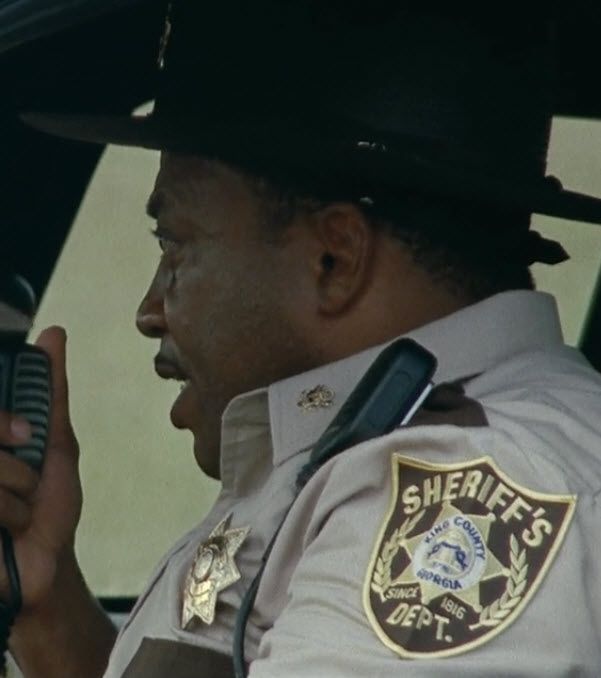
UPDATE (5 April, 2013) - Something I should have added, if only to be absurdly completist, is the info on Lori's pregnancy--yet another hole in the timeline. This is something I detailed, back when the matter was current, over on the IMDb's "Walking Dead" board, and I was reminded of it today. In "Cherokee Rose," Lori has Glenn acquire a pregnancy test for her from a drugstore, she uses it, and it comes back positive. Godawful baby-daddy melodrama ensues. At the time Lori used this test, it had only been 8 days since her first post-coma sex with Rick and 9-10 days, at the absolute most, since her first sex with Shane, which, of course, makes her positive from an over-the-counter urine pregnancy test impossible (despite inflated manufacturer's claims to the contrary, such a test will only yield reliable results after more than 2 weeks).
---
APPENDIX:
Those who think the timeline is longer than it actually is often come to that conclusion because they try to apply to the question the logic the writers failed to apply. In arguing for a longer timeline, it's often mentioned that it's impossible for Carl to have recovered from his horrendous gunshot wound in only a little over two days. That's true, of course, but on TWD, that's exactly how much time it took for him to recover. Since I run into this so often, I thought I'd put together a little appendix documenting the timeline with regard to Carl's recovery.
In the season opener, Carl is shot, on the second day of the search for Sophia; in episode 2, Rick takes him to Hershel, they need med supplies, they dispatch Shane and Otis to the school; Shane returns with supplies, Hershel operates--all of this happens in a matter of a few hours, and takes us to the end of episode 3.
Episode 4 begins the next morning, as the rest of the group comes to Hershel's farm. They immediately inquire about what exactly happened with Carl (who first wakes up from surgery, his fever having finally broken); Rick fills them in on the details of what happened, and they hold a little memorial to Otis in the yard; Maggie pulls out a county survey map, and they start the search for Sophia again--when Hershel asks how long she's been missing, Rick tells him this is the third day. Hershel vetoes Rick's participation in a search, because he's still too weak from giving blood to Carl. On the search, Daryl finds the old house, where it looks as if someone small has slept; Maggie and Glenn go to drug store, get pregnancy test, Lori uses it that night. That takes us to the end of episode 4.
Episode 5 begins the next morning. Lori is still brooding over pregnancy test. Carol offers to cook dinner for everyone that night. When they roll out the map for the day's search, the first item on the agenda is to follow up on Daryl's discovery of the old house. Shane announces he's going to begin firearms instruction the next day. In the course of the Sophia search, Daryl finds Sophia's doll; Andrea shoots him. At Carol's dinner, Glenn and Maggie pass notes, scheduling the hayloft rendezvous, when Glenn discovers zombies in the barn. That takes us to the end of episode 5.
Episode 6 begins the next morning, and Carl is up and around as if nothing had ever happened--feeding chickens. Glenn and Maggie have their first extended conversation about keeping the barn-zombies secret. Andrea apologizes to Daryl for shooting him the day before. When they roll out the map, the first item of the Sophia search is to follow up on Daryl's finding the doll. This is the day Shane begins target practice for the group--in ep. 5, he'd said it was starting the next day.
Carl was hit by a round from a big-caliber game rifle hard enough that it broke into six pieces, and was so near death Hershel was prepared to operate on him without the necessary equipment (a surgery he wouldn't have survived), yet he fully recovered in a little over 2 days, and suffered no further ill-effects.
[Cross-posted to my comic blog]
Monday, March 19, 2012
Beside The Dying Fire, THE WALKING DEAD Leaves Viewers Cold
When it comes to television, series season debuts and enders typically draw a much bigger audience than the regular season episodes and the knowledge that many more eyes are upon them during these crucial installments inspire those who toil in the business to bring their A game to them. Can't exactly say it's a surprise but the big, much-hyped season finale of THE WALKING DEAD tonight turned out to be a big bust, its creators' A game distinctly third string. "Beside the Dying Fire" was painfully awful, an embarrassing compendium of everything that has been so very wrong about the series this season.
The pre-credit sequence shows a zombie herd forming over an extended period, marching along, growing as it goes and finally, as it reaches the fence around the Greene farm, it's roughly the size of Napoleon's army. The horde leans against the fence until it collapses and the dastardly ghouls are on the property.
This happened at some point during the day, the day we were shown in last week's episode and that fact, introduced only a few seconds in, already makes the episode extremely problematic. As I've documented at some length here, TWD's writers have proven themselves abjectly incapable of crafting a story featuring a series of events that happen in a set timeline. One has to look to daytime soaps (their model for this season) to find a worse example of allegedly professional episodic television that so openly and blatantly disregards this most basic element of competent narrative construction. Last week, I wrote:
"Hershel's farm has, throughout the season, seemed to feature some sort of magical zombie repellent. Even as two groups of our heroes prowled the forests on the property in different places and for an extended period in search of Randall, they didn't encounter a single zombie except that of Randall himself (reanimated after Shane killed him). But as the shot that dusts zombie Shane rings out, the forests on the farm are suddenly absolutely thick with walkers, perhaps having freshly teleported to the scene, and they all immediately begin to converge on the source of the gun-shot, setting up a big showdown with the dead just in time for the season finale."
With the pre-credit sequence tonight, it's established that a herd of hundreds of walkers was on that property during all that searching. They converged on the farm tonight from every direction, appearing everywhere.
That timeline problem ran smack-dab into another one tonight. We don't know exactly how long the search for Randall continued but it was still daylight when it started and dark at the end. The longer it's said to continue though, the more thorough it becomes and the more ludicrous it is that none of the searchers encountered any zombies. If, on the other hand, it didn't continue for very long after dark, tonight's installment introduced a new problem. The farm is completely overrun. We follow every minute of the action; by the end of it, our heroes are forced to take to their vehicles and flee. They drive all night (in different directions) and at some point the next day, they all end up back at the traffic snarl they encountered at the beginning of this season. The traffic snarl that was established in the second episode as being only 2 miles from the farm.[*] They drove like bats out of hell all night and came to a place that, even at a slow speed, was about two minutes away. How long was that night? There's no answer that doesn't amount to an insult to every viewer of TWD and it's an insult this series offers on a regular basis.
The overrunning of the farm highlighted how bad the writing has been. TWD is supposed to be an ongoing tale of survival horror but for much of this season the writers have, instead--and stop me, if you've heard this one from me before--wallowed in retread soap storylines, while the zombie apocalypse has been relegated to a very distant concern indeed. In "18 Miles Out," Rick suggested they should start using their knives rather than guns to kill zombies. Logically, the group should have been using melee weapons all along, just as in the comics. Such weapons are quiet, effective and never run out of ammo, but Rick's suggestion with regard to knives was the first--and only--time the matter had even been raised in conversation, a full 10 episodes into the 2nd season of the series.[1] Heaven forbid the characters should ever be made to spend any time on dull things like surviving their situation--it would take away from the running-time spent wallowing in love triangle melodrama, baby-daddy melodrama and so on. And why should they be concerned about it anyway when they seem to have a magic zombie-repelling farm and the Ammo Fairy to keep them in bullets?[2] They don't have to worry their little heads about such things until or unless the writers decide to take a break from questioning Rick's worthiness as a father or Lori's essays on how women should stay barefoot and pregnant in the kitchen. Tonight it became an issue. A full-scale zombie invasion of the farm caught them totally unprepared. They had no warning system, no Plan A, no back-up plan, no escape route, no rendezvous point and the only reason the walkers had been on the property undetected in the first place was that they weren't making a practice of patrolling the grounds. In the course of the episode, one of the vehicles ran out of gas; they didn't have any extra (in the previous episode, they'd let the RV sit for so long it wouldn't start). The scenario served to highlight how very far the writing this season has departed from what should be its primary focus.
Without a plan, they initially decided to jump in their vehicles, kill as many zombies as they can then try to lure the rest of the herd away from the farm. A fight against such overwhelming numbers is nothing but a waste of what should be precious ammo so why not skip that and just try to lure them away in the first place? For that matter, all our heroes really had to do was just drive away for a few hours and wait until the herd passed but that would preclude a big, loud Last Stand battle over the farm for the season ender, so, as usual, all of the characters, to serve a metatextual need, get stupid. There was a lot of driving and yelling and shooting and assorted mayhem. To make this possible, the creators of the series took away the increased abilities they've been granting the dead of late, making them once again a slow-shuffling Romeroesque horde, as zombies should be. Jimmy and Patricia, the designated red-shirt non-characters, became Zombie Chow.[3] In the end, everyone fled.[4]
While nearly everything else about TWD remains mired in the poor house of creative bankruptcy, the cinematography at least continues to improve. There were two particularly impressive shots tonight of zombies framed by the barn as it went up in flames (after Rick set it on fire), another visual indicator of the remarkable potential this series had if it had been in more competent hands.
The main action over, the episode devolved into the usual wretched melodrama.
It wouldn't be TWD without mind-numbing repetition, so the different groups that have fled each have a variation on exactly the same cliché'd conversation. Did anyone else make it out? Do we go back for them? Do we leave them? Lots of over-the-top agonizing, determination to find loved ones, long faces.
Hershel, Rick, and Carl flee together and, stopping at the traffic snarl the next day, Hershel is ready to write off the others and tells Rick he should take Carl and leave. Rick snaps at him "You're a man of God--have some faith." With a straight face and in total earnest, Hershel replies:
"Christ promised a resurrection of the dead. I just thought he had something... a little different in mind."
...which probably topples "he talked about the deer" as the best unintentionally hilarious line of this badly-written season.
So the writers could stage a Big Emotional Reunion scene, all of the scattered characters independently decide to go to the traffic snarl and after having them apparently drive all night at high speeds in different directions, the writers decide not to belabor their plight by writing a credible scenario and have them all just coincidentally turn up there at the same time.
The writers' traditional contempt for women kicks in. As usual, Lori gets the worst of it. Rick tells Lori what happened with Shane; how Shane killed Randall in order to lure him away, how Shane planned to kill him and how he ultimately had to kill Shane. Lori seems horrified then poised to throw up then her countenance becomes one of pure, merciless hatred and if looks could kill, Rick would have been one paid-for son of a bitch in that moment. This is her reaction a few episodes after she, herself, told Rick to kill Shane. Rick would have probably been much better off killing her.[5] Rick reveals to the group that, back at the CDC, Jenner told him everyone was infected with the zombie virus and will reanimate when they die. There follows a lot of contrived bitching and moaning about the fact that Rick never shared this information. The info doesn't change anything at all, of course, but how terrible of Rick to keep this from them! All of the women then suggest to their respective cliques that this means they should get the hell away from the others.
The characters prove they haven't learned a thing from what just happened[6] and set up camp in the open forest.[7] They hear a sound near them and almost panic but instead of checking it out, Rick seems to come unhinged and, waving his gun at everyone, makes a nasty "I am your king; bring me your gold" speech, ending by declaring to all present that, if they're staying, this "isn't a democracy anymore." Just call him Il Duce. Charming.
On IMDb's TWD message board this morning, I made a prediction:
"Tonight, the farm will be overrun and this will be greeted with great enthusiasm, merely because everyone--even the show's defenders, who pretend otherwise--is sick to death of it. The farm isn't really the problem, to be sure, but it is something people have come to strongly associate with the shortcomings that have comprised this very bad season. Because of this, if it's wiped out tonight--no matter how badly it may be done--I imagine everyone will cheer."
That remains to be seen, of course, but I'm guessing I've gotten it right and I'm also guessing that enthusiasm may make many more forgiving of this bad, bad episode.
I remain unconvinced.
--j
---
[*] UPDATE (23 Nov., 2012) - One of my obsessively nitpicking detractors on the IMDb's "Walking Dead" board challenged this some months ago. The distance isn't, in fact, as precisely established as what I'd written, there. When, in "Bloodletting," Maggie, on horseback, rides out to the larger group intent on fetching Lori, she gives directions about how to get to the farm from the traffic snarl. "Backtrack to Fairborn Road. Two miles down is our farm." While my detractor sought merely to muddy the waters regarding the traffic snarl being close to the farm as a means of accusing me of inaccuracy, it's clear the traffic snarl is, in fact, quite close to the farm. Carl was shot somewhere in the immediate area and when, earlier in the same episode, Rick is running to the farm with him, the portly Otis, who can't keep up, says the farm is half a mile in a particular direction. Upon coming to the farm, the larger group then spends the next several episodes mounting their search for Sophia from the farm. So while it wasn't strictly accurate to say the snarl was 2 miles from the farm, the snarl is clearly in the immediate vicinity of the farm and there's no basis for any case for it being any real distance from it and particularly not any case that it could be far enough to even remotely account for all those hours of driving. ADDENDUM (17 Jan., 2013) -- Carl, in this very episode, describes the farm as "a mile away" from the traffic snarl.
Yes, it's a silly nitpick and not really worth even addressing but my TWD articles have become fodder for such nitpicking and contrary to what said nitpickers suggest, I do like to keep things accurate, here.
[1] And Rick's suggestion that they use knives was stupid anyway. It's hard to jam a knife into a human head, particularly the head of a creature that is trying to bite you. Better weapons include hatchets, hammers, bats, spears and so on. Even swords would be preferable to a pocket knife.
[2] Tonight, the Ammo Fairy visited Hershel while he tried to make his last stand in front of his house--he stood his ground and heroically blasted away at the encroaching dead with his shotgun, repeatedly popping off several times the gun's capacity before ever reloading. Infinite ammo weapons have long been a common feature of movies and television, but this one was particularly blatant and emblematic of the carelessness that goes into the making of TWD. The sequence was very badly staged and edited in general. Hershel blasted advancing walkers over and over again yet they would be closer to him in earlier shots than they were in later ones and the zombies he'd already dropped would disappear from the later shots as well (he should have been waist-deep in them toward the end but when the action cut back to him at one point there were none on the ground until he started shooting again).
[3] Jimmy's end was particularly poorly handled--he drove the RV to the barn where Rick and Carl were trapped on the second level, they jumped on the roof and instead of just driving on as soon as his passengers were on board, he comes to a dead stop, gets out of his seat for no possible reason and is attacked and consumed by a gaggle of zombies that get in.
[4] And the idea of returning to the farm after the walkers leave is never discussed. They simply abandon all the supplies they left there and head on up the road.
[5] Even with Shane dead, ludicrously contrived Shane melodrama continues. Brack.
[6] Just as they failed to learn anything from the horrendous attack on their camp in the first season--even after that, they had the same minimal concern with safety and survival measures throughout this season.
[7] Another contrived drama. One of the vehicles ran out of gas and, of course, they were totally unprepared and carrying no extra. When it's suggested that some break off from the group and go fetch some, Rick vetoes the idea on the grounds that they shouldn't split up. Makes sense. The obvious solution is that everyone jump in the remaining vehicles--there's plenty of room--and go for gas together but because the writers want the characters to camp in the open that night and feel uneasy about it, this is never suggested.
[Cross-posted to my comics blog]
The pre-credit sequence shows a zombie herd forming over an extended period, marching along, growing as it goes and finally, as it reaches the fence around the Greene farm, it's roughly the size of Napoleon's army. The horde leans against the fence until it collapses and the dastardly ghouls are on the property.
This happened at some point during the day, the day we were shown in last week's episode and that fact, introduced only a few seconds in, already makes the episode extremely problematic. As I've documented at some length here, TWD's writers have proven themselves abjectly incapable of crafting a story featuring a series of events that happen in a set timeline. One has to look to daytime soaps (their model for this season) to find a worse example of allegedly professional episodic television that so openly and blatantly disregards this most basic element of competent narrative construction. Last week, I wrote:
"Hershel's farm has, throughout the season, seemed to feature some sort of magical zombie repellent. Even as two groups of our heroes prowled the forests on the property in different places and for an extended period in search of Randall, they didn't encounter a single zombie except that of Randall himself (reanimated after Shane killed him). But as the shot that dusts zombie Shane rings out, the forests on the farm are suddenly absolutely thick with walkers, perhaps having freshly teleported to the scene, and they all immediately begin to converge on the source of the gun-shot, setting up a big showdown with the dead just in time for the season finale."
With the pre-credit sequence tonight, it's established that a herd of hundreds of walkers was on that property during all that searching. They converged on the farm tonight from every direction, appearing everywhere.
That timeline problem ran smack-dab into another one tonight. We don't know exactly how long the search for Randall continued but it was still daylight when it started and dark at the end. The longer it's said to continue though, the more thorough it becomes and the more ludicrous it is that none of the searchers encountered any zombies. If, on the other hand, it didn't continue for very long after dark, tonight's installment introduced a new problem. The farm is completely overrun. We follow every minute of the action; by the end of it, our heroes are forced to take to their vehicles and flee. They drive all night (in different directions) and at some point the next day, they all end up back at the traffic snarl they encountered at the beginning of this season. The traffic snarl that was established in the second episode as being only 2 miles from the farm.[*] They drove like bats out of hell all night and came to a place that, even at a slow speed, was about two minutes away. How long was that night? There's no answer that doesn't amount to an insult to every viewer of TWD and it's an insult this series offers on a regular basis.
The overrunning of the farm highlighted how bad the writing has been. TWD is supposed to be an ongoing tale of survival horror but for much of this season the writers have, instead--and stop me, if you've heard this one from me before--wallowed in retread soap storylines, while the zombie apocalypse has been relegated to a very distant concern indeed. In "18 Miles Out," Rick suggested they should start using their knives rather than guns to kill zombies. Logically, the group should have been using melee weapons all along, just as in the comics. Such weapons are quiet, effective and never run out of ammo, but Rick's suggestion with regard to knives was the first--and only--time the matter had even been raised in conversation, a full 10 episodes into the 2nd season of the series.[1] Heaven forbid the characters should ever be made to spend any time on dull things like surviving their situation--it would take away from the running-time spent wallowing in love triangle melodrama, baby-daddy melodrama and so on. And why should they be concerned about it anyway when they seem to have a magic zombie-repelling farm and the Ammo Fairy to keep them in bullets?[2] They don't have to worry their little heads about such things until or unless the writers decide to take a break from questioning Rick's worthiness as a father or Lori's essays on how women should stay barefoot and pregnant in the kitchen. Tonight it became an issue. A full-scale zombie invasion of the farm caught them totally unprepared. They had no warning system, no Plan A, no back-up plan, no escape route, no rendezvous point and the only reason the walkers had been on the property undetected in the first place was that they weren't making a practice of patrolling the grounds. In the course of the episode, one of the vehicles ran out of gas; they didn't have any extra (in the previous episode, they'd let the RV sit for so long it wouldn't start). The scenario served to highlight how very far the writing this season has departed from what should be its primary focus.
Without a plan, they initially decided to jump in their vehicles, kill as many zombies as they can then try to lure the rest of the herd away from the farm. A fight against such overwhelming numbers is nothing but a waste of what should be precious ammo so why not skip that and just try to lure them away in the first place? For that matter, all our heroes really had to do was just drive away for a few hours and wait until the herd passed but that would preclude a big, loud Last Stand battle over the farm for the season ender, so, as usual, all of the characters, to serve a metatextual need, get stupid. There was a lot of driving and yelling and shooting and assorted mayhem. To make this possible, the creators of the series took away the increased abilities they've been granting the dead of late, making them once again a slow-shuffling Romeroesque horde, as zombies should be. Jimmy and Patricia, the designated red-shirt non-characters, became Zombie Chow.[3] In the end, everyone fled.[4]
While nearly everything else about TWD remains mired in the poor house of creative bankruptcy, the cinematography at least continues to improve. There were two particularly impressive shots tonight of zombies framed by the barn as it went up in flames (after Rick set it on fire), another visual indicator of the remarkable potential this series had if it had been in more competent hands.
The main action over, the episode devolved into the usual wretched melodrama.
It wouldn't be TWD without mind-numbing repetition, so the different groups that have fled each have a variation on exactly the same cliché'd conversation. Did anyone else make it out? Do we go back for them? Do we leave them? Lots of over-the-top agonizing, determination to find loved ones, long faces.
Hershel, Rick, and Carl flee together and, stopping at the traffic snarl the next day, Hershel is ready to write off the others and tells Rick he should take Carl and leave. Rick snaps at him "You're a man of God--have some faith." With a straight face and in total earnest, Hershel replies:
"Christ promised a resurrection of the dead. I just thought he had something... a little different in mind."
...which probably topples "he talked about the deer" as the best unintentionally hilarious line of this badly-written season.
So the writers could stage a Big Emotional Reunion scene, all of the scattered characters independently decide to go to the traffic snarl and after having them apparently drive all night at high speeds in different directions, the writers decide not to belabor their plight by writing a credible scenario and have them all just coincidentally turn up there at the same time.
The writers' traditional contempt for women kicks in. As usual, Lori gets the worst of it. Rick tells Lori what happened with Shane; how Shane killed Randall in order to lure him away, how Shane planned to kill him and how he ultimately had to kill Shane. Lori seems horrified then poised to throw up then her countenance becomes one of pure, merciless hatred and if looks could kill, Rick would have been one paid-for son of a bitch in that moment. This is her reaction a few episodes after she, herself, told Rick to kill Shane. Rick would have probably been much better off killing her.[5] Rick reveals to the group that, back at the CDC, Jenner told him everyone was infected with the zombie virus and will reanimate when they die. There follows a lot of contrived bitching and moaning about the fact that Rick never shared this information. The info doesn't change anything at all, of course, but how terrible of Rick to keep this from them! All of the women then suggest to their respective cliques that this means they should get the hell away from the others.
The characters prove they haven't learned a thing from what just happened[6] and set up camp in the open forest.[7] They hear a sound near them and almost panic but instead of checking it out, Rick seems to come unhinged and, waving his gun at everyone, makes a nasty "I am your king; bring me your gold" speech, ending by declaring to all present that, if they're staying, this "isn't a democracy anymore." Just call him Il Duce. Charming.
On IMDb's TWD message board this morning, I made a prediction:
"Tonight, the farm will be overrun and this will be greeted with great enthusiasm, merely because everyone--even the show's defenders, who pretend otherwise--is sick to death of it. The farm isn't really the problem, to be sure, but it is something people have come to strongly associate with the shortcomings that have comprised this very bad season. Because of this, if it's wiped out tonight--no matter how badly it may be done--I imagine everyone will cheer."
That remains to be seen, of course, but I'm guessing I've gotten it right and I'm also guessing that enthusiasm may make many more forgiving of this bad, bad episode.
I remain unconvinced.
--j
---
[*] UPDATE (23 Nov., 2012) - One of my obsessively nitpicking detractors on the IMDb's "Walking Dead" board challenged this some months ago. The distance isn't, in fact, as precisely established as what I'd written, there. When, in "Bloodletting," Maggie, on horseback, rides out to the larger group intent on fetching Lori, she gives directions about how to get to the farm from the traffic snarl. "Backtrack to Fairborn Road. Two miles down is our farm." While my detractor sought merely to muddy the waters regarding the traffic snarl being close to the farm as a means of accusing me of inaccuracy, it's clear the traffic snarl is, in fact, quite close to the farm. Carl was shot somewhere in the immediate area and when, earlier in the same episode, Rick is running to the farm with him, the portly Otis, who can't keep up, says the farm is half a mile in a particular direction. Upon coming to the farm, the larger group then spends the next several episodes mounting their search for Sophia from the farm. So while it wasn't strictly accurate to say the snarl was 2 miles from the farm, the snarl is clearly in the immediate vicinity of the farm and there's no basis for any case for it being any real distance from it and particularly not any case that it could be far enough to even remotely account for all those hours of driving. ADDENDUM (17 Jan., 2013) -- Carl, in this very episode, describes the farm as "a mile away" from the traffic snarl.
Yes, it's a silly nitpick and not really worth even addressing but my TWD articles have become fodder for such nitpicking and contrary to what said nitpickers suggest, I do like to keep things accurate, here.
[1] And Rick's suggestion that they use knives was stupid anyway. It's hard to jam a knife into a human head, particularly the head of a creature that is trying to bite you. Better weapons include hatchets, hammers, bats, spears and so on. Even swords would be preferable to a pocket knife.
[2] Tonight, the Ammo Fairy visited Hershel while he tried to make his last stand in front of his house--he stood his ground and heroically blasted away at the encroaching dead with his shotgun, repeatedly popping off several times the gun's capacity before ever reloading. Infinite ammo weapons have long been a common feature of movies and television, but this one was particularly blatant and emblematic of the carelessness that goes into the making of TWD. The sequence was very badly staged and edited in general. Hershel blasted advancing walkers over and over again yet they would be closer to him in earlier shots than they were in later ones and the zombies he'd already dropped would disappear from the later shots as well (he should have been waist-deep in them toward the end but when the action cut back to him at one point there were none on the ground until he started shooting again).
[3] Jimmy's end was particularly poorly handled--he drove the RV to the barn where Rick and Carl were trapped on the second level, they jumped on the roof and instead of just driving on as soon as his passengers were on board, he comes to a dead stop, gets out of his seat for no possible reason and is attacked and consumed by a gaggle of zombies that get in.
[4] And the idea of returning to the farm after the walkers leave is never discussed. They simply abandon all the supplies they left there and head on up the road.
[5] Even with Shane dead, ludicrously contrived Shane melodrama continues. Brack.
[6] Just as they failed to learn anything from the horrendous attack on their camp in the first season--even after that, they had the same minimal concern with safety and survival measures throughout this season.
[7] Another contrived drama. One of the vehicles ran out of gas and, of course, they were totally unprepared and carrying no extra. When it's suggested that some break off from the group and go fetch some, Rick vetoes the idea on the grounds that they shouldn't split up. Makes sense. The obvious solution is that everyone jump in the remaining vehicles--there's plenty of room--and go for gas together but because the writers want the characters to camp in the open that night and feel uneasy about it, this is never suggested.
[Cross-posted to my comics blog]
Subscribe to:
Posts (Atom)