This week on TWD, showrunner Glen Mazzara's "throw zombies at the problem" approach to addressing the series' many shortcomings continues to yield less dull but still problematic results. Mazzara and his team have injected a bit of excitement into a series that desperately needed it. Unfortunately, the series continues to be plagued by many of the same problems that have made this season such a chore, and that usually prevent it from rising above merely risible.
In any series of this sort, there needs to be a workable balance between moments of action and tension and moments of character drama. Ideally, the two operate hand-in-glove with one another, and are inseparable. They've never worked together on this season of TWD. For much of this season, the writers simply removed the action-and-tension stuff altogether. At the same time, what they've pawned off as "character drama" is a string of putrid soap storylines, all of which are dependent on every character being written like an utter moron. These are completely uninteresting, built of mind-numbingly repetitive scenes, and actively insult the viewers' intelligence at every turn. They were creatively bankrupt at birth, and as they've been allowed to consume--and waste--much of this season, they've been run into the ground deeper than David Innis's iron mole. When TWD throws some action its viewers' way, it can be entertaining, but it has absolutely nothing to fall back on.
Only three episodes this season have featured extended action sequences--"Save the Last One," last week's "Triggerfinger," and this week's "18 Miles Out"--and all three also illustrate this problem.
"Save The Last One" featured Shane and the ill-fated Otis on a critical mission to fetch medical supplies needed to save Carl's life, and struggling to, themselves, survive in a chase through a pitch-dark high school campus swarming with zombies. It should have been a great, suspenseful, race-against-time story, emphasizing the hopelessness of their plight leading up to Shane's murder of Otis. Instead, the writers bled every ounce of tension out of this scenario by constantly cutting away to dull soap melodrama back on the farm.
The first 20 or so minutes of last week's "Triggerfinger" was quite exciting by TWD standards, but at the mid-point, the writers left the action on a cliffhanger they never resolved, and returned to their dull soap melodrama, bringing the episode--and anything interesting about it--to a dead halt.
With "18 Miles Out," the creators are cross-cutting again, following, on the one hand, a suspenseful Rick/Shane story, and, on the other, another dull, pointless, horrendously written soap storyline back at the farm, this one regarding Beth and her sudden desire to kill herself.
Last week, Rick rescued Randall, a member of a band of marauders who had been left for dead by his comrades with his leg impaled on a fence. Hershel stitched up the fellow's leg, and the plan, this episode, is to take him out to the middle of nowhere and dump him. As the story opens, Rick and Shane are on their way to do that very thing. Rick pulls over and tries to lay down some law to Shane regarding the situation with Lori and Carl. My wife, my son, he tells Shane, and says he'd do anything to keep them safe. It isn't a bad scene, in itself. It threatens to bring on a headache only because this "storyline" has been done absolutely to death by this point.
The two seem to have achieved some sort of understanding, but it falls apart shortly after. In an absurdly contrived twist, Randall reveals, at the last minute, he went to school with Maggie. He knows Hershel, and, unfortunately for him, this also means he knows where the farm is located. The point of dumping him, of course, was that he didn't know, and if he found his way back to the hostile group from which he came, he wouldn't be able to tell them.
Randall has been on the farm for a week, at this point. In the previous episode, Hershel said it would take about a week for him to be up and abouts, and at the beginning of this one, Rick tells Shane he's been "waiting a week" to dump Randall. The writers apparently had Hershel use the same Veterinarian's Magic Healing Potion on Randall as they'd earlier had him use on Carl--Randall's wound was horrendous, and should have taken a very long time to heal, if it ever healed at all, but after a week, he's able to get around with no more than a minor limp, and even breaks the arm of a zombie with the bad leg. Randall is very cooperative, professes to have no allegiance to the marauders who left him for dead, and the fact that his last-minute revelation about having gone to school with Maggie is a revelation suggests they haven't even bothered to question him in all the time he's been at the farm. Questions like, how many are there in the group from which he came? How well armed are they? These aren't just obvious questions; they're ones that would have certainly been asked and, given Randall's cooperativeness, answered. But not on TWD.
Now, Rick and Shane get into it over what to do about him. Rick wants to take the guy back to the farm and figure out what to do with him; Shane wants to immediately liquidate him. It leads to accusations, by Shane, that Rick is placing Lori and Carl in danger via his preferred course of action, and that leads to a fist-fight, which leads to a whole lotta' zombies turning up looking for dinner, which sets everyone to fleeing for their lives.
The zombies move really fast in this episode. They're agile. Some of them even do the equivalent of gymnastics. Like everything else on TWD, these are things that always vary based upon the needs of the plot at the moment.[1] Shane, down to his knife, holes up in a bus, where he wrestles to keep the front folding door closed against the zombie onslaught--the creatures are suddenly strong enough to carry out a credible onslaught against a guy trying to hold a bus door shut (something living people would only be able to do with great difficulty).[2] There is, of course, the emergency exit in the back of the bus. It's the first thing that pops into every viewers' mind--every viewer that has a mind, anyway--and Shane could go out it at any time, and escape the entire herd, but the writers decided it would be more dramatic if he stayed there, wrestling for control over that folding door, until Rick and Randall--the fellow Shane wanted to murder--show up to save him. By having him go out the emergency exit in the back.
Where would TWD be this season without repetition? Rick gives Shane exactly the same extended speech he did at the beginning of the episode. Will it take this time? No. The preview for next week's episode makes it clear Shane has achieved no enlightenment on the matter. When they take Randall back to the farm, they bind him with a hood over his eyes, which they'd previously done to try to conceal the location of the farm, but which doesn't make much sense by the end of the episode, because it's already been established that he probably knows where the farm is anyway.
That's the "A" plot this week.[3]
Intercut with this throughout the episode is a "storyline" back on the farm. Beth has been so isolated from the zombie apocalypse that she bought into her father's insane notion that zombies were merely sick people, yet now, she's so distraught about the fact that there's a zombie apocalypse and that she could die horribly in it that she just wants to do herself in before that can happen. So much so that she totally brushes aside, as insignificant in comparison to this, her lover and family. All of this angst is, once again, offered in a house in the midst of beautiful rural farm country where she has all the luxuries of civilization, and there are no zombies in sight.
The series' usual contempt for the women is front-and-center in these scenes. Beth had kept a knife from her dinner tray with which to slit her wrists. Lori had talked her out of it and had taken the knife back to the kitchen. Andrea jumped down Lori's throat over this, saying suicide was Beth's decision, and that Lori should let Beth make it. Lori countered by complaining that the newly "liberated" Andrea was now doing men's work, when a woman's place should be in the home, making it a fit place to live. Andrea went to see Beth and offered up a few words that veered perilously close to encouraging her to kill herself, if that's what she wanted. And then left her! Such charming creatures are the women of TWD!
This entire Beth "storyline" was, of course, like a stone around the neck of the more exciting Rick/Shane portion of the episode, repeatedly bringing everything to a jarring halt. TWD can be entertaining when it features action, but it can't feature action all the time, or even most of the time. It needs solid writing to hold it up in the moments when there isn't mayhem on the screen. It just doesn't have it in its present creative team.
All of that said, though, the final image of "18 Miles Out" was actually quite striking, a reprise of one glimpsed earlier in the episode. Shane looks out the window of the vehicle, as he and Rick are returning to the farm, and glimpses a lone zombie at a distance, slowly moving through a field adjoining the road. It's a simple moment, haunting in its simplicity. When I mentioned it on the IMDb Walking Dead board, poster HelenBackAgain wrote of it:
"This one great, artistic image, all alone within this cheesy, stupid episode that added absolutely nothing in terms of story. There are within the episode no others like it; it stands apart, a monument and a martyr to the lost possibility of greatness."
Couldn't have said it better myself, and, in fact, didn't.
--j.
---
[1] One of them was a lot smarter, too--when Rick points his gun at it, the creature actually pushes it away to save itself!
[2] Zombies suddenly become vampiric and go after blood in this episode, instead of living people. Rick and Shane decide to use their knives to kill zombies when they're able to do so. Their mere presence, however, isn't enough to attract a pair of walkers they come across inside a fence--to bring the critters in, they have to cut their hands so there is visible blood. When the zombies get close, they then drive a knife into the creatures' skulls, causing zombie-infected grue to spew all over the cuts they've opened in themselves. Smart move, guys. So smart that Shane, when he's holed up in that bus, pulls the same trick several times.
[3] And this "A" plot threw zombies at TWD's problems without advancing the story even an inch. At the end, the Randall situation remains unresolved, stuck at exactly the same point it was at the beginning, and, as the preview for next week makes plain, Rick and Shane failed to come to any resolution of their conflict. One could not only entirely skip this episode without missing a thing; doing so would probably improve the overall series. In the preview for the next ep, it looks as if they're finally interrogating Randall about that group of armed hostiles of which he was a part. It's not credible that they wouldn't have already done this (it is, in fact, ludicrous). Skipping this ep would make that big, gaping hole go away.
[Cross-posted to my comics blog]
Sunday, February 26, 2012


Friday, February 24, 2012
A Few Words in Memory of Lina Romay
 A few years ago, it was announced that filmmaker Jesús Franco and his longtime muse, companion, and collaborator Lina Romay would be attending the Fantastic Fest in Austin. At the time, I'd been falling hopelessly in love with a woman who was almost as big a fan of this pair as I, and I suggested we trek to Texas on the appointed date and spend some time in the flesh with this remarkable couple to whose work we'd devoted so many hours of our lives. She thought it a grand idea.
The economic straits of an indie filmmaker and small businessman being what they are, I was never able to make the trip. The woman I wished to accompany me on it is someone I came to love more than I've ever loved anyone or anything in this world, and she became my own muse, in much the same way Romay was Franco's. She professed to love me and I doubt a more perfect couple could be assembled in a laboratory by all-knowing gods. And then she threw me away like an old newspaper. The sparsity of my contributions to this blog in the 15 months since mirrors the sparsity of my contribution to living in that same time--without hyperbole, it has been the worst 15 months of my life.
The aim of today's little blog entry, however, isn't to offer up boring personal details about which no one cares a whit. I start at this point because I was reminded of something today. When I suggested to my love we go to meet Jess and Lina, I didn't have to make much of a pitch. We were fans. Once, we'd even cooked up a movie idea that was a sort of homage to their work, particularly FEMALE VAMPIRE and its derivatives (it's a project I plan to eventually produce). I did offer that Jess wasn't getting any younger, didn't come to the U.S. very often and that this may be our last chance to see him. Maybe it was. Jess is still around though. The reason I'm reminded of those remarks today is that news has just arrived that Lina Romay isn't. All those cigarettes finally seem to have caught up with her. She has died of cancer on Feb. 15th, at far too young an age.
Hearing about it so late, I thought word of this must have had to cross the Atlantic by steamship but as it turns out, Jess simply hadn't announced it yet. Probably didn't feel up to doing so. There hasn't been any press attention, which isn't surprising. In the last 40 years, Lina appeared in over 100 movies but few, indeed, would ever be mistaken for mainstream fare. Jesús Franco made obscure, mini-budgeted exploitation pictures, usually well beneath the notice of the "mainstream" and, with few exceptions, Lina Romay made movies with Jesús Franco.
Lina was a striking beauty and a born exhibitionist, which made her a perfect subject for the camera of the obsessively voyeuristic Franco. He preserved her every millimeter in celluloid many times over. When it came to performance though, it wasn't all about getting naked. Not even close. Lina, as actress, was absolutely fearless and it wasn't the kind of "fearless" generously attributed to A-list actresses when they make films in which they cry a lot, bare their breasts to the undeserving masses for a moment, behave in an unladylike manner or play a part that could hurt their mega-box-office by alienating some little coterie of their infinity of fans. This was the real bravery of someone utterly committed to her craft, a woman uninhibited by absurd egotistical concerns who was willing to do just about anything, whatever a part required. She's mostly renowned--by those who go about renowneding such things--as an earthy sex goddess, and, indeed, her sexually charged performances could be breathtaking to behold but she was a much more versatile talent than this suggests. She appeared in a wide variety of films--horror movies, comedies, thrillers, prison movies, mysteries, spy pictures, hardcore sex pictures--and played a wide variety of roles in them--strong heroines, heartless villainesses, hapless innocents, sympathetic monsters--and she was, for the most part, damn good at whatever she did. Lina's early specialty was what may broadly be described as "sexual frenzy," but she developed quite a range as she went along. Tim Lucas, in his excellent obituary, comments on this:
"...Lina became a skilled actress under his [Franco's] tutelage, acquitting herself admirably not only as vampire women and nymphomaniacs, but in roles requiring the deft touch of a light comedienne. She could carry a film without dialogue; she could be funny, tragic, insanely desirable, shocking, even embarrassing in ways that left one admiring her bravery. On the two occasions when she ended a film by screaming--LORNA... THE EXORCIST (1974) and MACUMBA SEXUAL (1980)--she could chill the blood like no one else, on the strength of her performance alone."
Lina also sometimes wrote, she directed, and she starred in a handful of films by other directors. Her collaboration with Franco, which accounts for most of her filmography, has produced a body of work like nothing the cinema has ever seen or is likely to ever see again. A lot of people would say the latter was a good thing but fortunately for such simple souls, the only penalty they'll ever have to pay is to miss out on something that was often quite special, just as I did when I didn't make that trip to Austin. When on the screen, Lina could make you laugh, cry, cringe, shiver, hate her or fall in love with her. Which, in itself, can sort of make you fall in love with her if you appreciate such things. I do, and I did. And I will miss her.
--j.
Monday, February 20, 2012
WALKING DEAD Gives Viewers the "Triggerfinger"
Another week, another episode of THE WALKING DEAD, and here I am writing about it again. "Triggerfinger," this week's installment, instantly become the best TWD of this season, and by a wide margin. Rather than thinking this a turnaround for the series, one should bear that judgment in mind when reading the rest of this.
This was the best we've seen of TWD this season because of the first 20 minutes, which allegedly picks up immediately after the events of "Nebraska." Allegedly, because, once again, the writers have paid absolutely no attention to their own continuity. I'll get back to that in a moment, though.
First, the set-up: Lori, having survived the car wreck at the end of the writers' last effort to prove all women are just stupid bitches, struggles to survive zombies looking for road-kill, while, in town, Rick, Glenn, and Hershel are involved in a tense shootout and escape with a gaggle of thugs. Rick shot some no-accounts from Philly at the end of the last episode; their buddies turn up, looking for some payback. For 20 minutes, we get some pretty good drama, for television. By the standards of this season's TWD, it's great drama.
As the situation unfolds, the thugs are driven off by the combined efforts of our heroes and of hordes of zombies who appear in town,[1] but they leave, for dead, one of their own, a young fellow who took a leap off a building and ended up with his leg skewered by an iron fence-post. Our heroes don't want to shoot such a youthful specimen, but if they leave him, he'll be eaten by the encroaching corpses, so they struggle to free him as the hungry dead creep closer and closer.
It's a pretty good set-up, a pretty good scene, and more in line with the spirit of TWD than anything that has happened this season. They're trying to get that guy off the fence as the walkers are closing in. They're blasting away, but there's too many, a whole army of the dead within a few feet of them. They're nearly out of ammo. It seems hopeless. In a desperation move, Rick forcibly rips the guy's leg free, and we cut to a commercial. A great cliffhanger.
Can't wait to see what happens next? Too bad, because--believe it or not--the situation is resolved off camera. The show never returns to it.
Instead, it just returns to form. And the farm. The writers throw out the drag-weights, kill the momentum, bring everything to a halt, and spend most of the rest of the episode wallowing in the pointless, overwrought soap melodrama that has become TWD's trademark this season. Baby-daddy melodrama, love triangle melodrama, Maggie relating what hack writers mistake for a fond remembrance of an incident involving her now-ill sister[2]
In order to clear the slate for all of this rubbish, Rick, Glenn, and Hershel don't even return to the farm until the next day! That brings me to "Triggerfinger's" epic continuity snarl, another element that has become a TWD trademark.
Two episodes ago, it was morning on TWD. Lori was chopping carrots for lunch, Andrea and Daryl were waiting to start the day's search for Sophia, Rick and Hershel were herding zombies, and Shane pitched his little fit and freed the walkers in the barn. Last episode, we pick up at that same moment. Hershel goes to town to drink away his troubles, Beth falls ill, Rick and Glenn go to retrieve Hershel, Lori tells Andrea to watch Carl, goes to retrieve everyone, and crashes her car. A pair of thugs show up at the bar, and, after a brief conversation, draw on Rick, and he blasts them.[3] That's the precise moment at which "Triggerfinger" picks up, except it's now suddenly night outside, total darkness that only falls over a Georgia summer well after 9 p.m.[4]
Where did all that time go? Did Lori crack up her car and lie in it for several hours? That's plausible, but did Rick really shoot that last thug, then just stand there, in a raised-gun pose over him, for a few hours? That's where we rejoined Rick in this week's episode. Maybe he just wanted to make really, really sure the guy was dead before lowering his weapon, but that doesn't explain why Glenn and Hershel would stand there beside him also looking at the dead guy for all that time.
What it really means, of course, is that those behind TWD are once again showing the same lack of concern with keeping straight their continuity as the soaps on which they've patterned their series. Amusingly, someone in the writers' room didn't get the memo, and was still working from what had been established--when, back at the farm, Lori's disappearance is finally noted at dinner, Carl says the last time he saw her was "this afternoon." That fits with everything up to this week's installment, but can't be squared with anything else in "Triggerfinger."
So hours of daylight have just been made to disappear. Assuming that darkness had only just fallen--and we must, because it was bright daylight outside right up to the beginning of this episode--that means we've still got plenty of night left. The shootout with the gunmen happens in real time, without ellipses. After Rick frees the skewered thug, there are several pressing matters. Hershel had made it very clear the fellow speared by the fence would need immediate medical care. Back at the farm, Beth, Hershel's daughter, was also urgently in need of the medical attention only Hershel could provide. The rest of the characters at the farm needed to be immediately told there was an unknown number of armed hostiles in the area. Night had fallen, a time when it's extremely dangerous to be out in the open. Our heroes should have been looking to return to the farm immediately.
Our writers, on the other hand, are looking to wallow in the usual melodrama, so these pressing matters are simply pressed aside to that end. The characters in town disappear from the timeline as if kidnapped by UFOs, returning to the farm some time the next morning. As they drive up, it's well into the morning, too. The sun is high. Everyone is preparing to go look for them. They've somehow managed to turn what should have been a flight back to the farm of only a few minutes[5] into one that took 12 hours or more.[6]
In other news, it's the same old story. TWD's misogyny holds firm--the "empowered" Andrea aligned herself even more strongly with Shane this week. Mind-numbing repetition being the soul of TWD, the awful writing from the past was revisited: Dale again talked to Andrea about Shane, listened to her tell him Shane had done more to ensure the survival of the group than anyone, including Rick, and, yet again, he failed to tell her about what kind of man Shane really is. Beth continues to be seriously ill, having collapsed, last episode, after tussling with a zombie, and, again, no one thinks to check her for zombie-inflicted injuries or even voices any concern that she could be infected by the zombie bug. Glenn continues to have cold feet about Maggie for completely ridiculous reasons.[7] The usual story.
This episode had a very strong opening, but in the end, it continued the series' habit of giving the viewers a finger. The one proffered is not the "Triggerfinger."
--j.
---
[1] While, theoretically, it seems entirely appropriate to feature zombies in the midst of a zombie holocaust, the sudden appearance of the creatures, particularly in such large numbers, was a jarring change for TWD this season. We've seen parts of the town a few times, but we've only ever seen one zombie there (one that apparently magically teleported into the local drug-store). The town has been deserted. No damage. No trash in the street. No bodies. No indication that much of anything, like, say, the end of the world, has even happened.
[2] One that, in this case, goes absolutely nowhere, and seems inserted for no other purpose than establishing a Maggie/Andrea rapport as a way of setting up something later.
[3] During all of this, it was bright sunlight outside. They walked through it. You could see it through the windows. It was quite bright in the bar, with no electricity, lanterns, candles, or light of any kind. It was bright daylight when Lori wrecked her car.
[4] Later than that, in the early summer, but it's probably late summer on TWD now.
[5] UPDATE: In the episode in which Maggie and Glenn take the first of two very leisurely horseback rides into town and back, Maggie says it's about a mile up the road. Rick and co. are, of course, driving a truck.
[6] Upon arrival, they rush the injured boy, Randall, into surgery, though he should be dead or well beyond their ability to help, by that point (he's gone untreated for half a day).
[7] Glenn's behavior with regard to Maggie in the last two episodes is indicative of a few of the bad habits of the writers. Because they insist on rendering everything through the lens of overwrought soap melodrama, no relationship is allowed to just be a happy one; every one of them has to be made dysfunctional in some way. At the same time, the writers get so lost in their purloined soap opera "storylines" that they completely lose sight of the premise of the show and how it should affect the characters. Glenn has found a woman who, after he chased her for several episodes, loves him, and, instead of clinging to her, he's pushing her away because he's unsure about whether she could really be in love (his story in "Nebraska"), then because she gives him something for which to live (his story in "Triggerfinger"). Those may form some basis for friction in a relationship on some brainless daytime soap, but on TWD, the world has ended, and this behavior is absolutely ridiculous.
[Cross-posted to my comics blog]
This was the best we've seen of TWD this season because of the first 20 minutes, which allegedly picks up immediately after the events of "Nebraska." Allegedly, because, once again, the writers have paid absolutely no attention to their own continuity. I'll get back to that in a moment, though.
First, the set-up: Lori, having survived the car wreck at the end of the writers' last effort to prove all women are just stupid bitches, struggles to survive zombies looking for road-kill, while, in town, Rick, Glenn, and Hershel are involved in a tense shootout and escape with a gaggle of thugs. Rick shot some no-accounts from Philly at the end of the last episode; their buddies turn up, looking for some payback. For 20 minutes, we get some pretty good drama, for television. By the standards of this season's TWD, it's great drama.
As the situation unfolds, the thugs are driven off by the combined efforts of our heroes and of hordes of zombies who appear in town,[1] but they leave, for dead, one of their own, a young fellow who took a leap off a building and ended up with his leg skewered by an iron fence-post. Our heroes don't want to shoot such a youthful specimen, but if they leave him, he'll be eaten by the encroaching corpses, so they struggle to free him as the hungry dead creep closer and closer.
It's a pretty good set-up, a pretty good scene, and more in line with the spirit of TWD than anything that has happened this season. They're trying to get that guy off the fence as the walkers are closing in. They're blasting away, but there's too many, a whole army of the dead within a few feet of them. They're nearly out of ammo. It seems hopeless. In a desperation move, Rick forcibly rips the guy's leg free, and we cut to a commercial. A great cliffhanger.
Can't wait to see what happens next? Too bad, because--believe it or not--the situation is resolved off camera. The show never returns to it.
Instead, it just returns to form. And the farm. The writers throw out the drag-weights, kill the momentum, bring everything to a halt, and spend most of the rest of the episode wallowing in the pointless, overwrought soap melodrama that has become TWD's trademark this season. Baby-daddy melodrama, love triangle melodrama, Maggie relating what hack writers mistake for a fond remembrance of an incident involving her now-ill sister[2]
In order to clear the slate for all of this rubbish, Rick, Glenn, and Hershel don't even return to the farm until the next day! That brings me to "Triggerfinger's" epic continuity snarl, another element that has become a TWD trademark.
Two episodes ago, it was morning on TWD. Lori was chopping carrots for lunch, Andrea and Daryl were waiting to start the day's search for Sophia, Rick and Hershel were herding zombies, and Shane pitched his little fit and freed the walkers in the barn. Last episode, we pick up at that same moment. Hershel goes to town to drink away his troubles, Beth falls ill, Rick and Glenn go to retrieve Hershel, Lori tells Andrea to watch Carl, goes to retrieve everyone, and crashes her car. A pair of thugs show up at the bar, and, after a brief conversation, draw on Rick, and he blasts them.[3] That's the precise moment at which "Triggerfinger" picks up, except it's now suddenly night outside, total darkness that only falls over a Georgia summer well after 9 p.m.[4]
Where did all that time go? Did Lori crack up her car and lie in it for several hours? That's plausible, but did Rick really shoot that last thug, then just stand there, in a raised-gun pose over him, for a few hours? That's where we rejoined Rick in this week's episode. Maybe he just wanted to make really, really sure the guy was dead before lowering his weapon, but that doesn't explain why Glenn and Hershel would stand there beside him also looking at the dead guy for all that time.
What it really means, of course, is that those behind TWD are once again showing the same lack of concern with keeping straight their continuity as the soaps on which they've patterned their series. Amusingly, someone in the writers' room didn't get the memo, and was still working from what had been established--when, back at the farm, Lori's disappearance is finally noted at dinner, Carl says the last time he saw her was "this afternoon." That fits with everything up to this week's installment, but can't be squared with anything else in "Triggerfinger."
So hours of daylight have just been made to disappear. Assuming that darkness had only just fallen--and we must, because it was bright daylight outside right up to the beginning of this episode--that means we've still got plenty of night left. The shootout with the gunmen happens in real time, without ellipses. After Rick frees the skewered thug, there are several pressing matters. Hershel had made it very clear the fellow speared by the fence would need immediate medical care. Back at the farm, Beth, Hershel's daughter, was also urgently in need of the medical attention only Hershel could provide. The rest of the characters at the farm needed to be immediately told there was an unknown number of armed hostiles in the area. Night had fallen, a time when it's extremely dangerous to be out in the open. Our heroes should have been looking to return to the farm immediately.
Our writers, on the other hand, are looking to wallow in the usual melodrama, so these pressing matters are simply pressed aside to that end. The characters in town disappear from the timeline as if kidnapped by UFOs, returning to the farm some time the next morning. As they drive up, it's well into the morning, too. The sun is high. Everyone is preparing to go look for them. They've somehow managed to turn what should have been a flight back to the farm of only a few minutes[5] into one that took 12 hours or more.[6]
In other news, it's the same old story. TWD's misogyny holds firm--the "empowered" Andrea aligned herself even more strongly with Shane this week. Mind-numbing repetition being the soul of TWD, the awful writing from the past was revisited: Dale again talked to Andrea about Shane, listened to her tell him Shane had done more to ensure the survival of the group than anyone, including Rick, and, yet again, he failed to tell her about what kind of man Shane really is. Beth continues to be seriously ill, having collapsed, last episode, after tussling with a zombie, and, again, no one thinks to check her for zombie-inflicted injuries or even voices any concern that she could be infected by the zombie bug. Glenn continues to have cold feet about Maggie for completely ridiculous reasons.[7] The usual story.
This episode had a very strong opening, but in the end, it continued the series' habit of giving the viewers a finger. The one proffered is not the "Triggerfinger."
--j.
---
[1] While, theoretically, it seems entirely appropriate to feature zombies in the midst of a zombie holocaust, the sudden appearance of the creatures, particularly in such large numbers, was a jarring change for TWD this season. We've seen parts of the town a few times, but we've only ever seen one zombie there (one that apparently magically teleported into the local drug-store). The town has been deserted. No damage. No trash in the street. No bodies. No indication that much of anything, like, say, the end of the world, has even happened.
[2] One that, in this case, goes absolutely nowhere, and seems inserted for no other purpose than establishing a Maggie/Andrea rapport as a way of setting up something later.
[3] During all of this, it was bright sunlight outside. They walked through it. You could see it through the windows. It was quite bright in the bar, with no electricity, lanterns, candles, or light of any kind. It was bright daylight when Lori wrecked her car.
[4] Later than that, in the early summer, but it's probably late summer on TWD now.
[5] UPDATE: In the episode in which Maggie and Glenn take the first of two very leisurely horseback rides into town and back, Maggie says it's about a mile up the road. Rick and co. are, of course, driving a truck.
[6] Upon arrival, they rush the injured boy, Randall, into surgery, though he should be dead or well beyond their ability to help, by that point (he's gone untreated for half a day).
[7] Glenn's behavior with regard to Maggie in the last two episodes is indicative of a few of the bad habits of the writers. Because they insist on rendering everything through the lens of overwrought soap melodrama, no relationship is allowed to just be a happy one; every one of them has to be made dysfunctional in some way. At the same time, the writers get so lost in their purloined soap opera "storylines" that they completely lose sight of the premise of the show and how it should affect the characters. Glenn has found a woman who, after he chased her for several episodes, loves him, and, instead of clinging to her, he's pushing her away because he's unsure about whether she could really be in love (his story in "Nebraska"), then because she gives him something for which to live (his story in "Triggerfinger"). Those may form some basis for friction in a relationship on some brainless daytime soap, but on TWD, the world has ended, and this behavior is absolutely ridiculous.
[Cross-posted to my comics blog]
Thursday, February 16, 2012
Mr. WALKING DEAD & Ms. Ogyny
When my initial review of THE WALKING DEAD started running a bit long, I decided not to address some of the issues I had with the show. I reduced one--TWD's treatment of women--to a footnote, though I knew it merited much more prominent attention. After "Nebraska," this week's installment of the series, I'm compelled to finally pull it out of the basement, put it front and center and try to do it some little bit of justice.
I outlined the problem in my initial note:
The shooting of Daryl was the most dramatic example of this. The writers seem to know they'd done something pretty ugly there. What I take to be their efforts to soften it only succeeded in making it worse. Dale was present for the incident and had told Andrea not to pull the trigger. In the aftermath, the writers have him tell her she shouldn't be too hard on herself and joked that everyone had thought about shooting Daryl at some point. Even Daryl himself, who had been through a grueling day before she shot him and whose most prominent characteristic is his hot-headedness, wasn't upset at all. When she apologized to him, he tells her not to fret over it. "You were defending the group." Viewers had been shown Andrea had been dangerously irresponsible in the worst possible way yet the writers have no one on the show itself offer her a harsh word. Can't have a feminist empowerment narrative if the boys make much of a fuss, so the boys just shrug it off and that's meant to give us permission to do the same, while still knowing the boys were right all along.
The boys will just have to set her straight.
In the next episode, that's exactly what they set out to do, putting Andrea on a shooting range under the harsh instruction of Shane. She doesn't do well at all with a moving target or under pressure but, hey, she's just getting started. Unfortunately, her big Empowerment Moment comes only minutes later and involves those very things. While exploring an abandoned neighborhood, she and Shane are swarmed by zombies. In an effort to get her to rise to the occasion, Shane refuses to shoot several of the creatures and to keep herself out of danger Andrea becomes an instant crack-shot. In the world of TWD, this apparently isn't an actual skill but merely something that comes naturally when one finds one's inner Powerful Woman.
I suspect few viewers who had managed to withhold a groan or roll of the eyes at this absurd scene bothered to show such restraint with what came next. On the car-ride back to the farm, Andrea, all hot and bothered in her newly empowered state, grabs Shane's crotch and the two pull over, jump one another and get jiggy wit' it fo' a while.
That's the capper to Andrea's big Empowerment Moment--getting screwed by a homicidal sociopath and would-be rapist.
And it only gets worse.
Andrea aligns herself with Shane from that point forward. She even admits she idolizes him. Dale, who is rather sweet on her, is, of course, horrified by this development. Dale knows what kind of "man" Shane is, and while some would no doubt argue that Andrea's lack of knowledge of Shane's true character could preclude any harsh judgment of Andrea's actions, that misses the point when it comes to TWD's treatment of women. Whether the character knows what Shane is about, the writers know. They've shown it to their audience and they've chosen to have Andrea's "empowerment" consist of getting in bed--both figuratively and literally--with this loathsome creature, who, of course, cares about no one but himself. At the same time, Dale, who genuinely cares for Andrea, expresses his concerns about this[1] and the writers have her treat him as someone she finds frustrating and barely tolerable. Totally dismissive of what he says. She tells him he has to stop looking out for her. She's a big girl and can look after herself now.
Just look at the great job she's done of it so far.
None of this was developed at any sort of reasonable pace. On TWD, it never is. Andrea goes from being suicidally depressed and terrified to proficient, fearless zombie-killing Shane sidekick (and side-fuck) in less than four days story time. The only consistent element is that she is always made, by the writers, to come off looking badly.
The same is true of all the other female characters. The creators of TWD have made a big show of publicly acknowledging the criticism they've gotten for the very unfortunate first 7 episodes of this season. They promised they were trying to reform the series. Unfortunately, if this week's episode is any indication, they must have missed the criticism about their treating the women like this.
In "Nebraska," Lori bore the brunt of their assault, as is often the case. In my initial critque of TWD, I spent a lot of time on Lori. She's the most prominent female character and the one that, arguably, has been treated the worst. As I wrote then,
In the aftermath of the barn massacre, Hershel hightails it to a tavern in town to reacquaint himself with the bottle after decades on the wagon. After he's gone, Beth, who may have been injured by a zombie, collapses and falls into some sort of shock-like state. As Hershel is the only one with any medical training (and Beth's father), Rick and Glenn set out to retrieve him.
Lori, incredibly, objects to this. Carl, it seems, had just told her Rick was right to shoot the zombified Sophia, and though anyone of any conscience would have reached the same conclusion as the boy, the writers have Lori decide this means Carl is becoming too "cold" and needs his father around to combat this. Apparently can't even spare him for the few minutes it would take to drive into town and retrieve Hershel, the only one who may know how to treat Beth.[2]
Rick and Glenn go anyway.
Within minutes of their having left, Lori decides she simply must go into town herself to retrieve them! There's no reason for this, it makes absolutely no sense, it won't get anyone back to the farm any faster and could, in fact, delay their return, but immediately after heaping guilt on Rick for allegedly abandoning their son, she abandons their son to do this. And she goes alone, which the series had already established is a big no-no but it seems the writers of the series had some more negative caricatures of women they wanted to indulge and it seems that, when it comes to making women look bad, damn the torpedoes, this is THE WALKING DEAD!
To this point, the writers had already heaped idiocy upon idiocy but the real jaw-dropper came almost immediately upon Lori taking to the road. Instead of actually watching where she's going, Lori, like all women drivers in the minds of those who don't like women, is reading while driving. She isn't also applying lipstick but that's the only part the writers left out. Lori, of course, runs off the road at high speed, smashing the car, inflicting as-yet-unknown damage on herself and setting up whatever melodrama the writers wanted to set up by manufacturing this stupid, stupid situation.
TWD would rarely be mistaken for a smart show and never by anyone who was actually qualified to render the judgment. Its treatment of women seems to me something uglier than its other many shortcomings though. Much uglier.[3] Its turning TWD from something that could be regarded as a brainless pasttime into something toxic, something far less pardonable.
--j.
---
[1] Though, in typical TWD fashion, the writers don't have Dale tell Andrea any of the things he suspects about Shane. He just expresses his dismay that she would want to be like Shane, and lets her think it's just because he doesn't like Shane.
[2] A few episodes earlier, Lori had berated Shane for tinkering with the idea of abandoning the search for Sophia, angrily dismissing as an "excuse" his rationalization that his primary concern was for her and not for the others. The parallel scene in the current episode, wherein she's adopting the very view she had earlier denounced and holding to it to the extent that, just like Shane, she's entirely willing to allow harm to come to an innocent for her own selfish reasons, just underscores the idea that the point is, in both cases, merely to show her being bitchy.
[3] Perhaps the best defense against the charge that TWD treats women badly is that it treats everyone badly. It's true there are no well-written characters on the show--the overwrought soap melodrama approach its creators have adopted this season precludes it. The difference is that the fellows, who are sometimes made to look bad, are also shown to be lots of other things. Brave, loyal, perceptive, amusing, thoughtful, badass, sympathetic, lovable, even wise. The women are always made to look bad.
I outlined the problem in my initial note:
"The writing of the women on the show this season has drawn charges of misogyny and, in fact, every female character has been presented as a Clueless Male caricature's negative caricature of women. They're selfish, cartoonishly over-emotional, bitchy, stupid, whiny, totally uninteresting and totally unlikeable. They're generally treated like children then written in such a way that justifies that treatment."I left out several other traits TWD's writers impose upon the ladies--"completely irrational" immediately jumps to mind--but they all fall under that broad "negative caricature" heading. I outlined the case of Andrea. She tried to kill herself and the menfolk conspired to deny her a gun. Andrea bitched about this quite a bit. Finally, she gets her hands on a rifle, and
"draws down on what she takes to be a zombie approaching across a field. Her target is actually Daryl, one of the other survivors. She's facing into the sun at long range and can't even clearly see the target at which she's aiming. Another group of characters are between her and her target and could be hit if she fires blind. All the males tell her not to shoot but out to prove herself to the boys, she does it anyway and hits Daryl in the head, nearly killing him and confirming, in the most dramatic way possible the wisdom of the menfolk in having, earlier, parted her from firearms."In line with the writers' habit of re-re-rehashing cliché storylines from other sources, Andrea is, this season, being put through a Woman Who Refuses To Be A Victim Anymore storyline, a tale that was already well-worn in movies and television before most people reading these words today had even been born. This, of course, is a feminist empowerment narrative. Not the sort of thing one would normally expect from writers who seem to think so poorly of the fairer sex, and in fact their version of it looks exactly like one would expect a feminist empowerment narrative to look if written by people who are clueless about and contemptuous of women. It unintentionally plays like an ill-intentioned satire.
The shooting of Daryl was the most dramatic example of this. The writers seem to know they'd done something pretty ugly there. What I take to be their efforts to soften it only succeeded in making it worse. Dale was present for the incident and had told Andrea not to pull the trigger. In the aftermath, the writers have him tell her she shouldn't be too hard on herself and joked that everyone had thought about shooting Daryl at some point. Even Daryl himself, who had been through a grueling day before she shot him and whose most prominent characteristic is his hot-headedness, wasn't upset at all. When she apologized to him, he tells her not to fret over it. "You were defending the group." Viewers had been shown Andrea had been dangerously irresponsible in the worst possible way yet the writers have no one on the show itself offer her a harsh word. Can't have a feminist empowerment narrative if the boys make much of a fuss, so the boys just shrug it off and that's meant to give us permission to do the same, while still knowing the boys were right all along.
The boys will just have to set her straight.
In the next episode, that's exactly what they set out to do, putting Andrea on a shooting range under the harsh instruction of Shane. She doesn't do well at all with a moving target or under pressure but, hey, she's just getting started. Unfortunately, her big Empowerment Moment comes only minutes later and involves those very things. While exploring an abandoned neighborhood, she and Shane are swarmed by zombies. In an effort to get her to rise to the occasion, Shane refuses to shoot several of the creatures and to keep herself out of danger Andrea becomes an instant crack-shot. In the world of TWD, this apparently isn't an actual skill but merely something that comes naturally when one finds one's inner Powerful Woman.
I suspect few viewers who had managed to withhold a groan or roll of the eyes at this absurd scene bothered to show such restraint with what came next. On the car-ride back to the farm, Andrea, all hot and bothered in her newly empowered state, grabs Shane's crotch and the two pull over, jump one another and get jiggy wit' it fo' a while.
That's the capper to Andrea's big Empowerment Moment--getting screwed by a homicidal sociopath and would-be rapist.
And it only gets worse.
Andrea aligns herself with Shane from that point forward. She even admits she idolizes him. Dale, who is rather sweet on her, is, of course, horrified by this development. Dale knows what kind of "man" Shane is, and while some would no doubt argue that Andrea's lack of knowledge of Shane's true character could preclude any harsh judgment of Andrea's actions, that misses the point when it comes to TWD's treatment of women. Whether the character knows what Shane is about, the writers know. They've shown it to their audience and they've chosen to have Andrea's "empowerment" consist of getting in bed--both figuratively and literally--with this loathsome creature, who, of course, cares about no one but himself. At the same time, Dale, who genuinely cares for Andrea, expresses his concerns about this[1] and the writers have her treat him as someone she finds frustrating and barely tolerable. Totally dismissive of what he says. She tells him he has to stop looking out for her. She's a big girl and can look after herself now.
Just look at the great job she's done of it so far.
None of this was developed at any sort of reasonable pace. On TWD, it never is. Andrea goes from being suicidally depressed and terrified to proficient, fearless zombie-killing Shane sidekick (and side-fuck) in less than four days story time. The only consistent element is that she is always made, by the writers, to come off looking badly.
The same is true of all the other female characters. The creators of TWD have made a big show of publicly acknowledging the criticism they've gotten for the very unfortunate first 7 episodes of this season. They promised they were trying to reform the series. Unfortunately, if this week's episode is any indication, they must have missed the criticism about their treating the women like this.
In "Nebraska," Lori bore the brunt of their assault, as is often the case. In my initial critque of TWD, I spent a lot of time on Lori. She's the most prominent female character and the one that, arguably, has been treated the worst. As I wrote then,
"...in every scene the writers have ever given [Lori], they've gone out of their way to make her stupid, selfish, bitchy, totally unlikeable and totally unsympathetic... [S]he's never gotten a single scene or line of dialogue that gives us any reason at all to be on her side.."This week, the writers were at it again.
In the aftermath of the barn massacre, Hershel hightails it to a tavern in town to reacquaint himself with the bottle after decades on the wagon. After he's gone, Beth, who may have been injured by a zombie, collapses and falls into some sort of shock-like state. As Hershel is the only one with any medical training (and Beth's father), Rick and Glenn set out to retrieve him.
Lori, incredibly, objects to this. Carl, it seems, had just told her Rick was right to shoot the zombified Sophia, and though anyone of any conscience would have reached the same conclusion as the boy, the writers have Lori decide this means Carl is becoming too "cold" and needs his father around to combat this. Apparently can't even spare him for the few minutes it would take to drive into town and retrieve Hershel, the only one who may know how to treat Beth.[2]
Rick and Glenn go anyway.
Within minutes of their having left, Lori decides she simply must go into town herself to retrieve them! There's no reason for this, it makes absolutely no sense, it won't get anyone back to the farm any faster and could, in fact, delay their return, but immediately after heaping guilt on Rick for allegedly abandoning their son, she abandons their son to do this. And she goes alone, which the series had already established is a big no-no but it seems the writers of the series had some more negative caricatures of women they wanted to indulge and it seems that, when it comes to making women look bad, damn the torpedoes, this is THE WALKING DEAD!
To this point, the writers had already heaped idiocy upon idiocy but the real jaw-dropper came almost immediately upon Lori taking to the road. Instead of actually watching where she's going, Lori, like all women drivers in the minds of those who don't like women, is reading while driving. She isn't also applying lipstick but that's the only part the writers left out. Lori, of course, runs off the road at high speed, smashing the car, inflicting as-yet-unknown damage on herself and setting up whatever melodrama the writers wanted to set up by manufacturing this stupid, stupid situation.
TWD would rarely be mistaken for a smart show and never by anyone who was actually qualified to render the judgment. Its treatment of women seems to me something uglier than its other many shortcomings though. Much uglier.[3] Its turning TWD from something that could be regarded as a brainless pasttime into something toxic, something far less pardonable.
--j.
---
[1] Though, in typical TWD fashion, the writers don't have Dale tell Andrea any of the things he suspects about Shane. He just expresses his dismay that she would want to be like Shane, and lets her think it's just because he doesn't like Shane.
[2] A few episodes earlier, Lori had berated Shane for tinkering with the idea of abandoning the search for Sophia, angrily dismissing as an "excuse" his rationalization that his primary concern was for her and not for the others. The parallel scene in the current episode, wherein she's adopting the very view she had earlier denounced and holding to it to the extent that, just like Shane, she's entirely willing to allow harm to come to an innocent for her own selfish reasons, just underscores the idea that the point is, in both cases, merely to show her being bitchy.
[3] Perhaps the best defense against the charge that TWD treats women badly is that it treats everyone badly. It's true there are no well-written characters on the show--the overwrought soap melodrama approach its creators have adopted this season precludes it. The difference is that the fellows, who are sometimes made to look bad, are also shown to be lots of other things. Brave, loyal, perceptive, amusing, thoughtful, badass, sympathetic, lovable, even wise. The women are always made to look bad.
Tuesday, February 14, 2012
Talkin' The Talking In WALKING DEAD Blues
My semi-long critique of THE WALKING DEAD from last month seems to have found quite an audience. In only a few weeks, it has become the second-most hit-upon article on this site. Sunday, the series itself returned from its mid-season hiatus with "Nebraska," an episode that, though mostly unfortunate and plagued by all of the problems I had earlier identified, still managed to set a cable ratings record, drawing 8.1 million viewers.[see Update below] As I explained in my earlier piece, I have a friend who, deprived of AMC, visits and watches the show with me each week. He's a good fellow and I'm happy for the company but it means I end up watching the series every week, which I wouldn't do under my own steam. Since I am watching it, along with so many others, and since my critique of it is something that seems to interest people, I thought I'd continue. I don't know how often or how long I'll do so. I'll just play it by ear.
A note: My earlier article was heavy on exposition in an effort to make it accessible to those with minimal knowledge of the show. I don't know if that approach was effective or misguided but I think I'm going to dial back on it, go with a bit less structure and speak more to those who know the series. There seem to be enough of them.
The horrendous writing that has become TWD's trademark was on full display this week when Dale, the wise old man of the group, expressed his growing suspicions about Shane to Lori. The scene became something like a workshop on bad writing and authorial contempt for the audience.
Earlier in the season, Shane and Otis trekked to a zombie-infested school to retrieve medical supplies needed to save Carl, then dying from a gunshot wound to the midsection. In the course of the adventure, Shane panicked and, in an act of cowardice, shot Otis, crippling him so the pursuing zombie horde would stop to snack on him while Shane escaped. Shane, of course, lied about what happened. As he told the story, he and Otis were cut off at every turn and almost out of ammo. They were, in his words, "down to pistols" when it came to fighting the dead and Otis heroically volunteered to stay behind and cover Shane's escape. The hole: the only pistol Otis had was Rick's and Shane returned with both it (which he wrestled from Otis's hands after shooting him) and his own. This being TWD, no one in the group noticed this huge, gaping hole in Shane's story.[1]
No one, that is, except Dale. Dale is, as I wrote in my earlier piece, "a careful observer of people who often gets in everyone else's business because he's trying to head off potential conflicts before they balloon into problems that could endanger the groups' survival." A Wise Old Man character. He immediately recognized Shane's story as ridiculous and already had good reason to suspect Shane, as he once saw Shane poised to shoot Rick in the back and only his own fortunate appearance on the scene at that moment saved Rick's life. He knew why Shane would do such a thing as well, because he knew of Shane's affair with Rick's wife Lori.
Later, Dale would confront Shane with his suspicions about Otis. Rather than being upset or hurt or trying to set Dale straight, as one would expect from someone wrongly accused, Shane went into psycho mode, all but confirming he'd done something terrible and even threatening Dale's life.
When it came time, in this week's episode, for Dale to outline for Lori his case against Shane, the writers decided to leave out every substantive element of that case. Dale offered his suspicion that Shane may have killed Otis and Lori, shocked by this, wanted concrete evidence ("You need to be really clear with me right now!"). Dale didn't bother to mention the pistol thing, though that's physical evidence of Shane's lie. He didn't mention seeing Shane draw down on Rick, who, again, is Lori's husband. He tells Lori that, when he confronted Shane about these things, Shane all but confirmed his suspicions but he leaves out the fact that Shane's response also included threatening to kill him if he didn't leave the matter be. Lori's experience of nearly being raped by Shane is also very germane to this matter but it was left out, as well--Lori, in fact, defends Shane. Also forgotten was the fact that, only minutes earlier, they'd all seen Shane go on a total out-of-control rampage and release a barn full of zombies on them, recklessly endangering everyone. Dale is the observer who tries to head off trouble and though this is what led to his conversation with Lori in the first place, the writers, in that scene, have him leave the matter of Shane at little more than the fact that he has a bad feeling about the fellow and has known no-account people like that in the past, giving Lori no real reason to buy into it.[2]
As writing goes, a total fail.
Absolutely typical of TWD this season though.
Hershel Greene's family, to cite another example, has spent the entire zombie apocalypse believing the zombies are merely sick people rather than dead ones. Only on TWD could Hershel, a trained medical professional with, presumably, decades of experience, be said to be incapable of distinguishing a living creature from a dead one without anyone batting an eye. Still, Hershel is set up as delusional and delusion can be a powerful thing. Is it powerful enough that Hershel and his family can observe the creatures literally rotting away right before their eyes without ever questioning their deluded premise? They feed the zombies raw chickens--live ones. A most curious diet on which to put sick people (or people). Otis, who lived with Hershel, was, himself, an Emergency Medical Technician who apparently realized the creatures were dead (he showed no compunction against killing them) but humored Hershel. If he was a second opinion on the medical question--while Hershel repeatedly dispatched him to wrangle dangerous zombies into the barn--he clearly didn't make a dent in the Greene families' analysis.[3] Once our heroes arrive at the farm, they're similarly unable to convince any of Hershel's clan that they are dealing with the dead. We've followed this group as they've seen zombies take damage no living person could survive. They've even lopped the heads off zombies and the heads keep trying to bite them. Three days before arriving on Hershel's farm, they trekked to the CDC in Atlanta, where a scientist explained what was happening and even showed them video of a woman dying and of portions of her brain reactivating. Yet in multiple conversations on this subject with Hershel and his family--Dale with Hershel, Rick with Hershel, Glenn with Hershel's daughter Maggie--the writers fail to have any of them ever mention any of these things. Our heroes just say the dead are dead, the Greenes disagree and that's the end of the matter. That's what the mess that passes for a "plot" demanded. Hershel and co. only come to their senses when they see zombies horrendously wounded without dying. If you question why this would convince them, when seeing creatures bereft of any vital signs (many of them already horrendously wounded) rot away and "live" off live chickens didn't, you're probably too sharp for the writing staff of TWD.
Probably too sharp to be watching it, too.
--j.
[Cross-posted to my comic book blog]
---
[1] Unless one is to think the portly Otis opted to give up his gun and go hand-to-hand with the pursuing zombie horde.
[2] The writers did the same thing an episode earlier, when Dale was discussing Shane with Andrea.
[3] This is another example of the series' writers making a mess of a storyline from the comics by unnecessarily changing things. In the book, Hershel is no physician; he's just a regular farmer who has done amateur vet work on some of his animals in the past. Otis was just a dumb hick without any medical training. It wasn't clear that Hershel's children shared in his delusion, and that delusion didn't include the notion that the dead were merely sick--he acknowledged they were dead but wanted to believe there was some way to reverse the process, because his son had zombified. The impression offered is that, in his heart, he knows the truth, but refuses to admit it. In short, a much more credible scenario on every front.
UPDATE (20 Feb., 2012) -- This claim, that "Nebraska" drew record ratings, seems to have originated with AMC and been circulated far and wide. The original claim was that the episode had set a record for a scripted basic cable drama. Note the multiple caveats, there. In reality, MTV's wretched JERSEY SHORE had, only last year, drawn, with various episodes, 8.45 million, 8.6 million, and 8.9 million viewers. AMC's claim was based on the idea that JERSEYS SHORE, as a "reality show," isn't a scripted drama but, of course, the series is actually just as scripted as TWD.
A note: My earlier article was heavy on exposition in an effort to make it accessible to those with minimal knowledge of the show. I don't know if that approach was effective or misguided but I think I'm going to dial back on it, go with a bit less structure and speak more to those who know the series. There seem to be enough of them.
The horrendous writing that has become TWD's trademark was on full display this week when Dale, the wise old man of the group, expressed his growing suspicions about Shane to Lori. The scene became something like a workshop on bad writing and authorial contempt for the audience.
Earlier in the season, Shane and Otis trekked to a zombie-infested school to retrieve medical supplies needed to save Carl, then dying from a gunshot wound to the midsection. In the course of the adventure, Shane panicked and, in an act of cowardice, shot Otis, crippling him so the pursuing zombie horde would stop to snack on him while Shane escaped. Shane, of course, lied about what happened. As he told the story, he and Otis were cut off at every turn and almost out of ammo. They were, in his words, "down to pistols" when it came to fighting the dead and Otis heroically volunteered to stay behind and cover Shane's escape. The hole: the only pistol Otis had was Rick's and Shane returned with both it (which he wrestled from Otis's hands after shooting him) and his own. This being TWD, no one in the group noticed this huge, gaping hole in Shane's story.[1]
No one, that is, except Dale. Dale is, as I wrote in my earlier piece, "a careful observer of people who often gets in everyone else's business because he's trying to head off potential conflicts before they balloon into problems that could endanger the groups' survival." A Wise Old Man character. He immediately recognized Shane's story as ridiculous and already had good reason to suspect Shane, as he once saw Shane poised to shoot Rick in the back and only his own fortunate appearance on the scene at that moment saved Rick's life. He knew why Shane would do such a thing as well, because he knew of Shane's affair with Rick's wife Lori.
Later, Dale would confront Shane with his suspicions about Otis. Rather than being upset or hurt or trying to set Dale straight, as one would expect from someone wrongly accused, Shane went into psycho mode, all but confirming he'd done something terrible and even threatening Dale's life.
When it came time, in this week's episode, for Dale to outline for Lori his case against Shane, the writers decided to leave out every substantive element of that case. Dale offered his suspicion that Shane may have killed Otis and Lori, shocked by this, wanted concrete evidence ("You need to be really clear with me right now!"). Dale didn't bother to mention the pistol thing, though that's physical evidence of Shane's lie. He didn't mention seeing Shane draw down on Rick, who, again, is Lori's husband. He tells Lori that, when he confronted Shane about these things, Shane all but confirmed his suspicions but he leaves out the fact that Shane's response also included threatening to kill him if he didn't leave the matter be. Lori's experience of nearly being raped by Shane is also very germane to this matter but it was left out, as well--Lori, in fact, defends Shane. Also forgotten was the fact that, only minutes earlier, they'd all seen Shane go on a total out-of-control rampage and release a barn full of zombies on them, recklessly endangering everyone. Dale is the observer who tries to head off trouble and though this is what led to his conversation with Lori in the first place, the writers, in that scene, have him leave the matter of Shane at little more than the fact that he has a bad feeling about the fellow and has known no-account people like that in the past, giving Lori no real reason to buy into it.[2]
As writing goes, a total fail.
Absolutely typical of TWD this season though.
Hershel Greene's family, to cite another example, has spent the entire zombie apocalypse believing the zombies are merely sick people rather than dead ones. Only on TWD could Hershel, a trained medical professional with, presumably, decades of experience, be said to be incapable of distinguishing a living creature from a dead one without anyone batting an eye. Still, Hershel is set up as delusional and delusion can be a powerful thing. Is it powerful enough that Hershel and his family can observe the creatures literally rotting away right before their eyes without ever questioning their deluded premise? They feed the zombies raw chickens--live ones. A most curious diet on which to put sick people (or people). Otis, who lived with Hershel, was, himself, an Emergency Medical Technician who apparently realized the creatures were dead (he showed no compunction against killing them) but humored Hershel. If he was a second opinion on the medical question--while Hershel repeatedly dispatched him to wrangle dangerous zombies into the barn--he clearly didn't make a dent in the Greene families' analysis.[3] Once our heroes arrive at the farm, they're similarly unable to convince any of Hershel's clan that they are dealing with the dead. We've followed this group as they've seen zombies take damage no living person could survive. They've even lopped the heads off zombies and the heads keep trying to bite them. Three days before arriving on Hershel's farm, they trekked to the CDC in Atlanta, where a scientist explained what was happening and even showed them video of a woman dying and of portions of her brain reactivating. Yet in multiple conversations on this subject with Hershel and his family--Dale with Hershel, Rick with Hershel, Glenn with Hershel's daughter Maggie--the writers fail to have any of them ever mention any of these things. Our heroes just say the dead are dead, the Greenes disagree and that's the end of the matter. That's what the mess that passes for a "plot" demanded. Hershel and co. only come to their senses when they see zombies horrendously wounded without dying. If you question why this would convince them, when seeing creatures bereft of any vital signs (many of them already horrendously wounded) rot away and "live" off live chickens didn't, you're probably too sharp for the writing staff of TWD.
Probably too sharp to be watching it, too.
--j.
[Cross-posted to my comic book blog]
---
[1] Unless one is to think the portly Otis opted to give up his gun and go hand-to-hand with the pursuing zombie horde.
[2] The writers did the same thing an episode earlier, when Dale was discussing Shane with Andrea.
[3] This is another example of the series' writers making a mess of a storyline from the comics by unnecessarily changing things. In the book, Hershel is no physician; he's just a regular farmer who has done amateur vet work on some of his animals in the past. Otis was just a dumb hick without any medical training. It wasn't clear that Hershel's children shared in his delusion, and that delusion didn't include the notion that the dead were merely sick--he acknowledged they were dead but wanted to believe there was some way to reverse the process, because his son had zombified. The impression offered is that, in his heart, he knows the truth, but refuses to admit it. In short, a much more credible scenario on every front.
UPDATE (20 Feb., 2012) -- This claim, that "Nebraska" drew record ratings, seems to have originated with AMC and been circulated far and wide. The original claim was that the episode had set a record for a scripted basic cable drama. Note the multiple caveats, there. In reality, MTV's wretched JERSEY SHORE had, only last year, drawn, with various episodes, 8.45 million, 8.6 million, and 8.9 million viewers. AMC's claim was based on the idea that JERSEYS SHORE, as a "reality show," isn't a scripted drama but, of course, the series is actually just as scripted as TWD.
Saturday, January 7, 2012
Pretty Much WALKING DEAD Already

As I've noted in my very sparse entries in the last 14 months, I haven't really been up to writing much lately. I'm still not. I have managed to see THE WALKING DEAD though. I don't think it's a very special show, particularly now, but I end up watching it every week because I have a friend who enjoys it but doesn't have AMC. He comes by, we look at it and I'm glad for the company. The show disappoints me. Collectively, I've written a lot about it, if in little dribs and drabs, mostly on the message boards of the Internet Movie Database. My thoughts on its many shortcomings have often led to heated debates there with the series' defenders. I thought I'd try to organize them, here:
American Movie Classics used to be a cable station that specialized in a wide variety of classic movies from every era of the cinema screened uncut, without commercial interruptions and usually shown in their original aspect ratios. It was a must-have for movie lovers. Several years ago, the sages charged with running it decided to change things and under their wise guidance, it became, instead, a cable station devoted to a very limited selection of mostly recent movies that were either outright awful or that everyone had already seen a million-and-a-half times, screened chopped to ribbons, usually panned-and-scanned, packed with as many commercial interruptions as could be squeezed in and then repeated ad infinitum. Perhaps because no one wanted to look at such a station, the AMC gang started dipping their toes into the potentially much more lucrative field of original programming. As it turned out, they were extremely lucky. Two of their early acquisitions, MAD MEN and BREAKING BAD, proved to be some of the best television on television and though not particularly huge ratings successes they did well enough and brought AMC some things it hadn't had since the format change: respect and even prestige. AMC played up the angle. "AMC: We know drama," the ads proclaimed. Or "AMC: Telling the best original stories on tv." Those who write about such things agreed--or at least bought into it--and were usually discrete enough when singing AMC's praises not to bring up the fact that it was still mostly just a channel that re-re-replayed lousy, way-overscreened movies.[1]
Such praise makes for good ink and to an extent, the mystique it generates can act somewhat like teflon when it comes to future projects, which have little hope of measuring up to those early successes. That mystique can make some be much more forgiving toward an offering from the Masters of Drama at The Great And Powerful AMC. It can also become a curse as well though, because it can make others expect a great deal more than the merely mundane that is most television.
Given the remarkable surge in the popularity of zombie tales in the last few years, it was inevitable that a zombie-centric project would eventually make its way to American television and the gang over at AMC made a good call indeed when they decided they were going to facilitate the creation of a tv version of THE WALKING DEAD, a popular comic book set during a zombie apocalypse. AMC's signature dramas were adult, complex, well-written and what the PR boys call "edgy." As these were the very qualities that had made the comic a success, it seemed like a match made in heaven. Fans of the comic, fans of AMC's dramas and the larger community of genre fans, who had been in love with zombie tales for years, greeted news of the project with enthusiasm.
It started very strong. The pilot movie, "Days Gone Bye," was a direct adaptation of the first few issues of the comic. Helmed by Frank Darabont, the series' showrunner and general guiding light, it debuted in October 2010 after a massive promotional campaign and became the highest-rated cable series premiere of the year. The series had a successful but brief first season (only 6 episodes), and returned this past October for another, which, in its first 7 episodes, has garnered even higher ratings (as of this writing, the series is on mid-season hiatus until February).
But while everything about TWD on television has come up good ratings, the first season became, in some ways, creatively problematic almost immediately. The series, overall, didn't live up to the hype. In fact, by the high standards set by AMC's signature dramas (and by some of the other great television of the last few years), the episodes were frequently mediocre-to-terrible. The much higher standard set by the pilot wasn't matched by anything that followed (and to date, still hasn't been) and a slow but steady decline set in.[2] Collectively, though, these first six installments were still relatively good by the generally low standards of television and set up what could have grown, with a little polish and fine-tuning, into a solid series. Unfortunately, this brief, flawed first season, even with warts and all, quickly began to look like the good ol' days upon the inauguration of season 2, when the quality of the series crashed as dramatically as a truck full of pianos charging over a cliff. By the time the mid-season ender rolled around, its title, "Pretty Much Dead Already," looked like a metatextual comment on the series itself. Many successful television series suffer a "sophomore jinx" and for whatever reason just can't get it right in their second season. TWD has to be one of the most extreme examples of this in the history of the medium.
How has something so full of potential and based on such solid source-material gone so terribly wrong?
TWD would be a difficult property for most commercial television outlets. It's a very dark story, set in a bleak, unforgiving, relentlessly dangerous world that, on a regular basis, forces tough decisions on its characters, the kind that could utterly alienate a mainstream television audience. Where such audiences typically demand a stable cast of familiar characters, no one in TWD has script immunity; anyone can be killed at any moment, including your favorites, and they routinely are. AMC's prestige dramas aren't mainstream fodder. They don't have to draw the ratings of NCIS. They go in directions that, on a regular network show, would be unthinkable. That's why there was hope when it was announced AMC would be creating the series that it would be done justice on the screen. Of course, when it comes to screen adaptations of literature, everybody knows the movie ain't never as good as the book. Ideally, an adaptation aims to capture the spirit of the original work, if not necessarily its letter. Even in departing from the source material though, it can rise on its own merits. In the first season, TWD was passable entertainment but, as an adaptation, strictly weak tea; in the second season, it completely lost its way on both counts--it has been both a terrible adaptation of the comic and a terrible show.
When it comes to adapting print to the screen, there are a lot of legitimate reasons for changing things and this is particularly true with regard to an open-ended project like TWD. Obviously, the creators of any ongoing series will want a certain amount of freedom and not to be tied, in an overly restrictive manner, to the material they're adapting but when it comes to changes, the creators of TWD have exercised absolutely wretched judgment. In almost every instance, the extensive changes they've enacted in the comic story and characters significantly weakened both, are completely unnecessary and have caused, in themselves, all manner of problems.
For example, our hero Rick Grimes is a very stoic fellow in the comic. It's one of the things that makes him a natural at being the leader he later becomes. He isn't made of stone, by any means, but he's very controlled, takes things in stride and isn't easily upset. It takes a lot to make him completely lose his composure and when he finally loses it, it can be quite a sight. The series began to dispense with this right from the pilot. In both the comic and series, Rick is a Kentucky police officer[2a] who is left in a coma after being wounded in the line of duty. He awakens from it to find the world has been overrun by walking, flesh-eating corpses and no living people to be found anywhere. He immediately goes to his home, finding it abandoned, his wife and child gone. At this moment in the comic, he looks around, finds nothing and walks back outside, looking puzzled and a bit frustrated. On tv, he finds the house abandoned and, in an ominous sign of things to come, has a big emotional breakdown, sobbing into incoherence--completely hysterical.[3] Unnecessarily amping up the melodrama to 11 in this way becomes a major problem in general as the series progresses but it's a particular problem when it comes to Rick. In season 1, he does still manage to demonstrate significant leadership skills. By season 2 though--the point where most of the more serious problems with TWD kick in--he is devolved rather spectacularly. The writers still want to follow the comic in making him the leader of the survivors while, at the same time, constantly undermining the things that made him a natural choice as leader. Rick has been shown, throughout season 2, as overly emotional, weak-willed, indecisive and just plain dumb--no leader at all.[4]
As that suggests, no real thought seems to have gone into many of the changes, which, at times, made a real mess of the plot. For example, the dead, in both comic and on tv, rise and overrun the world while Rick is comatose. As the zombie situation starts to become a concern, Rick's friend and fellow officer Shane accompanies Rick's wife Lori and son Carl to Atlanta, where Lori's parents live, leaving Rick at the hospital at which he's been receiving care. In the comic, they end up stranded on the outskirts of Atlanta. Lori is distraught about what's happening--Atlanta has fallen to the dead--and, in a moment of weakness, has sex with Shane, who'd been secretly carrying a torch for her. A one-time thing and something she immediately regrets. About a week later, back in Kentucky, the hospital is overrun and Rick awakens. He deduces Lori's likely destination and sets out for Atlanta. A fairly simple scenario. Too simple, it seems, for the tv writers. Rather than having Shane accompany Rick's family to Atlanta while the hospital is still operational and the zombie problem not yet at a crisis level, the series offered up a flashback showing Shane present at the hospital at the very moment it was being overrun. He unsuccessfully tries to rescue Rick and ends up leaving him behind, believing him dead. At the same time, the series also changes that one-time sex business to an extended, passionate affair between Shane and Lori, carried on after they'd left Kentucky and after Shane told her Rick was dead. But if Shane was present in Kentucky for the hospital's fall, there's no time for the extended affair with which we're presented. Rick awakens at the hospital within, at most, a day or two of its being overrun--maybe even on the same day it was overrun--and after a night spent with a pair of local survivors, drives to Atlanta the next day and is reunited with his family.[4a]
To be fair to the pilot movie, neither the extended affair between Rick and Lori nor the flashback showing Shane at the hospital were present in it. These items were added to subsequent episodes, creating problems where none existed. This wasn't the only time something like this happened in the first season (and the pilot, though pretty good overall, is by no means innocent of this sort of thing either). When, for example, did the zombie uprising begin? The writers never got it straight twice running and none of their various answers were even remotely reconcilable with either one another or with what we're shown. In both the comic and series, the zombie apocalypse takes place after Rick is shot and left comatose. It hasn't started before he's hurt; he has no knowledge of what's happened after he awakens. In the comic, he's asleep for about a month. The series never says exactly how long Rick is comatose but its creators' habit of making unnecessary changes kicked in and made a hash of it. Whereas in the comic, Rick's wound was basically healed at the time he awakened and was never an issue, Rick's wound, on tv, is still enough of a mess that it needs to be kept covered and will have to be kept covered for some time after. This would suggest it had been two weeks or less since he'd been shot. Before the pilot had even concluded though, problems arose. The first survivor Rick meets relates to him what's been happening and says the zombie situation got really bad a month earlier. Even if one stretched enough to allow that Rick was in the hospital for a full month with a wound that inexplicably refused to close, this still implies the zombie uprising had been going on for quite some time before even that.[4b] As impossible as this is to reconcile, it gets even worse with subsequent episodes. In episode 5, set three days after Rick awakens, a lone scientist, still working on the zombie phenomenon at the CDC in Atlanta, makes a video log stating that the zombie virus first appeared 6 1/2 months earlier and went global 63 days ago. This means that the dead began to rise over 5 months before Rick was shot and that, at the time of that shooting, a full-scale global zombie apocalypse had been underway for over a month and neither Rick nor anyone else noticed.[5]
What it actually means is that the writers on the series have problems. Showrunner Frank Darabont must have noticed--after the first season, he fired them and brought in a new team. The results, however, have been disastrous. The sorts of things I've been outlining here became, in season 2, an every-episode epidemic, while the quality of the show--the thing that made one willing to be somewhat merciful toward them--plummeted. TWD is, as the comic legend says, a "continuing story of survival horror." Robert Kirkman, the comic's co-creator (with artists Tony Moore and, later, Charlie Adlard), said his idea for the book was to show what happens in a DAWN OF THE DEAD-type world after the helicopter leaves the roof at the end. The central theme of the comic has been exploring, on an open-ended basis, how this harsh, unrelenting world changes the characters and is forever breaking down their, broadly speaking, civilized values. In order to survive, even the best of them end up having to do some pretty horrible things at times. In season 1, the writers often de-emphasized the horror elements, in what I suspect was a misguided effort to "mainstream" the show.[6] Their plots always flowed from survivalist concerns but because they were muting the horror elements, they were also soft-pedaling these concerns. In the comic, when the characters are out on the road, they're short of everything, starving, stinking, at the mercy of the elements, of zombies, of other humans and are rarely far from devastating harm. There was little sense of this in the series and the atmosphere of desperation it produced was almost entirely absent.[7] But while the 1st season writers were soft on these things, those comprising the new team behind season 2 apparently had no interest at all in writing either a horror story or a survival story. They aggressively removed as many of the horror/edge-of-survival elements as they were able and seemed to resent the whole zombie apocalypse thing, as if it was just some inconvenient angle toward which they were sometimes forced to offer a tip of the hat, rather than the basic premise of the entire project. Instead of trying to capture something of the spirit of the book, their work is like some twisted negative image of it. The book is set during the end of the world; they remove the end of the world. Where the book perpetually challenges those civilized values, they try to perpetually reinforce them.[8] The book is printed in black-and-white but deals with moral dilemmas that are distinctly grey; their work is filmed in bright color but they've kept the morality rigorously black-and-white. The book is great; their work sucks.
"What Lies Ahead," the season 2 opener, begins with the survivors driving the freeway and, in a situation that will become a painfully apt metaphor for everything that follows, they're brought to a complete stop by a large traffic snarl. As things progress, Sophia, a minor character who, up to that point, hadn't spoken more than two or three lines in the entire series, is lost. Astonishingly enough, the search for her--a character of absolutely no consequence about which the audience has been given absolutely no reason to care--becomes the thing around which the writers organize the first seven episodes, over half the season. They don't dedicate a moment of those seven episodes to giving the audience any reason to care about Sophia either. They make a fundamentally wrongheaded decision to strip the series of nearly every horror and survivalist element and the characters end up camping on a farm for the duration, free of the troubles of the zombie apocalypse and looking, looking, looking for Sophia.
The end of the world as they've known it becomes a thing about which they still sometimes talk but the disconnect between that talk and both what we'd expect to see in such a situation and what we're actually shown, episode after episode, is so severe that it plays, at times, like a Monty Python sketch. By episode 6, Rick has discovered Lori is pregnant and they stand around having an emotional moment, full of the clichés bad writers mistake for existential angst about whether it's right to bring a child into such a horrible, fucked up world, and the entire scene is shot against a backdrop of absolutely beautiful farm country, the birds chirping, bugs buzzing, the sun sinking low in the evening--there's even a windmill in the background. And of course it comes after we've watched them spend episode after episode on what amounts to a camping trip in the same idyllic country setting.
Yeah, that's a really terrible world you've got there, Lori.
It's hard to overstate the extent to which the end of the world is pushed aside as the season lumbers along. In one typical sequence (from the 4th episode), Glenn and Maggie, two of the characters who are becoming close, take a trip to a drugstore in the nearby town, which is presented like a deserted version of Mayberry. It's a leisurely horseback ride in the sunshine, Glenn and his favorite gal running errands for Aunt Bea. They tie up the horses outside, even though zombies in this world eat horses. The good town druggist has been kind enough to leave the door unlocked with a sign telling passers-by to take what they need and everyone else has been kind enough not to loot the place. They go in, pick up what they need and even take a break for some sweet afternoon delight, without a care in the world. Tension and a sense of danger and of what has become of the world could have been imparted to this simply by including a brief shot of something watching them pass from inside one of the buildings or by throwing in a glimpse of a shuffling ghoul in the background of one of the long-shots or by just putting a dead body in the street somewhere. Instead, there is, as with most of the season, nothing.
The zombies themselves didn't entirely disappear but the writers adopted an apparent quota system for them. There's usually at least one brief, token zombie encounter per episode. Sometimes, they're written in to serve some plot need. When Glenn and Maggie make that same trip to the drugstore again in a later episode--repetition being the soul of TWD this season--there was a need for Glenn to convince Maggie that the rotting, people-eating walking corpses that had overrun the world weren't just "sick people"--obviously a very bright girl, right?--so the writers put a zombie in the drugstore (it having apparently teleported inside), had it attack Maggie and had it survive a counter-attack by Glenn that would kill any living person. Other times, it's just a filler scene tacked on to meet the quota and eat up screen-time. In episode 4, for example, the characters discover a zombie that has fallen down a well on the farm. The farm has four other wells around the property and dealing with this would seem to be a simple matter of closing off the one and just using the others. Instead, they decide to try to get the zombie out. They opt not to shoot it, because that would contaminate the well and if anyone present realizes having already had a rotting corpse in the water for weeks makes this an absolutely absurd concern, they don't bother to mention it. They adopt a ridiculous plan that involves lowering Glenn into the well in the hopes that he can get a rope around it so they can drag it out.[9] Glenn succeeds, nearly being eaten in the process, and as they're pulling out the waterlogged corpse, it splits in half, spilling gouts of guts into the water. Looking over the carnage, T-Dog, one of the underused characters, offers, in response, the best line of season 2. "Good thing we didn't do anything stupid, like shoot it." More metatextual commentary? Perhaps, but the writers did manage to burn through a few minutes of the episode with this and the zombie quota was met.
Once the quota is met, the rest of THE WALKING DEAD features little of the walking dead. Rather than coming up with anything original or--heaven particularly forbid--anything uniquely in line with the premise of TWD, the writers filled time by turning, for inspiration, to bad television and movie drama, particularly that bastion of high-quality entertainment known colloquially as the soap opera. Actually, I'm pretty sure the word "inspiration," with its connotation of originality, can't be sufficiently stretched to cover their practice of precisely replicating cliché'd scenarios and scenes such programs have done to death for decades. At the same time, the word's positive connotation means it seems wrong in a different way to apply it to their practice of replicating the soaps' glacial pace and insanely overwrought melodrama. Let's just put it this way: if imitation is indeed the sincerest form of flattery, the hacks who have ground out these awful programs for all these years ought to be feeling pretty damn appreciated by TWD's writing staff just now. With the zombie apocalypse removed, this season of TWD has wallowed in missing child melodrama, love-triangle melodrama, baby-daddy melodrama and they've even managed to burn through a lot of time with a Woman Who Refuses To Be A Victim Anymore melodrama, among other well-toasted chestnuts of the genre.
Replicating the snail's pace of the soaps, the writers concocted only about two episodes worth of actual plot then stretched it out over seven. Most of the running time for this season to date has been made up of padding. The eternal search for Sophia--the central plot--was stretched over the entirety of this time. Lots and lots of scenes of planning, planning, planning to look for her, followed by lots and lots of scenes of people looking, looking, looking and finding nothing. With mind-numbing regularity, the characters repeat exactly the same scenes, the same conversations. After Rick's son Carl is shot in a hunting accident and hovers close to death, Rick has to be told--cliché alert--that his place is with his son (because he wants to run off and tell his wife). Then, he has to be told this again (because Carl needs some medical equipment from a nearby school and he wants to go and get it himself, instead of allowing pal Shane to do so). Then, he has to be told it again (because Shane doesn't return as soon as they'd hoped). And so on--all in extended fashion. The farm being such a safe and idyllic location, Rick wants the group to stay, so he talks it over with Herschel, the farmer who owns it. Then, he talks it over with him again. Then he talks it over with him again. And so on. With Carl hovering close to death, Lori and Rick get into that cliché'd version of existential angst, wondering if it would be better if Carl didn't make it. Then, they do it again. And again. When, as I wrote earlier, Rick learns that Lori is pregnant, they do it yet again. And so on. Every species of filler has been on full display.
Of all the many changes the writers made to TWD in bringing it to television, the one that has always seemed to me the biggest departure from the comic is the tone the writers imported from the soaps. In their treatment of the characters and their interactions, the writers mercilessly jettison any hint of subtlety, complexity or maturity in favor of extreme, jacked-up melodrama, with everyone nearly going glassy-eyed from being so perpetually wide-eyed and overwrought.
The contrast between scenes that happen in both comic and series is striking. When Lori discovers she's pregnant, it turns into a ridiculously overwrought multi-episode melodrama. She's emotionally devastated, because she just can't understand how she's going to manage a pregnancy and baby in this awful world. She decides not to tell Rick or the others. She has to tell Glenn, because she needs him to secretly retrieve the pregnancy test to confirm it. Then, Glenn is so overwrought and, as he puts it, so bad at lying that he seems as if he's going to spontaneously combust if he has to keep the secret (we're meant to find this humorous). Then, Lori has him retrieve "morning after" pills, which can't abort a pregnancy but Lori, being the bright girl she is, thinks they will. Wild-eyed, she tears them open and swallows them. Then, she becomes uncertain and makes herself throw them up. Rick returns to their tent, finds the pills and goes out to confront her in the big, emotional scene I described earlier. Anger, frustration, perspiration, wild emoting, yelling at one another. Everything on the series is handled in this same stupid, over-the-top manner. In the comic, when Lori feels pregnant, she immediately tells Rick. Her concern with this is written in her sober, earnest expression. She solicits his thoughts. Both clearly understand the potential difficulties but he is cautiously optimistic. And that's it. No extended melodrama, no overwrought emoting, the matter handled in a simple, mature manner and it took three pages. And comic Lori lived in a much harsher world than her television counterpart.
Even beyond the lobotomy demanded to bring the character in line with the soap approach of the series, Lori has been much abused in the translation to television. The writers' clumsy tinkering with the details of her affair with Shane meant that almost immediately after thinking her husband dead (probably within mere hours), she started having regular sex with Shane. If Rick had died, the body wouldn't have even been entirely cold. There's a lot of hatred directed at Lori on internet message boards; in every scene the writers have ever given the character, they've gone out of their way to make her stupid, selfish, bitchy, totally unlikable and totally unsympathetic. They've abused every one of the female characters in this way,[10] but their treatment of Lori has been the most extreme--unlike some of the others, she's never gotten a single scene or line of dialogue that gives us any reason at all to be on her side. Sarah Wayne Callies, who essays the part, hasn't helped, as she has played the character with one expression throughout: standoffishness.
As astonishing as it may sound to those who only know the tv version, Lori is actually a good character in the comic. Not always agreeable but smart and likeable. She and Rick, unlike their television counterparts, have a good marriage. Some of the other characters who, in the comic, brought interesting dynamics to the group were gutted, those dynamics tossed but not replaced with anything nearly as interesting (when replaced at all). In the book, Andrea is, like Lori, utterly likeable. She goes through the tragedy of her sister's death to emerge as a sort of female version of Dale (to whom I'll get in a moment). She would spot trouble, among the others and try to head it off. On the series, she's written as a moronic, self-obsessed woman-child. Comic Carol was young, beautiful and rather desperately clingy, her radiant exterior often concealing her pathological need for love in a world that didn't have much of it; the series made her older, the cowed wife of a batterer who, most of the time, is just a quietly passive non-entity. The children Carl and Sophia were much younger in the comic, maybe five or six years old. They became chums and Kirkman used them to great effect with poignant, Peanuts-style mouths-of-babes type observations on whatever was happening; the series made them older, nearly teenagers and took away anything of interest they had to say.[11]
Other characters have suffered in translation for other reasons. In the comic, Dale is a careful observer of people who often gets in everyone else's business because he's trying to head off potential conflicts before they balloon into problems that could endanger the groups' survival. Though the television version of the character is made to express himself in the same wide-eyed, mouth-agape, overwrought way as everyone else--that soap lobotomy--he is otherwise an almost direct copy of his comic counterpart. The reason this has become problematic is that, while season 2 has moved along, the writers have retained a version of this characteristic of Dale from the page while removing its rationale, the horror/survival elements. With the group in no danger, Dale doesn't appear to have any strong, logical motive for his prying and has started to come across as just a nosy old dick.
It's hard to overstate how profoundly awful the writing has been this season--incompetence cross-breeding with indifference, generating plot-holes, wildly inconsistent characterizations and logical problems in their wake at every turn.[12] Carl is shot in the midsection in a hunting accident and very nearly dies before Herschel is able to perform emergency surgery on him. A little over 2 days later, story time, he's walking around as if nothing had ever happened. When Rick came to Atlanta in the pilot, he brought a bag of guns and 700 rounds of ammo, which, during a zombie apocalypse, would be second in value only to food and water. Rick gave some of the guns and something less than half the ammo to another group of survivors who were guarding a nursing home. That's the last ammo the group picked up anywhere,[13] but this season, the writers decided the group would start holding shooting practice. Eight or nine characters, standing on a range, shooting at bottles and cans. If Rick had kept, say, 400 rounds, this would be gone in a matter of minutes in such a situation.[14] And it got worse, because at the end of the mid-season finale, still having made no effort to secure any more ammo, they spray more rounds than the Wild Bunch taking out a large group of zombies. When, in season 1, Lori discovered Rick hadn't died in the hospital, she angrily tells Shane (who had told her Rick was dead) to stay away from her and from her family. Three episodes later, he attempts to rape her. In the very next episode, the season 2 opener, her son Carl is trying to solicit fatherly interaction with Shane, Shane is cold toward him and Lori, apparently furious that her would-be rapist may no longer be acting as her son's role model, starts bitching at Shane over it. And so on.
A likely contributing factor in the series' precipitous decline is that AMC instituted deep cuts in the budget for season 2. Reportedly, the budget, per episode, went from $3.4 million to $2.75 million.[15] Then, some sort of unspecified technical problem rendered unusable a lot of the footage from the intended season opener, presumably meaning another episode had to be produced on even slimmer money to fill the order for 13.
Showrunner Frank Darabont couldn't understand the logic behind cutting the budget of one of the most successful cable series of all time and when he griped about it too often and too loudly, he was fired, less than 2 months into the production of season 2. Internet fans of the series, shell-shocked by its decline, have often tended to attribute that decline to Darabont's firing but I've always been skeptical of that. When Darabont was given the boot, he was still trying to edit the intended first episode, the one with the problem. Even that work was never used. Instead, the last few minutes of footage from it (footage apparently unaffected by that technical issue) were tacked on to the intended second episode, creating the slightly longer season 2 debut that actually aired. Darabont probably didn't see to completion even a single episode of the season and given the rushed, down-to-the-last-minute nature of television production, that means what actually made it to the screen is probably different--maybe quite different--than it would have been if he'd finished it himself. Jeffrey DeMunn, Darabont's friend and long-time collaborator who plays Dale, has, for example, spoken publicly about how extensively Darabont had his hands in the editing of the series and how his absence has been apparent in that area. Still, his contribution to the first 7 eps is, by every report, significant. He signed off on the writers. He approved the scripts. He oversaw the filming of at least two episodes and maybe one or two more (he was fired at some stage of advance preparation for episode 5). The decline had clearly started under his reign and the 1st season, over which he had full control, was hardly classic.
NIGHT OF THE LIVING DEAD was though. It gave birth to the modern version of zombie tales back in 1968. THE WALKING DEAD came about because those tales have become so remarkably popular in recent years. An ongoing series set during a zombie apocalypse is something no one has done before, and among those of us who were fans of this sort of tale, who have seen such tales done right and who realize their potential, I can't imagine how the series can be seen as anything other than an unfortunate waste. It isn't the absolute bottom of the barrel, to be sure--that slot, at present, is occupied by such brain-dead rubbish as the RESIDENT EVIL films--but TWD has, this season, scraped close enough to that edge to pick up splinters
Horror is all about metaphor and zombies are one of the richest metaphors in the genre. "They're us," as Peter correctly notes in DAWN OF THE DEAD. Twisted reflections of people. Their potential is endless; one can use them to tell literally any kind of story. Zombie tales have been actioneers, romances, comedies, character studies. They can be (and have been) used to address any matter of social concern or, indeed, any aspect of the human condition. I suspect the genre could never be--forgive me--done to death. Those who take to message boards to complain about TWD's sparsity of zombies are inevitably met, by the show's defenders, with the assertion that TWD is about the living people, not the zombies. I've always found the innocence of this somewhat charming. One way or another, zombie tales have always been about the living. The best of them operate at a much more intellectual level than most horrors and most who try their hand at creating them fall short because they either don't really have anything to say or don't have the skills to say it. With TWD, it's probably a lot of both and perhaps that robs any point from any impassioned lament over its creators' terrible, terrible shortsightedness in turning the series into just another bad tv melodrama and treating the zombie premise as if it's something they resent and try to avoid whenever possible. But I've rarely been one to avoid an impassioned lament when the spirit is on me, so I'll do my best to make the rest of this one short:
An ongoing zombie tv series is unique, and the rich zombie premise rendered through that unique format means those behind TWD have in their hands a creature that, if they would (or could) embrace its potential, would allow them to tell stories--stories of any kind--that have never been told, at least not as they could tell them. Instead, they seem content to badly tell stories that not only could be told on any other show but have been told on every other show. And told. And told. And told. They could be engaged in an ambitious project. The comic they travesty certainly is. Instead, they're just adding another shitty project to all of the other shitty zombie projects already out there. With zombies, as with anything successful, you always end up with a lot of lousy knock-offs, rip-offs and remakes. The good stuff still turns up though. I wish TWD was among it.
--j.
---
[1] Maybe because, by then, they weren't pan-and-scanning as many of them?
[2] When it came to the writing on season 1, plotting was a problem--plenty of plot-holes, dumb ideas, some manufactured drama, etc.--but the dialogue and the character interactions were often quite strong for television and certainly one of the series' biggest pluses.
[2a] UPDATE (17 Oct., 2012) - Actually, this turns out not to be the case in the television version. I assumed throughout this article that this was the case based on the TWD pilot's remarkable fidelity to the comic but FloridaSunshine, a poster on the IMDb's "Walking Dead" board, was able to freeze-frame and magnify a creased patch on the uniform of one of the police extras seen in the pilot and it says "King County, Georgia." This was the (fictional) county in which Rick and Shane worked, so they were, on the series, from Georgia, rather than Kentucky.
[3] For another contrast, in both the comic and season 2 of the series, Rick's son Carl is accidentally shot. In the comic, when he sees the boy isn't dead, he hurriedly takes command of the situation and deals with it. Through he's exhausted and looks worried to death, he keeps his composure throughout the ordeal and does what he has to do. TV Rick, on the other hand, has another hysterical breakdown, his reason departing him entirely.
[4] This is an example of another problem that will arise repeatedly. The comic's plots are driven by the characters' personalities. When those personalities are fundamentally altered, the plots that flowed from them, in their original form, no longer make any sense. The series radically alters the personalities, then tries to use the plots anyway.
[4a] UPDATE (17 Oct., 2012) - Renumbered. The fact that Rick and Shane work are from Georgia (see note 2a above) makes the timeline problem outlined above even more of a problem, as it means Rick was even closer to Atlanta than he would have been if he'd been in Kentucky--an even shorter drive away.
[4b] UPDATE (22 March, 2012) -- Renumbered. "Deanshore," a reader on the "Walking Dead" board at the Internet Movie Database has pointed out that I'd gotten the comments by this survivor wrong. As I remembered it, he'd said the zombie situation had gotten bad a month earlier and that this was when the utilities had gone out. What he actually said was "[The] gas line's been down for maybe a month." Earlier in the pilot, he'd been describing how the situation had become dangerous as the zombie problem had progressed and I may have juxtaposed those two scenes in my head but I'm really just guessing--I don't really know how I made a hash of it. Chalk it up to the danger inherent in working from memory.
It's a relatively minor point and doesn't really alter the underlying criticism I'd offered--it still extends Rick's time spent comatose to a month and still implies the zombie problem had been going on for a while before even that--but I'm a stickler for getting things right and I definitely didn't here.
[5] Like Biblical apologists who try to "harmonize" the contradictory gospels, fans of the show attempted to construct a timeline at Walking Dead Wiki that would incorporate everything we've been told about the zombie apocalypse. This unintentionally hilarious effort has Rick in a coma in the hospital after it fell, without any supervision, care, food, water, etc., for an incredible 55-60 days.
[6] For me, the loudest illustration of this phenomenon is Jim's end from the first season. In the comic, that's a seriously grisly piece of business and it haunts one's brain well after one has read it. Jim is a character who lost his family to the dead, ends up bitten by a zombie and as he's dying, he has the others abandon him near Atlanta in the "hope" that, when he comes back, he may be able to find his family in town and be together with them again. On tv, they just made it into a generic drama scene we've all seen a million times in a million movies and tv shows. All that business about his finding his family removed, they just leave him under a tree, Jim saying what a nice day it is, the director using a hammer to the face to tell us we're supposed to be sad about it. More generally, the cast and crew of TWD don't, by and large, bother with subtle touches that would suggest the characters live in a frightening environment. No offering up an occasional paranoid glance at an odd sound, no speaking in controlled tones or anything like that. When it comes to shooting the show, we don't even get any menacing angles, unsettling camera movements or sinister lighting. Nothing. For that matter, the cinematography in general is flat, dull and totally uninspired. It shows no ambition at all and no originality--not even so much as an unorthodox camera angle.
[7] Oddly enough, the CDC plotline, which was pretty dumb, was one of the only times the series briefly featured the sense of desperation that hovers over the characters in every issue of the comic when they're out in the open. With the exception of that one story (which mostly just paid it lip-service), the series does very little to convey this.
[8] To, in the words of the announcer at the beginning of DAWN OF THE DEAD, "pitch an audience the 'moral' bullshit it wants to hear."
[9] It's completely ridiculous and both it and its subsequent execution wouldn't be at all out of place in a slapstick comedy but here, they're treated entirely seriously.
[10] The writing of the women on the show this season has drawn charges of misogyny and, in fact, every female character has been presented as a Clueless Male caricature's negative caricature of women. They're selfish, cartoonishly over-emotional, bitchy, stupid, whiny, totally uninteresting and totally unlikeable. They're generally treated like children, then written in such a way that justifies that treatment. One, Andrea, constantly bitches about being denied a gun. She gets a rifle. She draws down on what she takes to be a zombie approaching across a field. Her target is actually Daryl, one of the other survivors. She's facing into the sun at long range and can't even clearly see the target at which she's aiming. Another group of characters are between her and her target and could be hit if she fires blind. All the males tell her not to shoot but, out to prove herself to the boys, she does it anyway and hits Daryl in the head, nearly killing him and confirming, in the most dramatic way possible, the wisdom of the menfolk in having earlier parted her from firearms.
[11] Most of the characters that are original to the show have been very poorly drawn as well. Some were nameless cannon-fodder, destroyed during a zombie attack on the survivors' camp. Others were non-entities: one fellow and his family left the larger group to go their own way, while another, a woman, committed suicide by staying at the CDC as it was about to explode (a profoundly stupid plot element). Merle, the racist redneck of the first two episodes, became very popular. It wasn't that racist rednecks were suddenly in fashion; it was that the most excellent Michael Rooker was playing the part. It's unfortunate that Rooker wasn't given a larger role in TWD--if Rick was written for television the way he is in the comic, Rooker would have been great in the part. After Merle disappeared, there was a great deal of enthusiasm among fans for his return. Season 2 obliged but, being a series that wallows in cliché, only brought him back as an hallucination his brother Daryl has after being injured in a fall. Daryl himself, played by solid Norman Reedus, has become a fan favorite in season 2 but he was a horrible, stock one-note character in the first season, with nowhere to go but up; his standing could have been improved merely by giving Reedus something to do besides being really angry.
[12] An example happened only minutes into season 2, when the characters encounter that traffic snarl. A lot of the cars involved are filled with mummified corpses, which is impossible, because if these were people who had died where they were, they would have come back as zombies and if, for whatever reason, they hadn't reanimated (or if someone had come along and shot them while they were in their cars), they'd have only been there a few weeks, not even remotely enough time to mummify. This was indicative of the lack of care that would follow.
[13] The details of that episode underlined the importance of weaponry. Rick, upon entering the city, was swarmed by thousands of zombies and separated from the bag, then led a group back into the city on an incredibly dangerous mission to retrieve them. In the course of this adventure, he was prepared to launch a firefight to the death--one there's very little chance he or anyone with him would have survived--against what he took to be a gaggle of gangbangers, rather than give up that bag. The "gangsters" were actually defending the patients of that nursing home, which is why Rick shared a little of the hardware. An entire episode, from a season of only six, was devoted to this story.
[14] In the comic, they also held target practice but only after Rick and Glenn raided a gun store, securing a huge supply of ammo. Many in the group had no experience with firearms and teaching them to shoot is a good idea but making them somewhat proficient requires a lot of ammo, which the group in the series does not have. To state the obvious, if you burn through all your ammo, all you have is a bunch of people who now may be able to hit the broad side of a barn--they're not going to get much better than that with such a microscopic supply--but no longer have any ammo with which to do so. That will certainly help when the next zombie herd comes along.
[15] That should still be more than adequate--most of the great zombie features have been made for far less and, in any event, very little of the $2.75 million made it to the screen anyway. In four of the seven episodes, there wasn't, excepting pay for the cast and crew, more than a few thousand dollars actually on the screen, or, more precisely, there wasn't anything on the screen that, under competent management, would have come to more than a few thousand dollars worth. In any event, if you have less money, you write something that doesn't take as much money. The creators of TWD weren't up to that.
American Movie Classics used to be a cable station that specialized in a wide variety of classic movies from every era of the cinema screened uncut, without commercial interruptions and usually shown in their original aspect ratios. It was a must-have for movie lovers. Several years ago, the sages charged with running it decided to change things and under their wise guidance, it became, instead, a cable station devoted to a very limited selection of mostly recent movies that were either outright awful or that everyone had already seen a million-and-a-half times, screened chopped to ribbons, usually panned-and-scanned, packed with as many commercial interruptions as could be squeezed in and then repeated ad infinitum. Perhaps because no one wanted to look at such a station, the AMC gang started dipping their toes into the potentially much more lucrative field of original programming. As it turned out, they were extremely lucky. Two of their early acquisitions, MAD MEN and BREAKING BAD, proved to be some of the best television on television and though not particularly huge ratings successes they did well enough and brought AMC some things it hadn't had since the format change: respect and even prestige. AMC played up the angle. "AMC: We know drama," the ads proclaimed. Or "AMC: Telling the best original stories on tv." Those who write about such things agreed--or at least bought into it--and were usually discrete enough when singing AMC's praises not to bring up the fact that it was still mostly just a channel that re-re-replayed lousy, way-overscreened movies.[1]
Such praise makes for good ink and to an extent, the mystique it generates can act somewhat like teflon when it comes to future projects, which have little hope of measuring up to those early successes. That mystique can make some be much more forgiving toward an offering from the Masters of Drama at The Great And Powerful AMC. It can also become a curse as well though, because it can make others expect a great deal more than the merely mundane that is most television.
Given the remarkable surge in the popularity of zombie tales in the last few years, it was inevitable that a zombie-centric project would eventually make its way to American television and the gang over at AMC made a good call indeed when they decided they were going to facilitate the creation of a tv version of THE WALKING DEAD, a popular comic book set during a zombie apocalypse. AMC's signature dramas were adult, complex, well-written and what the PR boys call "edgy." As these were the very qualities that had made the comic a success, it seemed like a match made in heaven. Fans of the comic, fans of AMC's dramas and the larger community of genre fans, who had been in love with zombie tales for years, greeted news of the project with enthusiasm.
It started very strong. The pilot movie, "Days Gone Bye," was a direct adaptation of the first few issues of the comic. Helmed by Frank Darabont, the series' showrunner and general guiding light, it debuted in October 2010 after a massive promotional campaign and became the highest-rated cable series premiere of the year. The series had a successful but brief first season (only 6 episodes), and returned this past October for another, which, in its first 7 episodes, has garnered even higher ratings (as of this writing, the series is on mid-season hiatus until February).
But while everything about TWD on television has come up good ratings, the first season became, in some ways, creatively problematic almost immediately. The series, overall, didn't live up to the hype. In fact, by the high standards set by AMC's signature dramas (and by some of the other great television of the last few years), the episodes were frequently mediocre-to-terrible. The much higher standard set by the pilot wasn't matched by anything that followed (and to date, still hasn't been) and a slow but steady decline set in.[2] Collectively, though, these first six installments were still relatively good by the generally low standards of television and set up what could have grown, with a little polish and fine-tuning, into a solid series. Unfortunately, this brief, flawed first season, even with warts and all, quickly began to look like the good ol' days upon the inauguration of season 2, when the quality of the series crashed as dramatically as a truck full of pianos charging over a cliff. By the time the mid-season ender rolled around, its title, "Pretty Much Dead Already," looked like a metatextual comment on the series itself. Many successful television series suffer a "sophomore jinx" and for whatever reason just can't get it right in their second season. TWD has to be one of the most extreme examples of this in the history of the medium.
How has something so full of potential and based on such solid source-material gone so terribly wrong?
TWD would be a difficult property for most commercial television outlets. It's a very dark story, set in a bleak, unforgiving, relentlessly dangerous world that, on a regular basis, forces tough decisions on its characters, the kind that could utterly alienate a mainstream television audience. Where such audiences typically demand a stable cast of familiar characters, no one in TWD has script immunity; anyone can be killed at any moment, including your favorites, and they routinely are. AMC's prestige dramas aren't mainstream fodder. They don't have to draw the ratings of NCIS. They go in directions that, on a regular network show, would be unthinkable. That's why there was hope when it was announced AMC would be creating the series that it would be done justice on the screen. Of course, when it comes to screen adaptations of literature, everybody knows the movie ain't never as good as the book. Ideally, an adaptation aims to capture the spirit of the original work, if not necessarily its letter. Even in departing from the source material though, it can rise on its own merits. In the first season, TWD was passable entertainment but, as an adaptation, strictly weak tea; in the second season, it completely lost its way on both counts--it has been both a terrible adaptation of the comic and a terrible show.
When it comes to adapting print to the screen, there are a lot of legitimate reasons for changing things and this is particularly true with regard to an open-ended project like TWD. Obviously, the creators of any ongoing series will want a certain amount of freedom and not to be tied, in an overly restrictive manner, to the material they're adapting but when it comes to changes, the creators of TWD have exercised absolutely wretched judgment. In almost every instance, the extensive changes they've enacted in the comic story and characters significantly weakened both, are completely unnecessary and have caused, in themselves, all manner of problems.
For example, our hero Rick Grimes is a very stoic fellow in the comic. It's one of the things that makes him a natural at being the leader he later becomes. He isn't made of stone, by any means, but he's very controlled, takes things in stride and isn't easily upset. It takes a lot to make him completely lose his composure and when he finally loses it, it can be quite a sight. The series began to dispense with this right from the pilot. In both the comic and series, Rick is a Kentucky police officer[2a] who is left in a coma after being wounded in the line of duty. He awakens from it to find the world has been overrun by walking, flesh-eating corpses and no living people to be found anywhere. He immediately goes to his home, finding it abandoned, his wife and child gone. At this moment in the comic, he looks around, finds nothing and walks back outside, looking puzzled and a bit frustrated. On tv, he finds the house abandoned and, in an ominous sign of things to come, has a big emotional breakdown, sobbing into incoherence--completely hysterical.[3] Unnecessarily amping up the melodrama to 11 in this way becomes a major problem in general as the series progresses but it's a particular problem when it comes to Rick. In season 1, he does still manage to demonstrate significant leadership skills. By season 2 though--the point where most of the more serious problems with TWD kick in--he is devolved rather spectacularly. The writers still want to follow the comic in making him the leader of the survivors while, at the same time, constantly undermining the things that made him a natural choice as leader. Rick has been shown, throughout season 2, as overly emotional, weak-willed, indecisive and just plain dumb--no leader at all.[4]
As that suggests, no real thought seems to have gone into many of the changes, which, at times, made a real mess of the plot. For example, the dead, in both comic and on tv, rise and overrun the world while Rick is comatose. As the zombie situation starts to become a concern, Rick's friend and fellow officer Shane accompanies Rick's wife Lori and son Carl to Atlanta, where Lori's parents live, leaving Rick at the hospital at which he's been receiving care. In the comic, they end up stranded on the outskirts of Atlanta. Lori is distraught about what's happening--Atlanta has fallen to the dead--and, in a moment of weakness, has sex with Shane, who'd been secretly carrying a torch for her. A one-time thing and something she immediately regrets. About a week later, back in Kentucky, the hospital is overrun and Rick awakens. He deduces Lori's likely destination and sets out for Atlanta. A fairly simple scenario. Too simple, it seems, for the tv writers. Rather than having Shane accompany Rick's family to Atlanta while the hospital is still operational and the zombie problem not yet at a crisis level, the series offered up a flashback showing Shane present at the hospital at the very moment it was being overrun. He unsuccessfully tries to rescue Rick and ends up leaving him behind, believing him dead. At the same time, the series also changes that one-time sex business to an extended, passionate affair between Shane and Lori, carried on after they'd left Kentucky and after Shane told her Rick was dead. But if Shane was present in Kentucky for the hospital's fall, there's no time for the extended affair with which we're presented. Rick awakens at the hospital within, at most, a day or two of its being overrun--maybe even on the same day it was overrun--and after a night spent with a pair of local survivors, drives to Atlanta the next day and is reunited with his family.[4a]
To be fair to the pilot movie, neither the extended affair between Rick and Lori nor the flashback showing Shane at the hospital were present in it. These items were added to subsequent episodes, creating problems where none existed. This wasn't the only time something like this happened in the first season (and the pilot, though pretty good overall, is by no means innocent of this sort of thing either). When, for example, did the zombie uprising begin? The writers never got it straight twice running and none of their various answers were even remotely reconcilable with either one another or with what we're shown. In both the comic and series, the zombie apocalypse takes place after Rick is shot and left comatose. It hasn't started before he's hurt; he has no knowledge of what's happened after he awakens. In the comic, he's asleep for about a month. The series never says exactly how long Rick is comatose but its creators' habit of making unnecessary changes kicked in and made a hash of it. Whereas in the comic, Rick's wound was basically healed at the time he awakened and was never an issue, Rick's wound, on tv, is still enough of a mess that it needs to be kept covered and will have to be kept covered for some time after. This would suggest it had been two weeks or less since he'd been shot. Before the pilot had even concluded though, problems arose. The first survivor Rick meets relates to him what's been happening and says the zombie situation got really bad a month earlier. Even if one stretched enough to allow that Rick was in the hospital for a full month with a wound that inexplicably refused to close, this still implies the zombie uprising had been going on for quite some time before even that.[4b] As impossible as this is to reconcile, it gets even worse with subsequent episodes. In episode 5, set three days after Rick awakens, a lone scientist, still working on the zombie phenomenon at the CDC in Atlanta, makes a video log stating that the zombie virus first appeared 6 1/2 months earlier and went global 63 days ago. This means that the dead began to rise over 5 months before Rick was shot and that, at the time of that shooting, a full-scale global zombie apocalypse had been underway for over a month and neither Rick nor anyone else noticed.[5]
What it actually means is that the writers on the series have problems. Showrunner Frank Darabont must have noticed--after the first season, he fired them and brought in a new team. The results, however, have been disastrous. The sorts of things I've been outlining here became, in season 2, an every-episode epidemic, while the quality of the show--the thing that made one willing to be somewhat merciful toward them--plummeted. TWD is, as the comic legend says, a "continuing story of survival horror." Robert Kirkman, the comic's co-creator (with artists Tony Moore and, later, Charlie Adlard), said his idea for the book was to show what happens in a DAWN OF THE DEAD-type world after the helicopter leaves the roof at the end. The central theme of the comic has been exploring, on an open-ended basis, how this harsh, unrelenting world changes the characters and is forever breaking down their, broadly speaking, civilized values. In order to survive, even the best of them end up having to do some pretty horrible things at times. In season 1, the writers often de-emphasized the horror elements, in what I suspect was a misguided effort to "mainstream" the show.[6] Their plots always flowed from survivalist concerns but because they were muting the horror elements, they were also soft-pedaling these concerns. In the comic, when the characters are out on the road, they're short of everything, starving, stinking, at the mercy of the elements, of zombies, of other humans and are rarely far from devastating harm. There was little sense of this in the series and the atmosphere of desperation it produced was almost entirely absent.[7] But while the 1st season writers were soft on these things, those comprising the new team behind season 2 apparently had no interest at all in writing either a horror story or a survival story. They aggressively removed as many of the horror/edge-of-survival elements as they were able and seemed to resent the whole zombie apocalypse thing, as if it was just some inconvenient angle toward which they were sometimes forced to offer a tip of the hat, rather than the basic premise of the entire project. Instead of trying to capture something of the spirit of the book, their work is like some twisted negative image of it. The book is set during the end of the world; they remove the end of the world. Where the book perpetually challenges those civilized values, they try to perpetually reinforce them.[8] The book is printed in black-and-white but deals with moral dilemmas that are distinctly grey; their work is filmed in bright color but they've kept the morality rigorously black-and-white. The book is great; their work sucks.
"What Lies Ahead," the season 2 opener, begins with the survivors driving the freeway and, in a situation that will become a painfully apt metaphor for everything that follows, they're brought to a complete stop by a large traffic snarl. As things progress, Sophia, a minor character who, up to that point, hadn't spoken more than two or three lines in the entire series, is lost. Astonishingly enough, the search for her--a character of absolutely no consequence about which the audience has been given absolutely no reason to care--becomes the thing around which the writers organize the first seven episodes, over half the season. They don't dedicate a moment of those seven episodes to giving the audience any reason to care about Sophia either. They make a fundamentally wrongheaded decision to strip the series of nearly every horror and survivalist element and the characters end up camping on a farm for the duration, free of the troubles of the zombie apocalypse and looking, looking, looking for Sophia.
The end of the world as they've known it becomes a thing about which they still sometimes talk but the disconnect between that talk and both what we'd expect to see in such a situation and what we're actually shown, episode after episode, is so severe that it plays, at times, like a Monty Python sketch. By episode 6, Rick has discovered Lori is pregnant and they stand around having an emotional moment, full of the clichés bad writers mistake for existential angst about whether it's right to bring a child into such a horrible, fucked up world, and the entire scene is shot against a backdrop of absolutely beautiful farm country, the birds chirping, bugs buzzing, the sun sinking low in the evening--there's even a windmill in the background. And of course it comes after we've watched them spend episode after episode on what amounts to a camping trip in the same idyllic country setting.
Yeah, that's a really terrible world you've got there, Lori.
It's hard to overstate the extent to which the end of the world is pushed aside as the season lumbers along. In one typical sequence (from the 4th episode), Glenn and Maggie, two of the characters who are becoming close, take a trip to a drugstore in the nearby town, which is presented like a deserted version of Mayberry. It's a leisurely horseback ride in the sunshine, Glenn and his favorite gal running errands for Aunt Bea. They tie up the horses outside, even though zombies in this world eat horses. The good town druggist has been kind enough to leave the door unlocked with a sign telling passers-by to take what they need and everyone else has been kind enough not to loot the place. They go in, pick up what they need and even take a break for some sweet afternoon delight, without a care in the world. Tension and a sense of danger and of what has become of the world could have been imparted to this simply by including a brief shot of something watching them pass from inside one of the buildings or by throwing in a glimpse of a shuffling ghoul in the background of one of the long-shots or by just putting a dead body in the street somewhere. Instead, there is, as with most of the season, nothing.
The zombies themselves didn't entirely disappear but the writers adopted an apparent quota system for them. There's usually at least one brief, token zombie encounter per episode. Sometimes, they're written in to serve some plot need. When Glenn and Maggie make that same trip to the drugstore again in a later episode--repetition being the soul of TWD this season--there was a need for Glenn to convince Maggie that the rotting, people-eating walking corpses that had overrun the world weren't just "sick people"--obviously a very bright girl, right?--so the writers put a zombie in the drugstore (it having apparently teleported inside), had it attack Maggie and had it survive a counter-attack by Glenn that would kill any living person. Other times, it's just a filler scene tacked on to meet the quota and eat up screen-time. In episode 4, for example, the characters discover a zombie that has fallen down a well on the farm. The farm has four other wells around the property and dealing with this would seem to be a simple matter of closing off the one and just using the others. Instead, they decide to try to get the zombie out. They opt not to shoot it, because that would contaminate the well and if anyone present realizes having already had a rotting corpse in the water for weeks makes this an absolutely absurd concern, they don't bother to mention it. They adopt a ridiculous plan that involves lowering Glenn into the well in the hopes that he can get a rope around it so they can drag it out.[9] Glenn succeeds, nearly being eaten in the process, and as they're pulling out the waterlogged corpse, it splits in half, spilling gouts of guts into the water. Looking over the carnage, T-Dog, one of the underused characters, offers, in response, the best line of season 2. "Good thing we didn't do anything stupid, like shoot it." More metatextual commentary? Perhaps, but the writers did manage to burn through a few minutes of the episode with this and the zombie quota was met.
Once the quota is met, the rest of THE WALKING DEAD features little of the walking dead. Rather than coming up with anything original or--heaven particularly forbid--anything uniquely in line with the premise of TWD, the writers filled time by turning, for inspiration, to bad television and movie drama, particularly that bastion of high-quality entertainment known colloquially as the soap opera. Actually, I'm pretty sure the word "inspiration," with its connotation of originality, can't be sufficiently stretched to cover their practice of precisely replicating cliché'd scenarios and scenes such programs have done to death for decades. At the same time, the word's positive connotation means it seems wrong in a different way to apply it to their practice of replicating the soaps' glacial pace and insanely overwrought melodrama. Let's just put it this way: if imitation is indeed the sincerest form of flattery, the hacks who have ground out these awful programs for all these years ought to be feeling pretty damn appreciated by TWD's writing staff just now. With the zombie apocalypse removed, this season of TWD has wallowed in missing child melodrama, love-triangle melodrama, baby-daddy melodrama and they've even managed to burn through a lot of time with a Woman Who Refuses To Be A Victim Anymore melodrama, among other well-toasted chestnuts of the genre.
Replicating the snail's pace of the soaps, the writers concocted only about two episodes worth of actual plot then stretched it out over seven. Most of the running time for this season to date has been made up of padding. The eternal search for Sophia--the central plot--was stretched over the entirety of this time. Lots and lots of scenes of planning, planning, planning to look for her, followed by lots and lots of scenes of people looking, looking, looking and finding nothing. With mind-numbing regularity, the characters repeat exactly the same scenes, the same conversations. After Rick's son Carl is shot in a hunting accident and hovers close to death, Rick has to be told--cliché alert--that his place is with his son (because he wants to run off and tell his wife). Then, he has to be told this again (because Carl needs some medical equipment from a nearby school and he wants to go and get it himself, instead of allowing pal Shane to do so). Then, he has to be told it again (because Shane doesn't return as soon as they'd hoped). And so on--all in extended fashion. The farm being such a safe and idyllic location, Rick wants the group to stay, so he talks it over with Herschel, the farmer who owns it. Then, he talks it over with him again. Then he talks it over with him again. And so on. With Carl hovering close to death, Lori and Rick get into that cliché'd version of existential angst, wondering if it would be better if Carl didn't make it. Then, they do it again. And again. When, as I wrote earlier, Rick learns that Lori is pregnant, they do it yet again. And so on. Every species of filler has been on full display.
Of all the many changes the writers made to TWD in bringing it to television, the one that has always seemed to me the biggest departure from the comic is the tone the writers imported from the soaps. In their treatment of the characters and their interactions, the writers mercilessly jettison any hint of subtlety, complexity or maturity in favor of extreme, jacked-up melodrama, with everyone nearly going glassy-eyed from being so perpetually wide-eyed and overwrought.
The contrast between scenes that happen in both comic and series is striking. When Lori discovers she's pregnant, it turns into a ridiculously overwrought multi-episode melodrama. She's emotionally devastated, because she just can't understand how she's going to manage a pregnancy and baby in this awful world. She decides not to tell Rick or the others. She has to tell Glenn, because she needs him to secretly retrieve the pregnancy test to confirm it. Then, Glenn is so overwrought and, as he puts it, so bad at lying that he seems as if he's going to spontaneously combust if he has to keep the secret (we're meant to find this humorous). Then, Lori has him retrieve "morning after" pills, which can't abort a pregnancy but Lori, being the bright girl she is, thinks they will. Wild-eyed, she tears them open and swallows them. Then, she becomes uncertain and makes herself throw them up. Rick returns to their tent, finds the pills and goes out to confront her in the big, emotional scene I described earlier. Anger, frustration, perspiration, wild emoting, yelling at one another. Everything on the series is handled in this same stupid, over-the-top manner. In the comic, when Lori feels pregnant, she immediately tells Rick. Her concern with this is written in her sober, earnest expression. She solicits his thoughts. Both clearly understand the potential difficulties but he is cautiously optimistic. And that's it. No extended melodrama, no overwrought emoting, the matter handled in a simple, mature manner and it took three pages. And comic Lori lived in a much harsher world than her television counterpart.
Even beyond the lobotomy demanded to bring the character in line with the soap approach of the series, Lori has been much abused in the translation to television. The writers' clumsy tinkering with the details of her affair with Shane meant that almost immediately after thinking her husband dead (probably within mere hours), she started having regular sex with Shane. If Rick had died, the body wouldn't have even been entirely cold. There's a lot of hatred directed at Lori on internet message boards; in every scene the writers have ever given the character, they've gone out of their way to make her stupid, selfish, bitchy, totally unlikable and totally unsympathetic. They've abused every one of the female characters in this way,[10] but their treatment of Lori has been the most extreme--unlike some of the others, she's never gotten a single scene or line of dialogue that gives us any reason at all to be on her side. Sarah Wayne Callies, who essays the part, hasn't helped, as she has played the character with one expression throughout: standoffishness.
As astonishing as it may sound to those who only know the tv version, Lori is actually a good character in the comic. Not always agreeable but smart and likeable. She and Rick, unlike their television counterparts, have a good marriage. Some of the other characters who, in the comic, brought interesting dynamics to the group were gutted, those dynamics tossed but not replaced with anything nearly as interesting (when replaced at all). In the book, Andrea is, like Lori, utterly likeable. She goes through the tragedy of her sister's death to emerge as a sort of female version of Dale (to whom I'll get in a moment). She would spot trouble, among the others and try to head it off. On the series, she's written as a moronic, self-obsessed woman-child. Comic Carol was young, beautiful and rather desperately clingy, her radiant exterior often concealing her pathological need for love in a world that didn't have much of it; the series made her older, the cowed wife of a batterer who, most of the time, is just a quietly passive non-entity. The children Carl and Sophia were much younger in the comic, maybe five or six years old. They became chums and Kirkman used them to great effect with poignant, Peanuts-style mouths-of-babes type observations on whatever was happening; the series made them older, nearly teenagers and took away anything of interest they had to say.[11]
Other characters have suffered in translation for other reasons. In the comic, Dale is a careful observer of people who often gets in everyone else's business because he's trying to head off potential conflicts before they balloon into problems that could endanger the groups' survival. Though the television version of the character is made to express himself in the same wide-eyed, mouth-agape, overwrought way as everyone else--that soap lobotomy--he is otherwise an almost direct copy of his comic counterpart. The reason this has become problematic is that, while season 2 has moved along, the writers have retained a version of this characteristic of Dale from the page while removing its rationale, the horror/survival elements. With the group in no danger, Dale doesn't appear to have any strong, logical motive for his prying and has started to come across as just a nosy old dick.
It's hard to overstate how profoundly awful the writing has been this season--incompetence cross-breeding with indifference, generating plot-holes, wildly inconsistent characterizations and logical problems in their wake at every turn.[12] Carl is shot in the midsection in a hunting accident and very nearly dies before Herschel is able to perform emergency surgery on him. A little over 2 days later, story time, he's walking around as if nothing had ever happened. When Rick came to Atlanta in the pilot, he brought a bag of guns and 700 rounds of ammo, which, during a zombie apocalypse, would be second in value only to food and water. Rick gave some of the guns and something less than half the ammo to another group of survivors who were guarding a nursing home. That's the last ammo the group picked up anywhere,[13] but this season, the writers decided the group would start holding shooting practice. Eight or nine characters, standing on a range, shooting at bottles and cans. If Rick had kept, say, 400 rounds, this would be gone in a matter of minutes in such a situation.[14] And it got worse, because at the end of the mid-season finale, still having made no effort to secure any more ammo, they spray more rounds than the Wild Bunch taking out a large group of zombies. When, in season 1, Lori discovered Rick hadn't died in the hospital, she angrily tells Shane (who had told her Rick was dead) to stay away from her and from her family. Three episodes later, he attempts to rape her. In the very next episode, the season 2 opener, her son Carl is trying to solicit fatherly interaction with Shane, Shane is cold toward him and Lori, apparently furious that her would-be rapist may no longer be acting as her son's role model, starts bitching at Shane over it. And so on.
A likely contributing factor in the series' precipitous decline is that AMC instituted deep cuts in the budget for season 2. Reportedly, the budget, per episode, went from $3.4 million to $2.75 million.[15] Then, some sort of unspecified technical problem rendered unusable a lot of the footage from the intended season opener, presumably meaning another episode had to be produced on even slimmer money to fill the order for 13.
Showrunner Frank Darabont couldn't understand the logic behind cutting the budget of one of the most successful cable series of all time and when he griped about it too often and too loudly, he was fired, less than 2 months into the production of season 2. Internet fans of the series, shell-shocked by its decline, have often tended to attribute that decline to Darabont's firing but I've always been skeptical of that. When Darabont was given the boot, he was still trying to edit the intended first episode, the one with the problem. Even that work was never used. Instead, the last few minutes of footage from it (footage apparently unaffected by that technical issue) were tacked on to the intended second episode, creating the slightly longer season 2 debut that actually aired. Darabont probably didn't see to completion even a single episode of the season and given the rushed, down-to-the-last-minute nature of television production, that means what actually made it to the screen is probably different--maybe quite different--than it would have been if he'd finished it himself. Jeffrey DeMunn, Darabont's friend and long-time collaborator who plays Dale, has, for example, spoken publicly about how extensively Darabont had his hands in the editing of the series and how his absence has been apparent in that area. Still, his contribution to the first 7 eps is, by every report, significant. He signed off on the writers. He approved the scripts. He oversaw the filming of at least two episodes and maybe one or two more (he was fired at some stage of advance preparation for episode 5). The decline had clearly started under his reign and the 1st season, over which he had full control, was hardly classic.
NIGHT OF THE LIVING DEAD was though. It gave birth to the modern version of zombie tales back in 1968. THE WALKING DEAD came about because those tales have become so remarkably popular in recent years. An ongoing series set during a zombie apocalypse is something no one has done before, and among those of us who were fans of this sort of tale, who have seen such tales done right and who realize their potential, I can't imagine how the series can be seen as anything other than an unfortunate waste. It isn't the absolute bottom of the barrel, to be sure--that slot, at present, is occupied by such brain-dead rubbish as the RESIDENT EVIL films--but TWD has, this season, scraped close enough to that edge to pick up splinters
Horror is all about metaphor and zombies are one of the richest metaphors in the genre. "They're us," as Peter correctly notes in DAWN OF THE DEAD. Twisted reflections of people. Their potential is endless; one can use them to tell literally any kind of story. Zombie tales have been actioneers, romances, comedies, character studies. They can be (and have been) used to address any matter of social concern or, indeed, any aspect of the human condition. I suspect the genre could never be--forgive me--done to death. Those who take to message boards to complain about TWD's sparsity of zombies are inevitably met, by the show's defenders, with the assertion that TWD is about the living people, not the zombies. I've always found the innocence of this somewhat charming. One way or another, zombie tales have always been about the living. The best of them operate at a much more intellectual level than most horrors and most who try their hand at creating them fall short because they either don't really have anything to say or don't have the skills to say it. With TWD, it's probably a lot of both and perhaps that robs any point from any impassioned lament over its creators' terrible, terrible shortsightedness in turning the series into just another bad tv melodrama and treating the zombie premise as if it's something they resent and try to avoid whenever possible. But I've rarely been one to avoid an impassioned lament when the spirit is on me, so I'll do my best to make the rest of this one short:
An ongoing zombie tv series is unique, and the rich zombie premise rendered through that unique format means those behind TWD have in their hands a creature that, if they would (or could) embrace its potential, would allow them to tell stories--stories of any kind--that have never been told, at least not as they could tell them. Instead, they seem content to badly tell stories that not only could be told on any other show but have been told on every other show. And told. And told. And told. They could be engaged in an ambitious project. The comic they travesty certainly is. Instead, they're just adding another shitty project to all of the other shitty zombie projects already out there. With zombies, as with anything successful, you always end up with a lot of lousy knock-offs, rip-offs and remakes. The good stuff still turns up though. I wish TWD was among it.
--j.
---
[1] Maybe because, by then, they weren't pan-and-scanning as many of them?
[2] When it came to the writing on season 1, plotting was a problem--plenty of plot-holes, dumb ideas, some manufactured drama, etc.--but the dialogue and the character interactions were often quite strong for television and certainly one of the series' biggest pluses.
[2a] UPDATE (17 Oct., 2012) - Actually, this turns out not to be the case in the television version. I assumed throughout this article that this was the case based on the TWD pilot's remarkable fidelity to the comic but FloridaSunshine, a poster on the IMDb's "Walking Dead" board, was able to freeze-frame and magnify a creased patch on the uniform of one of the police extras seen in the pilot and it says "King County, Georgia." This was the (fictional) county in which Rick and Shane worked, so they were, on the series, from Georgia, rather than Kentucky.
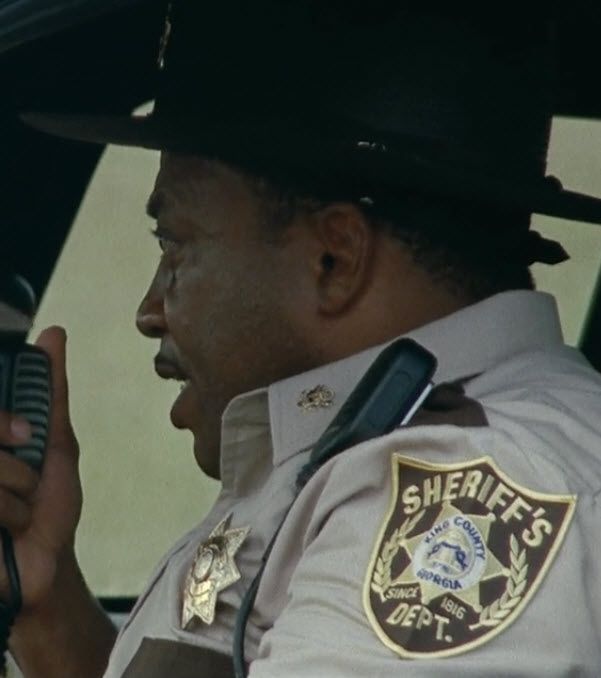
[3] For another contrast, in both the comic and season 2 of the series, Rick's son Carl is accidentally shot. In the comic, when he sees the boy isn't dead, he hurriedly takes command of the situation and deals with it. Through he's exhausted and looks worried to death, he keeps his composure throughout the ordeal and does what he has to do. TV Rick, on the other hand, has another hysterical breakdown, his reason departing him entirely.
[4] This is an example of another problem that will arise repeatedly. The comic's plots are driven by the characters' personalities. When those personalities are fundamentally altered, the plots that flowed from them, in their original form, no longer make any sense. The series radically alters the personalities, then tries to use the plots anyway.
[4a] UPDATE (17 Oct., 2012) - Renumbered. The fact that Rick and Shane work are from Georgia (see note 2a above) makes the timeline problem outlined above even more of a problem, as it means Rick was even closer to Atlanta than he would have been if he'd been in Kentucky--an even shorter drive away.
[4b] UPDATE (22 March, 2012) -- Renumbered. "Deanshore," a reader on the "Walking Dead" board at the Internet Movie Database has pointed out that I'd gotten the comments by this survivor wrong. As I remembered it, he'd said the zombie situation had gotten bad a month earlier and that this was when the utilities had gone out. What he actually said was "[The] gas line's been down for maybe a month." Earlier in the pilot, he'd been describing how the situation had become dangerous as the zombie problem had progressed and I may have juxtaposed those two scenes in my head but I'm really just guessing--I don't really know how I made a hash of it. Chalk it up to the danger inherent in working from memory.
It's a relatively minor point and doesn't really alter the underlying criticism I'd offered--it still extends Rick's time spent comatose to a month and still implies the zombie problem had been going on for a while before even that--but I'm a stickler for getting things right and I definitely didn't here.
[5] Like Biblical apologists who try to "harmonize" the contradictory gospels, fans of the show attempted to construct a timeline at Walking Dead Wiki that would incorporate everything we've been told about the zombie apocalypse. This unintentionally hilarious effort has Rick in a coma in the hospital after it fell, without any supervision, care, food, water, etc., for an incredible 55-60 days.
[6] For me, the loudest illustration of this phenomenon is Jim's end from the first season. In the comic, that's a seriously grisly piece of business and it haunts one's brain well after one has read it. Jim is a character who lost his family to the dead, ends up bitten by a zombie and as he's dying, he has the others abandon him near Atlanta in the "hope" that, when he comes back, he may be able to find his family in town and be together with them again. On tv, they just made it into a generic drama scene we've all seen a million times in a million movies and tv shows. All that business about his finding his family removed, they just leave him under a tree, Jim saying what a nice day it is, the director using a hammer to the face to tell us we're supposed to be sad about it. More generally, the cast and crew of TWD don't, by and large, bother with subtle touches that would suggest the characters live in a frightening environment. No offering up an occasional paranoid glance at an odd sound, no speaking in controlled tones or anything like that. When it comes to shooting the show, we don't even get any menacing angles, unsettling camera movements or sinister lighting. Nothing. For that matter, the cinematography in general is flat, dull and totally uninspired. It shows no ambition at all and no originality--not even so much as an unorthodox camera angle.
[7] Oddly enough, the CDC plotline, which was pretty dumb, was one of the only times the series briefly featured the sense of desperation that hovers over the characters in every issue of the comic when they're out in the open. With the exception of that one story (which mostly just paid it lip-service), the series does very little to convey this.
[8] To, in the words of the announcer at the beginning of DAWN OF THE DEAD, "pitch an audience the 'moral' bullshit it wants to hear."
[9] It's completely ridiculous and both it and its subsequent execution wouldn't be at all out of place in a slapstick comedy but here, they're treated entirely seriously.
[10] The writing of the women on the show this season has drawn charges of misogyny and, in fact, every female character has been presented as a Clueless Male caricature's negative caricature of women. They're selfish, cartoonishly over-emotional, bitchy, stupid, whiny, totally uninteresting and totally unlikeable. They're generally treated like children, then written in such a way that justifies that treatment. One, Andrea, constantly bitches about being denied a gun. She gets a rifle. She draws down on what she takes to be a zombie approaching across a field. Her target is actually Daryl, one of the other survivors. She's facing into the sun at long range and can't even clearly see the target at which she's aiming. Another group of characters are between her and her target and could be hit if she fires blind. All the males tell her not to shoot but, out to prove herself to the boys, she does it anyway and hits Daryl in the head, nearly killing him and confirming, in the most dramatic way possible, the wisdom of the menfolk in having earlier parted her from firearms.
[11] Most of the characters that are original to the show have been very poorly drawn as well. Some were nameless cannon-fodder, destroyed during a zombie attack on the survivors' camp. Others were non-entities: one fellow and his family left the larger group to go their own way, while another, a woman, committed suicide by staying at the CDC as it was about to explode (a profoundly stupid plot element). Merle, the racist redneck of the first two episodes, became very popular. It wasn't that racist rednecks were suddenly in fashion; it was that the most excellent Michael Rooker was playing the part. It's unfortunate that Rooker wasn't given a larger role in TWD--if Rick was written for television the way he is in the comic, Rooker would have been great in the part. After Merle disappeared, there was a great deal of enthusiasm among fans for his return. Season 2 obliged but, being a series that wallows in cliché, only brought him back as an hallucination his brother Daryl has after being injured in a fall. Daryl himself, played by solid Norman Reedus, has become a fan favorite in season 2 but he was a horrible, stock one-note character in the first season, with nowhere to go but up; his standing could have been improved merely by giving Reedus something to do besides being really angry.
[12] An example happened only minutes into season 2, when the characters encounter that traffic snarl. A lot of the cars involved are filled with mummified corpses, which is impossible, because if these were people who had died where they were, they would have come back as zombies and if, for whatever reason, they hadn't reanimated (or if someone had come along and shot them while they were in their cars), they'd have only been there a few weeks, not even remotely enough time to mummify. This was indicative of the lack of care that would follow.
[13] The details of that episode underlined the importance of weaponry. Rick, upon entering the city, was swarmed by thousands of zombies and separated from the bag, then led a group back into the city on an incredibly dangerous mission to retrieve them. In the course of this adventure, he was prepared to launch a firefight to the death--one there's very little chance he or anyone with him would have survived--against what he took to be a gaggle of gangbangers, rather than give up that bag. The "gangsters" were actually defending the patients of that nursing home, which is why Rick shared a little of the hardware. An entire episode, from a season of only six, was devoted to this story.
[14] In the comic, they also held target practice but only after Rick and Glenn raided a gun store, securing a huge supply of ammo. Many in the group had no experience with firearms and teaching them to shoot is a good idea but making them somewhat proficient requires a lot of ammo, which the group in the series does not have. To state the obvious, if you burn through all your ammo, all you have is a bunch of people who now may be able to hit the broad side of a barn--they're not going to get much better than that with such a microscopic supply--but no longer have any ammo with which to do so. That will certainly help when the next zombie herd comes along.
[15] That should still be more than adequate--most of the great zombie features have been made for far less and, in any event, very little of the $2.75 million made it to the screen anyway. In four of the seven episodes, there wasn't, excepting pay for the cast and crew, more than a few thousand dollars actually on the screen, or, more precisely, there wasn't anything on the screen that, under competent management, would have come to more than a few thousand dollars worth. In any event, if you have less money, you write something that doesn't take as much money. The creators of TWD weren't up to that.
Subscribe to:
Posts (Atom)