"For a long time, I've had the idea of putting together a series of posts
on the general degradation of the art of the movie one-sheet. In this
era of Photoshopped 'big faces' posters, even calling this an 'art'
anymore often stretches the meaning of the word to the breaking point."
Me, writing almost exactly a year ago in the first of those intended posts. That first presentation was an exhibition on how corporate Hollywood's devotion to "nothing-succeeds-like-success" led it to seize upon the SCREAM poster artwork and duplicate it into infinity. It's been 18 years since SCREAM. People born back when it debuted are now graduating high school but the movie biz is still using that same damn poster to peddle its wares to the public. It's like some '80s-era joke about Soviet social regimentation, except the joke isn't on the commies this time.
Today's presentation bemoans the sad, declining state of movie-poster-ism from a different angle. These days, new features, even good ones, are routinely saddled with unbearably shitty artwork. Those Photoshopped faceful frescos then follow the flicks to home video, becoming, alas, the featured public face of the film for most who will see it. But what about older movies, the pictures produced from that bygone era when the one-sheet was considered an art and earned respect as such? Those of us with even a touch of grey in our chin-whiskers can legitimately grouse about our living memories of the not-so-long-ago back-in-the-day when a lot of movies, upon their initial releases, sported poster artwork that was outright awesome, things you actually wanted to take home and hang on your wall. Those movies come to home video too, in wave upon wave, but often--far too often--that classic artwork ends up being discarded and replaced by, comparably, substandard rubbish that looks an awful lot like the awful, substandard rubbish that passes for artwork on the newer flicks with bad artwork.
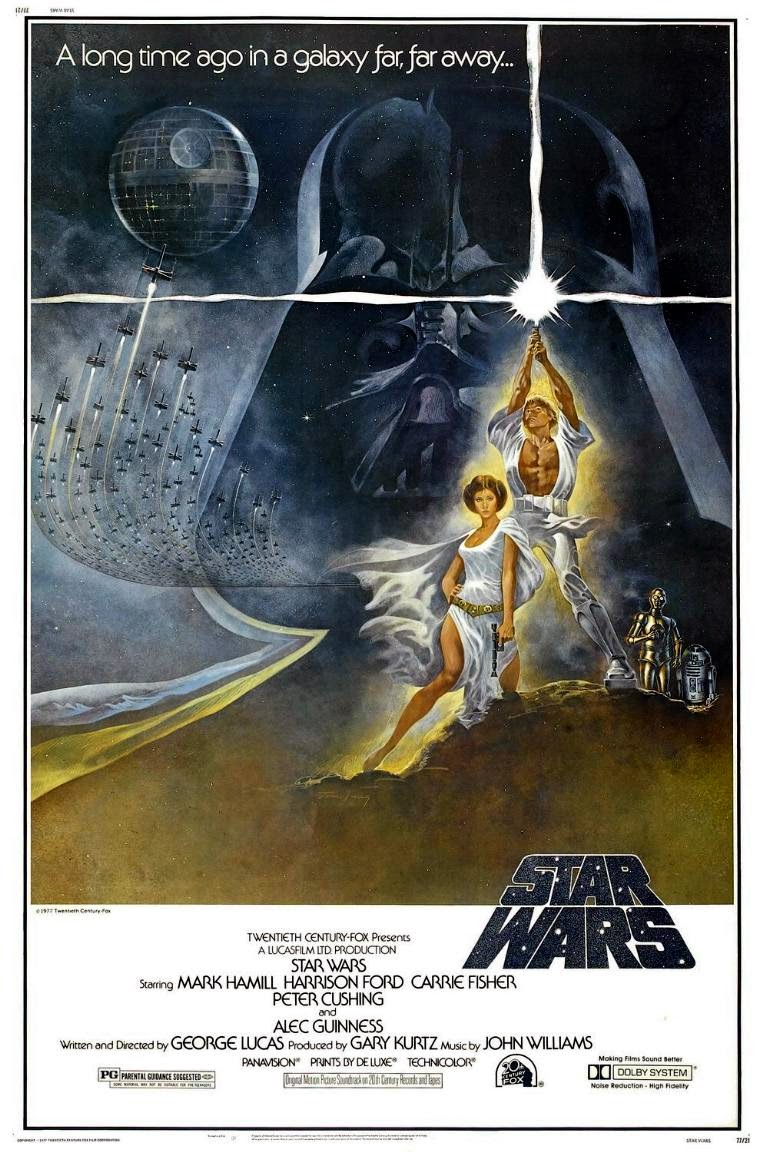
When I was but a lad, I had STAR WARS on my wall:
And not on my wall, but accompanying the film's release...
Can't argue with that, right? Well, it seems you can if you're George Lucas. When STAR WARS came to DVD, it wasn't with these images as covers. Instead, it was...
Feeling the overwhelming sense of being underwhelmed yet? I'm just getting started.
THE DIRTY DOZEN is a kickass picture with a kickass premise and kickass cast, and when, in 1967, it first kicked ass on the big screen, here's how its kicking ass was pimped to potential viewers:
When it made its way to DVD, though, there were definitely no boots to heinie:
In 1975, Roger Corman's shop turned out DEATHRACE 2000, which became their most successful feature up to that time. The poster that helped sell it:
Now take a gander at the cover Buena Vista (Disney) slapped on it when they were distributing it on DVD:
Thankfully, the most excellent Shout! Factory later corrected this, returning to the original artwork for their re-release edition.
Another hit pic of the period featuring fast cars and a race across the country was SMOKEY & THE BANDIT (1977). Its poster:
And look at what ended up on the DVD:
Still another road picture and an action classic, THE ROAD WARRIOR (1981):
And its significantly-less-than-classic home video incarnation:
Still out on the violent, crazy road, Clint Eastwood's 1977 actioneer THE GAUNTLET was blessed with poster artwork by the great Frank Frazetta:
And here's the DVD release:
(Thankfully, the Blu-ray release has apparently restored the original artwork.)
Clint's second Man With No Name flick FOR A FEW DOLLARS MORE (1965) offers another look at this phenomenon. The original poster:
Worth at least a thousand words. And the original DVD release:
A picture worth about 999 words less. MGM was responsible for that particular turd of a cover, and the company is one of the worst in the business for this sort of thing. Here, for example, is the poster for the 1975 James Bond outing THE MAN WITH THE GOLDEN GUN:
And what MGM did:
Still another: 1983's OCTOPUSSY:
And MGM's home video release:
All of the Bonds (and a lot of MGM's back catalog) are treated this way.
John Boorman's excellent EXCALIBUR (1981) had poster artwork worthy of the film:
On DVD, though, this is what was slapped on it:
The 1976 remake of KING KONG:
The promise of "the most... original motion picture event of all time" to advertise a remake is most amusing. Less amusing is what happened to this Kong's artwork on his second DVD release:
Another monster brought to the screen, this time by Wes Craven, was DC Comics' SWAMP THING (1982). Its poster appeared as an ad in DC's entire line of comics on the film's release:
When it came to DVD, though, the cover itself was the monster (and not in any good ways):
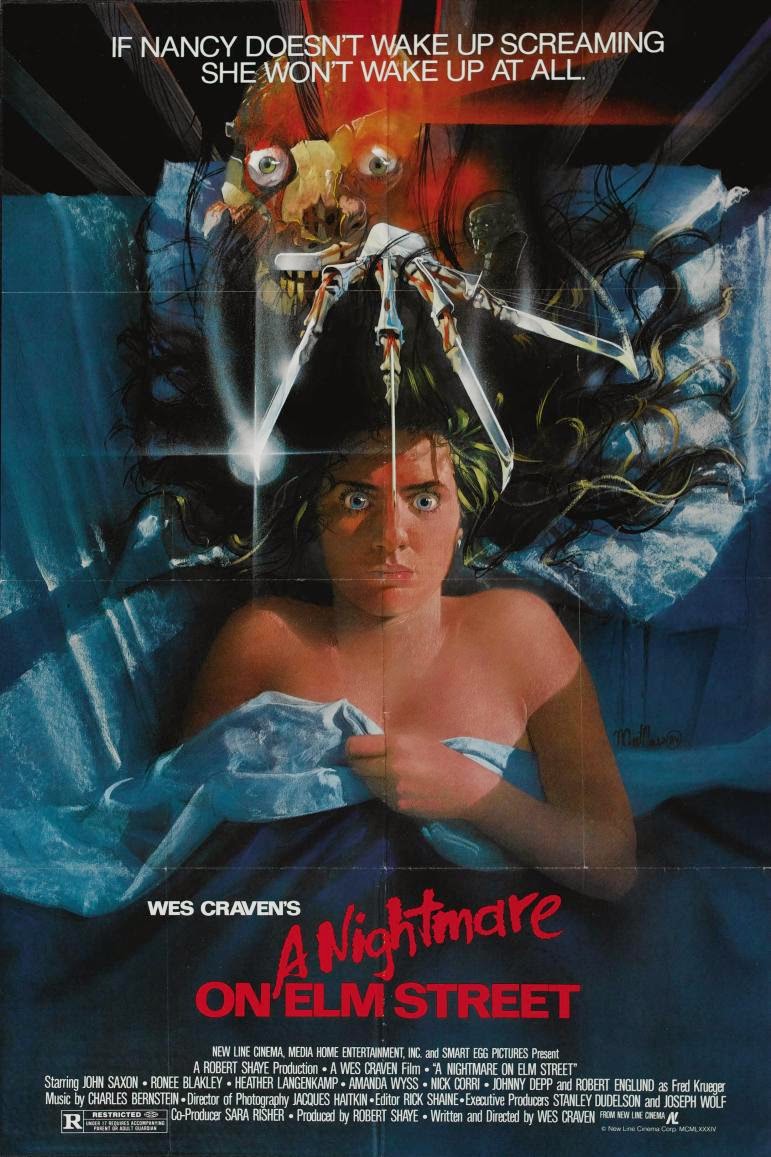
Freddy Krueger became a box-office sensation in the '80s. This is the killer poster that greeted crowds of the curious in 1984:
By the time it hit DVD, though, the artwork had become nightmarish in an entirely different way:
The original nightmare continued with A NIGHTMARE ON ELM STREET 3: DREAM WARRIORS (special thanks to "GaiaClaire" on the IMDb's horror board for noting this one):
...and the artwork nightmare continued with its later DVD release, too:
THE LAST ACTION HERO (1993) was an expensive bomb for Arnold Schwarzenegger, but it's actually a fun and unfairly dismissed movie. Its poster:
On home video, its distributors gave it a cover that treated it about as fairly as its harshest critics had:
Looking over such atrocities (and the others in this vein are absolutely legion), one gets the impression that there are lots of lost bets involved or that perhaps lurking behind such decisions are sinister hidden agendas aimed at sabotaging the pictures. One can conjure up images of resentful men in marketing departments who realize their contemporary work is rubbish and attempt to sabotage the releases of old films in their care so as not to have those films' superior poster artwork on the shelves next to their own deficient efforts. Who knows? The only thing one can say for sure is... well, you don't need me to tell you that.
--j.
Tuesday, April 29, 2014
Wednesday, April 2, 2014
CGI & Its Discontents
I was a huge fan of
RAIDERS OF THE LOST ARK when I was a kid, in a way that only kids can be
huge fans of something. Went to see it, had a poster, the
book-and-tape, the Marvel comic-book adaptation, even dressed up as
Indiana Jones for Halloween one year. Watched the movie until it had
fused with my DNA. I remember well the ugly bitterness and abject
revulsion that greeted my first viewing of INDIANA JONES & THE
TEMPLE OF DOOM as, only a few minutes into the picture, Indy and company
bail out of a plane with only a rubber life-raft. They fall and fall then land
with what should have been a sickening crunch but is, instead, only the
beginning of a wild ride down a mountain, down a river... you get the
idea. You've probably even seen it. People on internet message boards
often speak of "having their childhood raped" as a response to some
particularly bad screen version of something they loved when younger. I
was still a child when I saw TOD but it was my first (and still worst)
encounter with that phenomenon. What I was experiencing in that moment
wasn't just the painful realization that no one behind the franchise
even cared about turning out a quality product (what would later become
known as the "jump-the-shark" moment); it was, more importantly for my purposes here, also an example of
Hollywood learning that, if you throw enough special effects and
rapid-fire action at an audience, the movie can make a bundle without having to be particularly good. TOD was filled with one absurdity after another and raked
in nearly $180 million, becoming the third-biggest moneymaker of its
year.
My article about WORLD WAR Z drew some interesting remarks in my "comments" section from a fellow named John. I'd intended to respond at the time but I've put it off for a while then decided I probably had enough to say to make a new article of it. In that earlier piece, I'd written of the big studio, big money "blockbuster" pictures,
There's a lot of truth in that but I'd add, as caveat, that it wasn't just a matter of force. The filmmakers who worked on the blockbuster pictures when those pictures became so central to Hollywood's cash-flow--JAWS, STAR WARS and beyond--still had at least one foot in the old-school craft of filmmaking and its rules. Not coincidentally, they appeared during a particularly fertile period for American cinema, the "decade under the influence."
If I may be allowed a digression...
In the waning days of the mogul system, Hollywood had faced a crisis. This crisis had many aspects but one of the biggest was aging executives who just didn't understand what people wanted to watch anymore. After the runaway success of EASY RIDER and MIDNIGHT COWBOY, the 1970s saw Hollywood increasingly willing to turn its big moviemaking machine over to the rising young artists of the era, granting them increasingly large budgets with increasingly little oversight. The result was, among other things, the last (to date) great era of Hollywood filmmaking. Arguably its greatest era. One that was ended too soon though. A string of failures was capped, in 1980, by the flop of HEAVEN'S GATE--director Michael Cimino, hot off THE DEER HUNTER, had gone radically overbudget, producing a Western that cost $44 million and grossed only $1.3 million. After this, the show was over. The inmates were put back in charge of the newly-corporatized Hollywood asylum and thus began the reign of the money-men.
But before that fall, there had appeared, right smack-dab in the middle of this impressive era, a monster movie called JAWS. It was given a very wide release, heavily marketed and made a killing--became, in fact, the biggest moneymaker in movie history. Then a sci-fi fantasy called STAR WARS made the scene and blew away JAWS for the record. CLOSE ENCOUNTERS OF THE THIRD KIND turned up the same year--also a big hit. The money-men saw the green, saw the potential and the next few years saw SUPERMAN: THE MOVIE, STAR TREK: THE MOTION PICTURE, ALIEN, RAIDERS OF THE LOST ARK and on and on. The PLANET OF THE APES pictures had, a few years earlier, demonstrated the moneymaking potential of creating franchises and licensing products in other markets and most of the successful pictures in this vein followed their lead--a second killing to be made in sequels and sales of lots of derivative music, action figures, books, games, toys. This was the beginning of what would become the tentpole blockbuster.
These films are generally seen as a countervailing trend to that "decade under the influence" and their success paired with the failure of HEAVEN'S GATE as a factor in killing it off. And that's mostly true. In an era marked by much more intimate, complex, down-to-earth and personal cinema--challenging films that had to carve out an audience to succeed--they're blatant mass-appeal spectacles. Expansive, escapist films, huge releases, huge marketing campaigns, minimal risk and they're the path Hollywood chose. What I've long thought is missed or at least obscured by that analysis is the extent to which these films were, like those others, also a product of that era of Hollywood filmmaking. The creators behind them were as well, steeped in the craft like those doing the edgier stuff. Their work was quite good for what it was--that's why we're still talking about it--and they benefited from the relative freedom of the era--in any other, they wouldn't have been allowed to make the films as they did then. They had both talent and enthusiasm for their projects and, reflecting the period, often put a lot of themselves into the work, even when it was work-for-hire. The new special effects were, in their hands, merely a tool for telling a story, not the story itself. They couldn't rely on those effects to sell their films[1] and doing so wasn't, for the most part, even their aim. They understood that film is, in part, a magic trick, an art of illusion, and their conventional wisdom was that, to sell an audience on something implausible, one must make it and everything that unspools around it seem as plausible as possible.
My youthful experience with TEMPLE OF DOOM was an example of Hollywood unlearning all of this and walking away from it. TOD's director Steven Spielberg had already absorbed some lucrative but, artistically speaking, very pernicious lessons about pop cinema via the runaway success of his E.T.: THE EXTRA TERRESTRIAL two years earlier,[2] and, as he has admitted many times over the years, he didn't even want to make TOD. The film was merely a cynical cash-in on the original and its past-his-prime director's indifference is painfully obvious throughout it. More importantly, it's also a film that proved wrong the conventional wisdom regarding selling the implausible. Most importantly of all, neither the manifest indifference of its creator nor its infinity of inanities prevented it from making a fortune.[3] As, in later years, CGI tech rose to prominence, these lessons would have a major impact on the course of Hollywood filmmaking.
Computer-Generated Imagery grew out of the use of computer graphics in films going all the way back to the late 1960s. From a one-minute sequence in 1982's STAR TREK II: THE WRATH OF KHAN--the "Genesis Effect" remaking a planet--to the awesome light-cycle sequence in that same year's TRON, CGI grew into the alien-directed water-tentacle in James Cameron's THE ABYSS (1989) and to the liquid-metal killing-machine in his TERMINATOR 2 (1991). Eventually, it progressed to the point where George Lucas used it in his very unfortunate STAR WARS: THE PHANTOM MENACE (1999) to generate an entire universe and many of the "characters" in it. It has been an ubiquitous feature of upbudget Hollywood flicks for two decades and a familiar part of films in general.
In the hands of capable and talented filmmakers, CGI technology is a wonderful tool. It can be, among other things, a major time-saver, a safer alternative to dangerous stunts, a cheaper alternative to location shooting and, most of all, it can allow the conjuring forth of images never before displayed on a movie screen. As it has developed over the years, it can put just about anything on a screen.
It can't do everything well, though. In general--and particularly in certain areas--practical effects still have an organic feel that CGI can't touch. A well-executed practical effects can seem quite real and if you're engrossed in a film, you can believe in it and accept its existence within that world. It doesn't draw attention to itself as an effect, and you don't find yourself thinking of it as one. That's very much a magic trick. And when it comes to things like gore effects (an area in which the use of CGI has become quite common), CGI simply can't pull that off. It's always jarring, it always calls immediate attention to itself, it always just looks like animation, no matter how well done,[4] and, as can happen with a badly executed practical effect, it distances the viewer from the movie.[5] While CGI can render inanimate objects that can't be readily distinguished from the real thing, animated CGI characters can be very hit-or-miss; if they more closely resemble something with which we're familiar in the real world, they can seem particularly dodgy. CGI can deliver wonderful stylized fantasy worlds but an abundance of it is often jarring if plopped down in a more familiar world. A world that is a mirror of our own but rendered via CGI can be particularly bad, a soulless cartoon.[6]
These and other limitations are often ignored by filmmakers, particularly in high-profile Hollywood releases.
Over the years, the Hollywood studios came to be quite dependent upon their annual blockbusters to keep their lights on. These films became their "tentpoles." The lessons from films like TOD[7]--that effects-laden, rapid-fire action setpieces can sell even a substandard movie and that mass audiences aren't even remotely as picky about plausibility as everyone had assumed--collided with the CGI revolution in a terrible way. Just as the studios were learning that quality didn't necessarily matter that much and that mere spectacle, backed by largescale marketing, was enough to generate obscene profits, CGI delivered into their hands a technology that enabled them to put on screen just about anything. Spectacle without limits.
The toxicity of this combination made itself felt almost immediately. In 1993, JURASSIC PARK hit the screens. Its incredible, mostly-CGI-rendered dinosaurs were a marvel to behold, but it was painfully apparent from its beginning that no one involved in its production (other than the effects teams) even had any interest in trying to make a quality film. It was strictly a showcase for the dinosaur effects and utterly brainless (and terrible) in every other respect. And it made $900 million on its initial release.
It was the future. The coming years would see a seemingly endless stream of atrocities like BATMAN FOREVER,[8] ARMAGEDDON, INDEPENDENCE DAY, THE MUMMY, TRANSFORMERS, 2012, MAN OF STEEL, X-MEN ORIGINS: WOLVERINE, the STAR WARS prequels, WORLD WAR Z, and on into seeming infinity--films in which the sole draw is a string of effects-laden setpieces of escalating absurdity and that are otherwise as offensively inane as anything ever proffered as allegedly professional motion pictures.[9]
John, my commenter who set me upon this article, identified CGI--or, more particularly, its abuse--as the "biggest factor" in the downfall of the blockbusters. I'm not sure I would entirely agree with that, as there were a lot of other factors involved,[10] but as an entire species of films exist solely to showcase various setpieces enabled solely by CGI tech--films that are otherwise quite dreadful--it has to rank high on the list.
It should also be noted, since I've bashed them to such an extent, that there are still some good upbudget Hollywood movies. Not many but certainly a few. The slew of comic book adaptations of the last 16 years have produced a handful of keepers (along with the expected boatload of stinkers). And within a system as driven by the buck as Hollywood, there are always a few talented filmmakers who have had enough commercial success that they can work on blockbuster-scale pictures and, to some extent, buck the usual trends, getting their way over the pressure to keep things so strictly lowest-common-denominator.[11] Pixar has done some good, big animated movies (I'm particularly fond of THE INCREDIBLES). These are mostly exceptions though. Even among the better ones, we're just not seeing the kind of classics that regularly appeared in this class of films in the past. John writes:
--j
---
[1] In the earliest days of the big-budget effects movies born with STAR WARS, this was especially true, because the effects technology was literally being invented for those movies and, half the time, they didn't even know how well those effects were going to work.
[2] Among other things, he learned that he preferred to construct his films in such a way as to tell those in his audience exactly what they should think about absolutely everything he shows them on the screen rather than allowing them to make up their own minds about it and, most importantly, he learned that peddling schmaltzy, sentimentalist crap in this way can be quite lucrative.
[3] It also served to reinforce Hollywood's already-growing conviction that nothing succeeds like success. A clone culture was a natural consequence of post-DUI corporate Hollywood's extreme aversion to risk. An environment positively awash in sequels, remakes and rehashes had appeared at the very end of the '70s and was well in place by the time of TOD, which was largely a small-scale, badly-executed rehash of the previous film. The clone culture eventually came to dominate Hollywood's output--today, almost anything on which any real money is spent has to be heavily derivative of something that has already succeeded.
[4] The tech may one day enable such things to seem so realistic that viewers can't tell the difference, but we're nowhere near that now, nor have we been at any point in the decades since CGI appeared.
[5] John Boorman makes a related point on the commentary to DELIVERANCE. Boorman came to the subject via Bill McKinney's extraordinary performance as a corpse after Burt Reynolds puts an arrow through him. McKinney apparently spent some time training himself to lie absolutely motionless, holding his breath and with eyes wide open for extended periods, which is how Boorman was able to frame relatively long sequences with McKinney's dead inbred rapist in the shot. Boorman (who, as I recall, was describing a conversation he'd had with someone else) decried the fact that, when people see something extraordinary in movies today, they just assume it was done with a computer. He thinks this takes a lot away from the cinema and he's right.
[6] And soullessness is, in my view, a more general problem with CGI, owing to its inorganic nature.
[7] And I use that as my example solely to follow through on my earlier comments--I don't want to be seen as excessively picking on TOD; it's only one scores of films that reinforced those lessons and not even necessarily an important one of that particular many.
[8] That was another one that left me stunned. I'd been quite fond of Tim Burton's original BATMAN (1989), which is still the best live-action iteration of that character, but I'd missed the 1992 follow-up BATMAN RETURNS. That film, as I later learned, had devolved the franchise into a witless cartoon but when I went into BATMAN FOREVER, I was wholly unaware of this creative collapse, which was, of course, even more severe in FOREVER. Only minutes in, I was flabbergasted and turned it off (I came back to it later and finished it only because I'd paid for it). Warner Brothers spent $100 million on a feature-length version of the old, awful Adam West Batman television series; it made over $336 million. The next sequel, BATMAN & ROBIN, was even worse.
[9] The lack of serious limitations on the capabilities of the technology encourages less grounded filmmakers, chasing spectacle, to use it to inject into their productions an escalating stew of cartoonish idiocies, which kill any human engagement with the film. John, my commenter, used INDIANA JONES & THE KINGDOM OF THE CRYSTAL SKULL as an example of where this can lead and it's a good choice. One of my strongest memories of that movie was Shia LaBeouf doing an embarrassingly bad Tarzan act, swinging on vines through a hail of mimicking monkeys--a cartoon jungle, cartoon monkeys, a brainless, unengaging--even anti-engaging--sequence that actively alienates everyone not predisposed to ooh-and-aah over such asininity. John chose the film's swordfight, carried out through the jungle on the backs of two moving jeeps--abjectly ludicrous cartoons. He could have chosen the cartoon ants, which, at one point, carry off a cartoon of what's supposed to be a full-grown man. And on and on.
[10] Including, for example, the more general--and pathological--aversion to risk by studio suits, the insistence, beyond a certain budget level, on persistently dumbed down movies micromanaged by people with MBAs in place of any knowledge of the art of filmmaking, the clone culture, the shortening attention spans of audiences--something Hollywood has helped drive--and so on. A major factor in recent decades has been the opening of large foreign markets. More sophisticated material rarely travels well; those markets act as a major disincentive to producing it and a major incentive to keeping things as dumb and broad as possible. It's also the case that these populations haven't been as widely exposed to Hollywood's usual pap, which Hollywood reads as yet another opportunity to try to repeat past successes with a new audience.
[11] That's how we got Ang Lee's quite good HULK (which was criminally underappreciated), and two very good X-MEN films out of Bryan Singer. And also how Singer then shot himself in the foot with the unfortunate SUPERMAN RETURNS.
[12] I've lived through that, but I'm not one of them.
[13] The sort of picked-it-up-at-Glidden-on-the-way-over blood effects one often saw in the '60s and '70s are an example of John's rule about film effects aging badly, but something like ALIEN--all practical and looks better than anything made now--proves this is only, at best, a general rule.
My article about WORLD WAR Z drew some interesting remarks in my "comments" section from a fellow named John. I'd intended to respond at the time but I've put it off for a while then decided I probably had enough to say to make a new article of it. In that earlier piece, I'd written of the big studio, big money "blockbuster" pictures,
"I've lived long enough to have seen the birth of the tentpole pictures. The ones that caught fire in my youth and created the trend made their big piles of money because they were actually good, or that's what I'd like to think."John agreed and wrote that "there's been an incredible, tragic fall from grace for the modern blockbuster, and while the reasons for this are multifaceted and well-documented by countless writers, if pressed I would have to say that the biggest factor that ruins the enjoyment for me would be the overabundant CGI." John had been revisiting some of the movies of his youth and was "amazed at how much quotable dialogue and memorable set pieces exist per capita. The inherent constraints of a pre-CGI world forced filmmakers to not only use their spectacle more sparingly (and with more buildup), but to supplement those signature moments with inventive lines and performances."
There's a lot of truth in that but I'd add, as caveat, that it wasn't just a matter of force. The filmmakers who worked on the blockbuster pictures when those pictures became so central to Hollywood's cash-flow--JAWS, STAR WARS and beyond--still had at least one foot in the old-school craft of filmmaking and its rules. Not coincidentally, they appeared during a particularly fertile period for American cinema, the "decade under the influence."
If I may be allowed a digression...
In the waning days of the mogul system, Hollywood had faced a crisis. This crisis had many aspects but one of the biggest was aging executives who just didn't understand what people wanted to watch anymore. After the runaway success of EASY RIDER and MIDNIGHT COWBOY, the 1970s saw Hollywood increasingly willing to turn its big moviemaking machine over to the rising young artists of the era, granting them increasingly large budgets with increasingly little oversight. The result was, among other things, the last (to date) great era of Hollywood filmmaking. Arguably its greatest era. One that was ended too soon though. A string of failures was capped, in 1980, by the flop of HEAVEN'S GATE--director Michael Cimino, hot off THE DEER HUNTER, had gone radically overbudget, producing a Western that cost $44 million and grossed only $1.3 million. After this, the show was over. The inmates were put back in charge of the newly-corporatized Hollywood asylum and thus began the reign of the money-men.
But before that fall, there had appeared, right smack-dab in the middle of this impressive era, a monster movie called JAWS. It was given a very wide release, heavily marketed and made a killing--became, in fact, the biggest moneymaker in movie history. Then a sci-fi fantasy called STAR WARS made the scene and blew away JAWS for the record. CLOSE ENCOUNTERS OF THE THIRD KIND turned up the same year--also a big hit. The money-men saw the green, saw the potential and the next few years saw SUPERMAN: THE MOVIE, STAR TREK: THE MOTION PICTURE, ALIEN, RAIDERS OF THE LOST ARK and on and on. The PLANET OF THE APES pictures had, a few years earlier, demonstrated the moneymaking potential of creating franchises and licensing products in other markets and most of the successful pictures in this vein followed their lead--a second killing to be made in sequels and sales of lots of derivative music, action figures, books, games, toys. This was the beginning of what would become the tentpole blockbuster.
These films are generally seen as a countervailing trend to that "decade under the influence" and their success paired with the failure of HEAVEN'S GATE as a factor in killing it off. And that's mostly true. In an era marked by much more intimate, complex, down-to-earth and personal cinema--challenging films that had to carve out an audience to succeed--they're blatant mass-appeal spectacles. Expansive, escapist films, huge releases, huge marketing campaigns, minimal risk and they're the path Hollywood chose. What I've long thought is missed or at least obscured by that analysis is the extent to which these films were, like those others, also a product of that era of Hollywood filmmaking. The creators behind them were as well, steeped in the craft like those doing the edgier stuff. Their work was quite good for what it was--that's why we're still talking about it--and they benefited from the relative freedom of the era--in any other, they wouldn't have been allowed to make the films as they did then. They had both talent and enthusiasm for their projects and, reflecting the period, often put a lot of themselves into the work, even when it was work-for-hire. The new special effects were, in their hands, merely a tool for telling a story, not the story itself. They couldn't rely on those effects to sell their films[1] and doing so wasn't, for the most part, even their aim. They understood that film is, in part, a magic trick, an art of illusion, and their conventional wisdom was that, to sell an audience on something implausible, one must make it and everything that unspools around it seem as plausible as possible.
My youthful experience with TEMPLE OF DOOM was an example of Hollywood unlearning all of this and walking away from it. TOD's director Steven Spielberg had already absorbed some lucrative but, artistically speaking, very pernicious lessons about pop cinema via the runaway success of his E.T.: THE EXTRA TERRESTRIAL two years earlier,[2] and, as he has admitted many times over the years, he didn't even want to make TOD. The film was merely a cynical cash-in on the original and its past-his-prime director's indifference is painfully obvious throughout it. More importantly, it's also a film that proved wrong the conventional wisdom regarding selling the implausible. Most importantly of all, neither the manifest indifference of its creator nor its infinity of inanities prevented it from making a fortune.[3] As, in later years, CGI tech rose to prominence, these lessons would have a major impact on the course of Hollywood filmmaking.
Computer-Generated Imagery grew out of the use of computer graphics in films going all the way back to the late 1960s. From a one-minute sequence in 1982's STAR TREK II: THE WRATH OF KHAN--the "Genesis Effect" remaking a planet--to the awesome light-cycle sequence in that same year's TRON, CGI grew into the alien-directed water-tentacle in James Cameron's THE ABYSS (1989) and to the liquid-metal killing-machine in his TERMINATOR 2 (1991). Eventually, it progressed to the point where George Lucas used it in his very unfortunate STAR WARS: THE PHANTOM MENACE (1999) to generate an entire universe and many of the "characters" in it. It has been an ubiquitous feature of upbudget Hollywood flicks for two decades and a familiar part of films in general.
In the hands of capable and talented filmmakers, CGI technology is a wonderful tool. It can be, among other things, a major time-saver, a safer alternative to dangerous stunts, a cheaper alternative to location shooting and, most of all, it can allow the conjuring forth of images never before displayed on a movie screen. As it has developed over the years, it can put just about anything on a screen.
It can't do everything well, though. In general--and particularly in certain areas--practical effects still have an organic feel that CGI can't touch. A well-executed practical effects can seem quite real and if you're engrossed in a film, you can believe in it and accept its existence within that world. It doesn't draw attention to itself as an effect, and you don't find yourself thinking of it as one. That's very much a magic trick. And when it comes to things like gore effects (an area in which the use of CGI has become quite common), CGI simply can't pull that off. It's always jarring, it always calls immediate attention to itself, it always just looks like animation, no matter how well done,[4] and, as can happen with a badly executed practical effect, it distances the viewer from the movie.[5] While CGI can render inanimate objects that can't be readily distinguished from the real thing, animated CGI characters can be very hit-or-miss; if they more closely resemble something with which we're familiar in the real world, they can seem particularly dodgy. CGI can deliver wonderful stylized fantasy worlds but an abundance of it is often jarring if plopped down in a more familiar world. A world that is a mirror of our own but rendered via CGI can be particularly bad, a soulless cartoon.[6]
These and other limitations are often ignored by filmmakers, particularly in high-profile Hollywood releases.
Over the years, the Hollywood studios came to be quite dependent upon their annual blockbusters to keep their lights on. These films became their "tentpoles." The lessons from films like TOD[7]--that effects-laden, rapid-fire action setpieces can sell even a substandard movie and that mass audiences aren't even remotely as picky about plausibility as everyone had assumed--collided with the CGI revolution in a terrible way. Just as the studios were learning that quality didn't necessarily matter that much and that mere spectacle, backed by largescale marketing, was enough to generate obscene profits, CGI delivered into their hands a technology that enabled them to put on screen just about anything. Spectacle without limits.
The toxicity of this combination made itself felt almost immediately. In 1993, JURASSIC PARK hit the screens. Its incredible, mostly-CGI-rendered dinosaurs were a marvel to behold, but it was painfully apparent from its beginning that no one involved in its production (other than the effects teams) even had any interest in trying to make a quality film. It was strictly a showcase for the dinosaur effects and utterly brainless (and terrible) in every other respect. And it made $900 million on its initial release.
It was the future. The coming years would see a seemingly endless stream of atrocities like BATMAN FOREVER,[8] ARMAGEDDON, INDEPENDENCE DAY, THE MUMMY, TRANSFORMERS, 2012, MAN OF STEEL, X-MEN ORIGINS: WOLVERINE, the STAR WARS prequels, WORLD WAR Z, and on into seeming infinity--films in which the sole draw is a string of effects-laden setpieces of escalating absurdity and that are otherwise as offensively inane as anything ever proffered as allegedly professional motion pictures.[9]
John, my commenter who set me upon this article, identified CGI--or, more particularly, its abuse--as the "biggest factor" in the downfall of the blockbusters. I'm not sure I would entirely agree with that, as there were a lot of other factors involved,[10] but as an entire species of films exist solely to showcase various setpieces enabled solely by CGI tech--films that are otherwise quite dreadful--it has to rank high on the list.
It should also be noted, since I've bashed them to such an extent, that there are still some good upbudget Hollywood movies. Not many but certainly a few. The slew of comic book adaptations of the last 16 years have produced a handful of keepers (along with the expected boatload of stinkers). And within a system as driven by the buck as Hollywood, there are always a few talented filmmakers who have had enough commercial success that they can work on blockbuster-scale pictures and, to some extent, buck the usual trends, getting their way over the pressure to keep things so strictly lowest-common-denominator.[11] Pixar has done some good, big animated movies (I'm particularly fond of THE INCREDIBLES). These are mostly exceptions though. Even among the better ones, we're just not seeing the kind of classics that regularly appeared in this class of films in the past. John writes:
"It'll be fascinating to see how our current era is viewed 50 or so years from now. Nothing ages faster than special effects, and blockbusters that are built exclusively around green screen indulgence may be nothing more than the synthpop of cinematic history."The last is an appealing metaphor. Where it may fall short is that even sythpop crap can invoke, in some people who lived through the era,[12] some little pang of nostalgia.[13] Can you really imagine anyone ever getting nostalgic over THE DAY AFTER TOMORROW?
--j
---
[1] In the earliest days of the big-budget effects movies born with STAR WARS, this was especially true, because the effects technology was literally being invented for those movies and, half the time, they didn't even know how well those effects were going to work.
[2] Among other things, he learned that he preferred to construct his films in such a way as to tell those in his audience exactly what they should think about absolutely everything he shows them on the screen rather than allowing them to make up their own minds about it and, most importantly, he learned that peddling schmaltzy, sentimentalist crap in this way can be quite lucrative.
[3] It also served to reinforce Hollywood's already-growing conviction that nothing succeeds like success. A clone culture was a natural consequence of post-DUI corporate Hollywood's extreme aversion to risk. An environment positively awash in sequels, remakes and rehashes had appeared at the very end of the '70s and was well in place by the time of TOD, which was largely a small-scale, badly-executed rehash of the previous film. The clone culture eventually came to dominate Hollywood's output--today, almost anything on which any real money is spent has to be heavily derivative of something that has already succeeded.
[4] The tech may one day enable such things to seem so realistic that viewers can't tell the difference, but we're nowhere near that now, nor have we been at any point in the decades since CGI appeared.
[5] John Boorman makes a related point on the commentary to DELIVERANCE. Boorman came to the subject via Bill McKinney's extraordinary performance as a corpse after Burt Reynolds puts an arrow through him. McKinney apparently spent some time training himself to lie absolutely motionless, holding his breath and with eyes wide open for extended periods, which is how Boorman was able to frame relatively long sequences with McKinney's dead inbred rapist in the shot. Boorman (who, as I recall, was describing a conversation he'd had with someone else) decried the fact that, when people see something extraordinary in movies today, they just assume it was done with a computer. He thinks this takes a lot away from the cinema and he's right.
[6] And soullessness is, in my view, a more general problem with CGI, owing to its inorganic nature.
[7] And I use that as my example solely to follow through on my earlier comments--I don't want to be seen as excessively picking on TOD; it's only one scores of films that reinforced those lessons and not even necessarily an important one of that particular many.
[8] That was another one that left me stunned. I'd been quite fond of Tim Burton's original BATMAN (1989), which is still the best live-action iteration of that character, but I'd missed the 1992 follow-up BATMAN RETURNS. That film, as I later learned, had devolved the franchise into a witless cartoon but when I went into BATMAN FOREVER, I was wholly unaware of this creative collapse, which was, of course, even more severe in FOREVER. Only minutes in, I was flabbergasted and turned it off (I came back to it later and finished it only because I'd paid for it). Warner Brothers spent $100 million on a feature-length version of the old, awful Adam West Batman television series; it made over $336 million. The next sequel, BATMAN & ROBIN, was even worse.
[9] The lack of serious limitations on the capabilities of the technology encourages less grounded filmmakers, chasing spectacle, to use it to inject into their productions an escalating stew of cartoonish idiocies, which kill any human engagement with the film. John, my commenter, used INDIANA JONES & THE KINGDOM OF THE CRYSTAL SKULL as an example of where this can lead and it's a good choice. One of my strongest memories of that movie was Shia LaBeouf doing an embarrassingly bad Tarzan act, swinging on vines through a hail of mimicking monkeys--a cartoon jungle, cartoon monkeys, a brainless, unengaging--even anti-engaging--sequence that actively alienates everyone not predisposed to ooh-and-aah over such asininity. John chose the film's swordfight, carried out through the jungle on the backs of two moving jeeps--abjectly ludicrous cartoons. He could have chosen the cartoon ants, which, at one point, carry off a cartoon of what's supposed to be a full-grown man. And on and on.
[10] Including, for example, the more general--and pathological--aversion to risk by studio suits, the insistence, beyond a certain budget level, on persistently dumbed down movies micromanaged by people with MBAs in place of any knowledge of the art of filmmaking, the clone culture, the shortening attention spans of audiences--something Hollywood has helped drive--and so on. A major factor in recent decades has been the opening of large foreign markets. More sophisticated material rarely travels well; those markets act as a major disincentive to producing it and a major incentive to keeping things as dumb and broad as possible. It's also the case that these populations haven't been as widely exposed to Hollywood's usual pap, which Hollywood reads as yet another opportunity to try to repeat past successes with a new audience.
[11] That's how we got Ang Lee's quite good HULK (which was criminally underappreciated), and two very good X-MEN films out of Bryan Singer. And also how Singer then shot himself in the foot with the unfortunate SUPERMAN RETURNS.
[12] I've lived through that, but I'm not one of them.
[13] The sort of picked-it-up-at-Glidden-on-the-way-over blood effects one often saw in the '60s and '70s are an example of John's rule about film effects aging badly, but something like ALIEN--all practical and looks better than anything made now--proves this is only, at best, a general rule.
Sunday, March 30, 2014
A Walking Dead Season Ender
THE WALKING DEAD has a pretty lousy record with season enders. They
do the equivalent of 2 per year, and some of them are among the worst
TWD eps of the entire run. In general, this season was, overall, easily
the best since the first, and tonight's finale, simply titled "A,"
wanted to be very good, but ended up--as so many eps of the season--a
somewhat frustratingly mixed bag.
The central focus of "A" was Rick getting in touch with his inner Ugly. Flashbacks throughout the episode fill us in on the events leading to the birth of Rick 6.0, the pacifist farmer. At the beginning of the season, I interpreted this version of Rick as showrunner Scott Gimple's thumb in the eye of the prior TWD regime's handling of Rick--the writers offered a version of the various weak, stupid Ricks introduced under showrunner Glen Mazzara, had him realize how entirely inappropriate that was given the world in which he lives, and had him elect to put on his guns again. The series almost immediately began thumbing my interpretation in the eye--it wasn't quite done with weak, stupid Rick just yet. Tonight, Rick, his son, and his friends face a horrible fate, and Rick finally gets his mean on, and in a big way. The flashbacks show a different time from which the world has moved on, and the current events suggest it's time for a much harder edge to face that world. So maybe my thoughts weren't entirely wrong. This part of the series is, in any event, moving in the right direction, if it doesn't regress again next fall.
Rick tears open a fellow's throat with his teeth and mercilessly carves up a would-be pedophile rapist who was about to go all DELIVERANCE on Carl's ass. Good stuff. But he then has to indulge in one of the least fortunate habits of TWD's Mazzara era: he sits around and talks about his feelings about what just happened. One of the first rules of screenwriting is "Show, Don't Tell." It's a rule to which TWD's writers rarely seem to have been exposed. In general, nothing of this sort can pass as a matter-of-fact thing. It all has to be analyzed, and, worse, the post-mortem conveyed via painfully bad, anti-naturalistic dialogue. Melodrama, of the kind that gives melodrama its bad name. Daryl has to get in on the action too, making excuses for traveling with the bad men they'd just put down, as if there was anything in that for which to apologize--he does this so Rick can tell him he'd done nothing wrong. A very sweet, entirely pointless, and actively pernicious waste of several minutes of screentime.
Rick and co. make it to the Shangri-La the characters have been pursuing, the terminus of the railroad line where, they've been assured by the signs posted along the way, they'll find sanctuary. It turns out not to be the friendly place for which they'd hoped, and that's the point on which "A" hits its "z." To be continued.[1]
Overall, this season saw a major turnaround of a series that had been creatively dead for two years. We've gotten some of the best episodes of TWD ever produced--a slew of them--but no matter how much TWD has improved, it can't seem to shake the poisonous influence and crushing baggage of those bad ol' days, and I'm still left to look at the season as a whole as a disappointment. There's absolutely no reason why TWD can't be one of the best shows on television. It's had that potential from the day it launched--the comics make that crystal clear. No matter how good it's gotten, it continues to fail to live up to that potential, and even its best episodes are plagued by problematic elements.
The early portion of the season offered a great set-up. Someone was feeding the dead at night, resulting in great swarms of them besieging the prison; a mysterious and deadly disease broke out within its walls; an unknown murderer began killing the living. The horror elements of TWD, so neglected under the previous regime, were brought to the fore by these overlapping events; the prison that had become a sanctuary and place of freedom became a prison again, confining the characters in a claustrophobic space beset with constant dangers, both seen and unseen. It's impossible not to feel disappointment at the writers' failure to capitalize on this atmosphere after weaving it, and that disappointment becomes rather profound in light of the subject they pursued instead--a string of episodes devoted to bringing back GINO, one of the worst pieces of baggage from the previous regime, leading up to a fairly dismal rehash of the season 3 finale. By an intelligent extrapolation, by the writers, of her experiences, Carol was made the most interesting character then made to go way out-of-character in order to commit a pair of senseless murders to serve the season's big Theme. She was then written out of the show for most of the rest of the season. That big, pretentious Theme loomed large over most of the season, but, by the end, the writers had mostly abandoned it, which is another mark in their favor. The second half of the season saw the characters, in the aftermath of the prison's collapse, broken into smaller groups and wandering around having individual adventures, many of which were quite good but all of which are carried out in the shadow of the utterly ridiculous lack of interest they show in finding one another. Solely because the writers want them to meet up at the railroad terminus, they all happen across the signs promising sanctuary, and all decide to pursue that option. Idiot Plot Syndrome was a perpetual problem with TWD in the two prior season; it remained a recurring feature of this one.[2]
TWD improved remarkably this season, but for TWD, there's a galaxy of space between "improving remarkably" and Great. I'd like to see it move--and move a hell of a lot faster--toward the latter.
--j.
---
[1] Kudos to the writers for a season ender in which none of the regulars die. That may seem odd praise--a series like TWD should kill off regulars from time to time--but Mazzara used character deaths as cheap stunts. For shock value.
[2] Filler remained a problem this season as well. Last week's ep, "Us," was mostly an uninteresting filler episode--two different problems but certainly related. Excess filler is a problem the Gimple Gang seemed to recognize, and there was nowhere near as much of it this season as under Mazzara (where a single episode of plot would be stretched to fill six and seven eps), but it's still something that could use some attention. In a well-executed TWD, the writers would be straining every week to get in everything, not struggling to fill out the hour.
UPDATE (3 April, 2014) - Regular reader "Max Headroom," in the comments section, notes that the flashbacks in the season finale were probably full of continuity errors. I noticed problems with it, too, and, given my work on the show's timeline, it was probably something I should have covered.
The flashbacks do have continuity errors, but Gimple also seemed to be trying to work in a correction to one of the infinity of continuity problems that came as a consequence of Mazzara's non-existent timeline (and ended up making some more problems). Season 3 took place over a period of about 3 weeks story-time, which, going by the timeline from the end of season 2 (which ignored everything leading up to it), would have meant it concluded some time in July. Except it was already getting cold again by the end of S3; visible breath, everyone wearing jackets, and the leaves had turned and were falling. Sunday's flashback retcons that. In it, Hershel says they've been at the prison for two months now, and it was time to start planting. That would put the flashbacks at about five weeks after the conclusion of S3, deep into the fall by Mazzara's "timeline," but still in the summer if one goes by how much time had actually passed.
And in those flashbacks, Rick already seems to be pretty much recovered from his time as Crazy Rick. He's even making regular supply runs and seems to be rather pleased with things. Other than, of course, Carl's growing coldness. This is a complete contradiction to the opening of S4, which gave the impression of Rick having become Farmer Rick the Pacifist as a means of recovering from his Crazy Rick period. Everything was written around that, and he still seemed pretty messed up. He had, in a rather shockingly overbearing way, forcibly infantilized his son--recall Carl's near-terrified, apologetic reaction after having to confess he's used a gun at one point. And, of course, Farmer Rick the Pacifist is still showing signs of Crazy Rick--he's the guy who acts as if he's almost afraid to wear his gun, and who doesn't put it on, even when he goes outside. He continued to seem pretty messed up throughout much of the just-concluded season (recall his absolutely pathetic behavior when GINO came calling). The flashbacks make it appear Farmer Rick the Pacifist was an intentional choice made by him after he was already back to being himself rather than a recovery period taken as a necessity to try to pull himself together. The latter is how it was depicted and even described at the opening of the season.
Thursday, March 20, 2014
WORLD WAR Z (2013)
I'm told (by people who would know) that Max Brooks' "World War Z" is an exceptionally good book. Modeled on Studs Terkel's "The Good War," an epic, globe-spanning "oral history" of an apocalyptic uprising of Romeroesque flesh-eating zombies Definitely my cup 'o tea and one I'll likely imbibe in the near future.
I have, unfortunately, already seen how Hollywood treated the tale. Conceptually, the film's creators immediately disposed of the successful book, putting it through the usual creative gang-rape--I'm told the biggest similarity between it and the eventual film is its title--and rendering the film adaptation as a typical Hollywood tentppole, a huger-than-huge action extravaganza with a Big Name Star in front of it (Brad Pitt), shot on a budget that more closely resembles the gross domestic product of a small nation. As with anything on which an American studio spends that kind of money, it's made by a committee,[1] filled with computer-generated effects spectacles to ooh and aah the bumpkins, plotted, shot and edited in Attention-Span-Optional mode, watered down to a PG-13 rating so as not to keep the kiddies away and dumbed down to serve the needs of the dumbest son of a bitch who may wander into a theater to watch it.
I've lived long enough to have seen the birth of the tentpole pictures. The ones that caught fire in my youth and created the trend made their big piles of money because they were actually good, or that's what I'd like to think. Am I wrong in that? The pictures were good and all these years later they hold up but was this really a relevant factor in their success in those days? Were people really just paying for empty spectacle all along? To see the sorry state of this kind of movie now and contemplate the paradoxically obscene piles of money the pictures make anyway... it makes my head hurt. With few exceptions, I don't watch these kinds of movies anymore.
I do watch zombie movies from time to time though, and this was the most expensive film ever made in that particular subgenre. Not that its creators wanted you to know it was of that particular subgenre. I saw WWZ because my uncle inexplicably bought it and something I noticed in looking over his copy is that nowhere on the packaging does it mention it has anything to do with zombies or that it's even a horror picture.[2] The full description on the back reads:
"'The suspense in killer!' raves Peter Travers of Rolling Stone in this fast-paced, pulse-pounding action epic. Former United Nations investigator Gerry Lane (Brad Pitt) is in a race against time to save both his family and the world from a pandemic that is toppling governments and threatening to destroy humanity itself. David Denby of The New York Times calls World War Z 'the most gratifying action spectacle in years!'"
I was surprised to read there that Peter Travers was in the movie--the revelation does make you wonder why a studio that spends $190 million on a movie can't pay someone a few bucks to write competent ad-copy for them. That aside, the DVD cover reflects the description--it's just Brad Pitt with a gun, looking like he's dressed for action while helicopter gunships fly by in the background. The studio suits apparently decided to conceal WWZ's zombie-ness in order to up its "mainstream" appeal. Because, y'know, zombies aren't "mainstream." That's why no one paid to see the DAWN OF THE DEAD remake or ZOMBIELAND or the infinite RESIDENT EVIL films, no one watches THE WALKING DEAD, no one read Brooks' "World War Z" and no studio spent $190 million to turn the latter into a movie. Twice.
Though only one film was released, WWZ was, in effect, filmed twice. It wasn't just made; it was remade. Officially, there was only a round of "reshoots" to fix the ending. In reality, the suits saw the finished film, realized it was a disaster and, in effect, ordered it remade. The "reshoots" had a seven-week shooting schedule and reportedly cost something between $20 million and $65 million. That's a remake. Looking over the version that was released--an utterly moronic piece of shit that wasn't worth the guitar picks that were precluded birth in order to make it--one shudders at the thought of how bad the original cut must have been. Only the eventual theatrical release made its way to video.
WWZ chucked the shuffling ghouls of Brooks' book and instead followed and expanded upon one of the least fortunate trends in contemporary zombie pictures; its dead are hyperactive, rocket-fast sprinters. Rather than being a disadvantage, death supercharges them and WWZ ups the ante by making them more like ants; they're dead and supposed to be dumb but they seem to have a hive mind that lets them work together toward a common goal and they run all over one another like ants from a hill in ways that are physically impossible for humans and look even more comically absurd on film than they would sound if I described them. There's no humanity in them. They aren't particularly ghoulish in appearance either. They don't eat people like Brooks' zombies because that kind of carnage would kick the whole affair above the contractually-obligated PG-13 rating. Instead, they just bite folks. Bite them in order to spread the disease. Central to the film's plot--WWZ tries to make a big mystery of it--is the fact that the zombies ignore people with terminal illnesses. They only bite healthy people because that's what the disease infecting them wants. But the disease kills its victims in, quite literally, 10 seconds. They count it out on screen.
If that makes any sense to you, you're probably of WORLD WAR Z's target audience. And shame on you.
--j.
---
[1] Depressingly, the director of record for WWZ is Marc Forster, who, at one point in life, made flicks like EVERYTHING PUT TOGETHER (2000) and the incredible MONSTER'S BALL. Marc, you break my heart.
[2] Filmmakers who make horror pictures then explain they aren't really horror pictures have, of course, been a running joke in horror fandom for literally decades.
UPDATE (22 March, 2014) - As I posted this in some venues around the internet, one of the responses that came to me more than once was that I didn't outline a lot of the particular idiocies of the film itself. It's true one could write a long article indeed cataloging WWZ's many idiocies. Throughout the film, for example, our hero travels around the world and the situation with the zombies goes to shit as soon as he comes on the scene. The zombies had to wait for the star of the movie to arrive, you see. That's the kind of "plotting" at work in WWZ. As someone on one of the IMDb message boards observed, if Pitt's character had just stayed away, all that mayhem could have been avoided. Another example of idiocy is when Pitt's character is trying to be stealthy and sneak past a gaggle of zombies and he leaves the ringer on his sat-phone turned on. And--wouldn't you know it?--his awful wife chooses that very moment to call. The ringing alerts the creatures and Pitt's team is wiped out. And so on. In WWZ, these inanities are ubiquitous. They're also ubiquitous in nearly every big Hollywood "tentpole" film and my article was really a lament over how bad that kind of film had gotten and over the process that gives birth to such rubbish. I understand why readers of an article of that nature might be skeptical of building on that kind of premise without quantifying it with specifics. That's why I just decided, at nearly 4 in the morning, to tack on this little update.
Monday, March 17, 2014
In The Grove Grows THE WALKING DEAD
Tonight, I started to simply make this a two-word review: very good.
By WALKING DEAD standards, "The Grove" was outright excellent. I'm a bit
hesitant to use words like that when it comes to TWD, though--for too
long, it has set the bar far too low. Not the case this evening.
The one criticism I'd offer is to note the specter that continues to haunt TWD, the one that has haunted it since the middle of the season: the characters aren't looking for one another. After the midseason break, Michonne found Rick and Carl. Since then, only Glenn and Maggie have actively searched for one another, and even then, it was only temporarily. This week, Tyreese continues to fail to show any interest at all in finding his sister. When he, Carol, and the children find an isolated farmhouse, he even decides he wants to settle down there. They have the infant Judith in tow; no one is concerned with trying to get her back to her own family.
That aside--and logically, that continues to loom large--showrunner Scott Gimple's reformed TWD continues to impress. The Gimple Gang has added all manner of depth, darkness and even--dare I say it?--maturity to the proceedings. I hope to see this continue.
--j.
Monday, March 10, 2014
WALKING DEAD Alone, But Still Smilin'
This week was a bit of a middling ep of THE WALKING DEAD. "Alone" is a
big step down from last week and had several problems but still enough
noteworthy moments to keep them from entirely overwhelming the
proceedings.
The ep threw me a curveball with its opening, a series of events I read as a great little joke aimed at Mazzara-era TWD. The cold opening is excellent, a music-video flashback showing how Bob, his previous companions having been wiped out in some conflagration, wandered aimlessly through a world gone dead before being found by the prison group. It's a terrific, bleak little minimalist essay on a fellow who has been through hell and seems to have lost everything, including any understanding of why he's bothering to continue walking around breathing. Bob has, to date, been a bit of a background character, and whenever such a character was given a prominent spotlight on Mazzara-era TWD it meant he'd be toast before the ep ended. After this flashback, focus shifts back to the present, and Bob, Maggie, and Sasha are huddled in a bank of fog fighting off zombies as they appear. It's a pretty good sequence. For a moment, it seems as if our heroes will be overwhelmed, and almost immediately Bob is bitten, which, of course, is certain death. When the fighting is over and he inspects himself, though, it turns out the zombie got only a mouthful of the bandage covering a gunshot wound he received at the prison. Bob makes it through this evening's episode, smiling most of the way. And yes, that was worth the laugh I offered it.
I was pleased to see that, after being given a bit of a spotlight in the last ep, Beth didn't die this week. Score another for the Gimple gang. She even had a few more good moments with Daryl, with whom she's growing closer.[1] There was a great horror-movie sequence wherein an unseen assailant apparently brings a gaggle of zombies to the door of the funeral home where the two are staying. With the creatures virtually piling over one another to get at him, Daryl leads them to the basement and has to fight them off with only a pair of embalming tables separating him from the horde. He manages to escape, but someone--probably whoever brought the dead there--has kidnapped Beth and driven away. Beth may not make it yet!
As all of this indicates, this was yet another episode featuring various groups of characters wandering the countryside in the wake of the fall of the prison, the fifth such ep so far. It featured an unnecessary amount of filler. Nowhere near as bad as usual, but the pace could have used some real tightening, particularly in the sequences featuring Bob, Maggie, and Sasha, which have been overly repetitive (and not only in this ep).
While the wanderings of the characters give viewers a look at more of the world in which the series is set--something TWD has needed for a long time--it's also the case that the longer they wander, the more rankling is the Idiot Plot issue. On Mazzara's TWD, every bit of plot progression was made entirely dependent upon every character being a complete idiot at all times, and this is yet another example of it. "Too Far Gone" established that the prison group did, in fact, have a rendezvous point in case anything went wrong--it's impossible to imagine people in that situation wouldn't. But there's been no mention of it since. Tonight, Maggie and co. were looking for Glenn, not by trekking to any planned rendezvous but by making ever-widening circles away from the prison. Worse, the last several eps have set most of the major characters to following a series of signs along the railroad promising safe haven at the end of the line. They're doing this instead of looking for one another. Tyreese, who is with Carol and the children, is following the tracks instead of looking for his sister. Sasha, traveling with Maggie and Bob, hasn't done anything to try to find her brother,[2] and has wagged in disapproval of Maggie's efforts to find Glenn. While Maggie has searched for Glenn, she's shown no interest at all in finding her own sister, and, tonight, gave up the search for Glenn too, choosing to follow the tracks and mark the signs with messages to him. Beth hasn't looked for her sister. Daryl, who is with her and for whom the group was the closest thing he'd ever had to a real family, hasn't looked for anyone either--he just assumes they're dead. He and Michonne would be the most capable in tracking down the others; she, with Rick and Carl, is, instead, just following the railroad. The characters walking the tracks instead of looking for one another have expressed the belief that they'll probably find any of the others who are still alive at the promised sanctuary, a completely ridiculous assumption with no in-story rationale that has been inserted solely because the writers want the characters to follow that railroad to whatever awaits them at the end.
The other weakness in "Alone" is the silly melodrama that accompanied the Bob/Sasha/Maggie plot. Sasha, for no real reason than to provide a plot, suddenly wants to stop and find a new place to live rather than following the tracks to their terminus. Maggie, hearing Sasha's plans, abandons her companions in the night, intent on following the railroad herself, a completely ridiculous and unnecessarily dangerous decision--traveling together is obviously safer, and if the other two want to stop somewhere, Maggie could continue from there alone if she liked. But the Theme of the evening, reflected in the ep's title, is that Maggie just can't do it alone, so she leaves only to be reunited with Sasha later, to whom she offers up some of TWD's trademark cliché-ridden anti-naturalistic speechifying about how she just can't do this on her own. The trio are reunited. Everyone smiles. Isn't that sweet?
So tonight is, like so many eps this season, somewhat a mixed bag. Not a bad show by TWD's ridiculously low standards, and with some worthy moments, but still indicative of a series mired in some unfortunate habits and still falling well short of its potential.
--j.
---
[1] They find an embalming room where zombies who have died have been stretched out and professionally prepared for burial, a sign that someone, whoever managed the funeral home, still thought they were worthy of that respect. It's a small touch, but of the kind TWD needs, and I liked it. The moments spent with Beth and Daryl have taken on a vague atmosphere of wandering souls trying to find, in a world of horrors, some semblance of a good life, one worth the living. I like this very much.
[2] Tonight, the writers inserted a hint of an explanation, that Sasha is afraid to know if Tyreese is alive or dead--the sort of "explanation" that only flies on bad soap melodramas.
Saturday, March 8, 2014
From the Past, the Future
"To me, the great hope is that, now, these little 8mm. video recorders and stuff are coming out, some, just, people who normally wouldn't make movies are going to be making them. Suddenly, one day, some little fat girl in Ohio is gonna' be the new Mozart, y'know, and make a beautiful film with her little father's camera-corder, and for once the so-called 'professionalism' about movies will be destroyed forever, y'know, and it will really become an artform. That's my opinion."
--Francis Ford Coppola, from the documentary "Hearts of Darkness," 1991
Q - What changes do you foresee in the moviemaking of the future?
A - It will be so changed you can't imagine how different it will be. The satellite communications, where the whole world can watch something at the same time--this is just the little baby of what there will be. There will be audiences linked together in space, other planets... And movies will be available to each person's exact emotions and needs, whatever he wants available at that moment, instantly created--stories, biographies, pornography. There will be five hundred billion movies available. It will be just great for movie-makers!
--Sam Fuller, interviewed by Lee Server in "Film is a Battleground," 1994
Subscribe to:
Posts (Atom)